Sunshine Coast Birds

Birding and other wildlife experiences from the Sunshine Coast and elsewhere in Australia - and from overseas - with scribblings about travel, environmental issues, kayaking, hiking and camping.

Friday, 21 December 2012

Christmas Twitching on the Sunshine Coast


Among the birds seen on a good day out and about on the Sunshine Coast yesterday were Pale-vented Bush-hen, Superb Fruit-Dove, White-eared Monarch, Glossy Ibis and Cotton Pygmy-Goose. South African birder Phil Penlington and I kicked off just after dawn with a visit to Little Yabba Creek (above), searching around Charlie Moreland camping ground, then doing a couple of rounds of the Fig Tree walk.

Paradise Riflebird
Nice birds included a pair of Barred Cuckoo-shrikes, White-eared Monarch at two sites, a female Paradise Riflebird, Pale-yellow Robin, Russet-tailed Thrush, Logrunner, and Dusky Honeyeater, while Noisy Pitta was seen several times.

Pale-vented Bush-hen

We moved on to a site near Kenilworth where I've had Pale-vented Bush-hen and Lewin's Rail in the past. A pair of bush-hens kept under cover but eventually yielded reasonable views. An area of scrub near Imbil had some fresh Black-breasted Buttonquail platelets but no birds were seen during our short visit. We visited Lake Macdonald, seeing 4 Glossy Ibis (a scarce visitor to the Sunshine Coast), 5 Latham's Snipe, several Red-kneed Dotterels and 8 Wandering Whistling-Ducks. On a farm dam near Eumundi, we had a single Cotton Pygmy-Goose.


Wappa and Poona dams had quite a few Great Crested Grebes. We ended the day in lowland rainforest at Cooloolabin, where several Rose-crowned Fruit-Doves were seen (they had been calling commonly all day) along with a single Superb Fruit-Dove. A Pacific Baza also showed nicely here, as well as a few more Dusky Honeyeaters and a Crested Shrike-Tit.


Our last camp-out for the year earlier this month was at Boreen Point, Lake Cootharaba, a lovely setting although the birds were a bit thin on the ground.

Shining Flycatcher

I kayaked around the lake's southern shore but saw little. However, I had a nice pair of Shining Flycatchers on a separate kayaking excursion from Lake Cooroibah to the Noosa North Shore ferry crossing.

Varied Sittella


Varied Sittella

In wallum regrowth at nearby Elanda Point, a short drive from Boreen Point, a highly co-operative group of Varied Sittellas was entertaining.


There were some interesting historical sites in the Elanda Point area. This chimney is all that remains of a dairy farm built in the 1860s. (To put things in perspective, that's a decade before General Custer met his match at the Battle of the Little Big Horn!)


 This is an extract from The Gympie Times, relating in rather graphic detail (by current standards) the outcome of a boiler accident in 1873 (three years before Custer's Last Stand) at the Elanda Point timber mill.


Monday, 17 December 2012

Superb Fruit-Dove in Sunshine Coast Hinterland

Superb Fruit-Dove

Superb Fruit-Dove is a scarce summer visitor to south-east Queensland so it was a surprise to see and hear a total of three birds this morning and yesterday afternoon near Cooloolabin in the Sunshine Coast hinterland.


Superb Fruit-Dove

These birds can be very difficult to see and even more difficult to photograph, so it was with some effort that I finally had this one more or less co-operating.

Superb Fruit-Dove

The fruit-doves were located separately but within a few hundred metres of each other in lowland rainforest between Yandina and Cooloolabin; two were seen and a third was heard. The forest is privately owned but anyone interested could look in the vicinity of Shrapnel Road.

Rose-crowned Fruit-Dove

Plenty of Rose-crowned Fruit-Doves were also about, including this one, along with good numbers of Wompoo Fruit-Doves.

White-eared Monarch

This White-eared Monarch put in an appearance.

Red-necked Wallaby

As did this Red-necked Wallaby.

Forest Kingfisher

A Forest Kingfisher showed nicely at Lake Cooloolabin.


Later I drove up the Mapleton Forest Drive through the newly declared Mapleton National Park. A pair of Southern Boobooks and a Greater Glider showed nicely if distantly at dusk.


Meanwhile at home at Ninderry, this Boebuck (Short-eared Brushtail) has taken up residence in a nesting box used previously by one of its kind. Boebucks occurs in the garden alongside Common Brushtails.


Saturday, 15 December 2012

Wetlands Destruction Press Coverege


Some further publicity on the push to save what's left of Sunshine Coast wetlands:


Sunshine Coast Daily

Couple in sanctuary call


Lisa Warren, pictured with her daughter Emily, is hoping council will buy part of her property as a nature reserve.
Lisa Warren, pictured with her daughter Emily, is hoping council will buy part of her property as a nature reserve.Darryn Smith
A SUNSHINE Coast conservationist has called on the council to help save one of the last remaining parcels of wetlands along the Maroochy River.
Avid bird watcher and wild
life habitat crusader Greg Roberts says the 12ha site is home to several rare and threatened species of birds but council last year decided against the purchase which would protect it from development.
Council officers who reviewed the property said it was not suitable because the former sugar cane farmland was "not natural" and had been "human-modified".
Landowners Lisa and Geoff Warren want to separate the 4ha of riverfront land with their home on it from the other side of River Rd.
Mrs Warren said that once they had discovered the presence of rare and threatened bird species on the wetlands, they had offered the council the chance in November last year to buy it for conservation purposes.
"We would love to preserve it," she said.
"There has been a little bit of development around us and all these really rare birds lost everything.
"We hope the council or somebody will come out that can save it as a wildlife sanctuary so everybody can enjoy it."
On his many bird-watching visits to the site, Mr Roberts has recorded the presence of scarce or elusive birds such as the eastern grass owl, lewin's rail, spotless crake, brolga, king quail and red-backed buttonquail.
Mr Roberts has launched a campaign on his website and Facebook page urging people to contact the council to encourage them to secure the rare parcel of land.
"The council's previous decision was well-meaning, but it's unfortunate as these former farmlands provide excellent habitat for a range of species which have been largely eliminated from the region by the destruction of wallum heath and wetlands for residential development," he said.
"They need to look beyond their definition of what is worthy of conservation.
"That they are not natural should be no barrier.''


Here is earlier media coverege following publication of this previously published post.


Friday, 7 December 2012

Little Grassbird, Red-kneed Dotterel in large numbers on Sunshine Coast

Little Grassbird

Impressive numbers of Little Grassbird and Red-kneed Dotterel were recorded during a kayaking survey around the southern shore of Ewen Maddock Dam on the Sunshine Coast yesterday.

Little Grassbird

Little Grassbird is regarded as a scarce inhabitat of freshwater swamp reed-beds in south-east Queensland. I've found them regularly at Ewen Maddock Dam in the past, at all times of the year, but was surprised to see or hear no fewer than 30 birds during the kayaking survey.

Little Grassbird

Little Grassbird is also notoriously difficult to photograph, so it was nice to get the odd opportunity as birds uncharacteristically perched in the open a little in the early morning.

Red-kneed Dotterel

Red-kneed Dotterel is a rare visitor to the Sunshine Coast and several birds have been around the dam in recent weeks. At least 80 birds were counted around the southern shore yesterday, an unusually large number for this inland species in south-east Queensland.

Red-kneed Dotterel

White-necked Heron

White-necked Heron is another species that is normally rare on the Sunshine Coast but four were seen at Ewen Maddock yesterday. Another primarily inland species, these birds are presumably dispersing following good breeding seasons in the inland over the past couple of years. There was no sign yesterday of another inland species, Black-tailed Native-hen, which I found here two weeks ago.

Some of the regulars:

White-faced Heron


Australasian Grebe


Wednesday, 5 December 2012

Wetlands Destruction on the Sunshine Coast


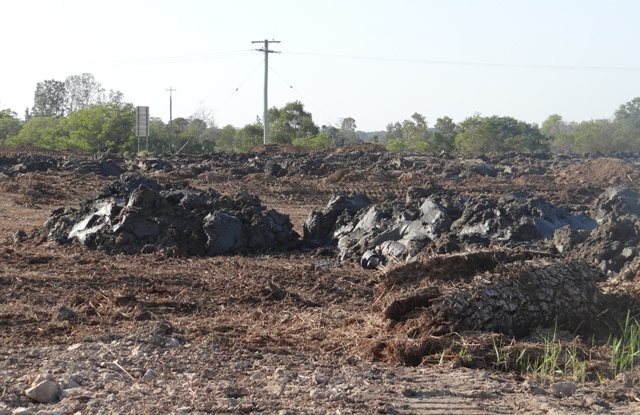
Current and planned developments threaten what little remains of freshwater wetlands on the Sunshine Coast. The images here were taken yesterday at the end of River Road, Maroochy River. The land being bulldozed above was until this week an excellent area of grassland and swamp. I have had a breeding population of at least two pairs of Lewin's Rail for the past couple of years at this spot. This is the only place on the Sunshine Coast where I had recorded Red-backed Buttonquail, and King Quail, another scarce species, were regular here.


Across the road, as part of the same development on the same land title, another area of grassland and swamp has been destroyed. A pair of Eastern Grass Owl had been resident at the site in the image above.
The land was sold recently to someone who wanted to "build a shed on it", said Nambour real estate agent Gary Blake. The new owner had "cleaned up the place, it was a real mess", he added. It's interesting how varied the perception of what constitutes a mess can be.

Lewin's Rail

Lewin's Rail is listed as Near Threatened under Queensland's Nature Conservation Act. Permission for development that could have detrimental consequences for the species is supposed to be obtained by the state Department of Environment and Heritage Protection.  No such approvals were given for the development in the images above.


This land is a former sugar cane farm so the swamps and grassland are not natural. However, given the almost total destruction of natural wetlands on the Sunshine Coast, they provide crucial habitat for many waterbirds and other birds and mammals. Government authorities should consider buying some of the properties and managing them as wetland habitat; the image above shows what this habitat looks like.

Eastern Grass Owl - Pic by Jim Sneddon
The flats around both sides of the Maroochy River constitute one of the best sites in Queensland for the rare Eastern Grass Owl. Other raptors frequenting them include good numbers of Spotted Harrier and Grey Goshawk, both regarded as uncommon.  

Spotless Crake


Good numbers of Spotless Crake and Buff-banded Rail are among the waterbirds that live in the grasslands and swamps. Other birds here include Brolga, Bush Stone-Curlew, Tawny Grassbird and Brown Quail.


Sunday, 2 December 2012

Sunshine Coast Pelagic Trip December 2012

Sooty Tern

Sooty Tern, Tahiti Petrel, large numbers of Short-tailed Shearwaters and a pod of Pantropical Spotted Dolphins were the highlights of the December 1 pelagic trip off the Sunshine Coast.
As we set off from Mooloolaba Harbour at 6.30am in our catamaran, Cat-A-Pult, the slightest swell and gentle north-easterly sea breeze of five knots did not bode well for the hoped for rarities. We reached the shelf within two hours and began leaving a berley trail of shark liver at 8.30am at 330 metres, 34 nautical miles offshore.

We drifted southwards for a couple of hours with the trail, seeing surprisingly little other than the odd Wedge-tailed Shearwater and regular flocks of 20-30 Short-tailed Shearwaters heading south. A good-sized pod of Pantropical Spotted Dolphins was nice, but the calm conditions were presumably keeping the Pteredromas away.

Pantropical Spotted Dolphin

Pantropical Spotted Dolphin - picture Stephen Murray

 We decided to head further out to 360 metres, seeing a single Sooty Tern on the way. As we laid a second berley trail, we saw two more Sooty Terns, an occasional Flesh-footed Shearwater  and a single Tahiti Petrel, which obliged by circling the boat several times, while showing no interest in the shark liver.

Tahiti Petrel

Tahiti Petrel - Picture Paul Barden 


We headed back towards shore at about 1pm, seeing quite a few Wedge-tailed Shearwaters and a single Arctic Jaeger. We stopped  for some Common and White-winged Terns closer in, as the wind belatedly began picking up to 15-20 knots, arriving back at the wharf at 3.30pm.

PARTICIPANTS: Lachlan Tuckwell (skipper), Greg Roberts (organiser),
Paul Barden, Ian Barnett, Rob Dougherty, Judith Hoyle, Mark Clarke, Jim Macready, Steve Murray, Gavin O''Meara, Colin Reid, Kathy Wilk, Brian Willey, Chris Wylie

SPECIES: Total (maximum at one time)

Pantropical Spotted Dolphin 15 (6)

Tahiti Petrel 1 (1)
Short-tailed Shearwater 400 (30)
Wedge-tailed Shearwater 60 (6)
Flesh-footed Shearwater 3(1)
Arctic Jaeger 1 (1)
Crested Tern 20 (4)
Common Tern 30 (5)
White-winged Tern 2 (1)

Wedge-tailed Shearwater

Thursday, 29 November 2012

Pale-vented Bush-hen on Bribie Island

Pale-vented Bush-hen

The normally elusive Pale-vented Bush-hen has showed very well indeed today and yesterday from the hide at Buckley's Hole, Bribie Island. I had a pair at very close quarters and a third in the distance across the wetland on the far shore.

Pale-vented Bush-hen
Spotless Crake and Buff-banded Rail were also seen, while a pair of Lewin's Rail were calling.

Pale-vented Bush-hen

Pale-vented Bush-hen

Also at Buckley's Hole were a few other nice waterbirds.

Black Swan

Latham's Snipe

Royal Spoonbill

While Dollar-birds and Pheasant-Coucals were nesting nearby.

Pheasant-Coucal

Dollar-bird

At the Boongaree Caravan Park, where we stayed, a female Peregrine Falcon was about the place in the late afternoons, doubltessly attracted to large numbers of roosting Rainbow Lorikeets and Little Corellas. The falcon spent long periods perched very high up on a concrete tower.

Peregrine Falcon

Rainbow Lorikeet

This Whimbrel was at the Kakadu high tide roost on Bribie Island. The roost was made by developers after the destruction of a natural wader roost to make way for the Pacific Waters canal development. Unfortunately, the waders do not seem to have taken to it. The Kakadu roost, like the natural one it replaced, was intended for use by waders when their main roost across Pumicestone Passage was inundated during very high tides. Although I was at the Kakadu roost this week during a 2.3m high tide, there were few birds using it.

Whimbrel

.