Sunshine Coast Birds

Birding and other wildlife experiences from the Sunshine Coast and elsewhere in Australia - and from overseas - with scribblings about travel, environmental issues, kayaking, hiking and camping.

Monday, 6 November 2017

Sunshine Coast Pelagic - November 5, 2017


Short-tailed Shearwater flock
We departed Mooloolaba Marina for the Sunshine Coast Pelagic on Sunday November 5, 2017 at 6.40am with tempered expectations in view of the forecast 10-knot south-easterly. A good start was a Wandering Tattler on the breakwater rocks as we left the Mooloolah River.

We noted as we headed east that numbers of Wedge-tailed Shearwaters were low. Given that we pass through waters off Mudjimba Island, which hosts an important nesting population - 2700 burrows were recorded in 1997 - this is cause for concern. We saw several flocks of Short-tailed Shearwaters, all of which were determinedly heading in a southerly direction.

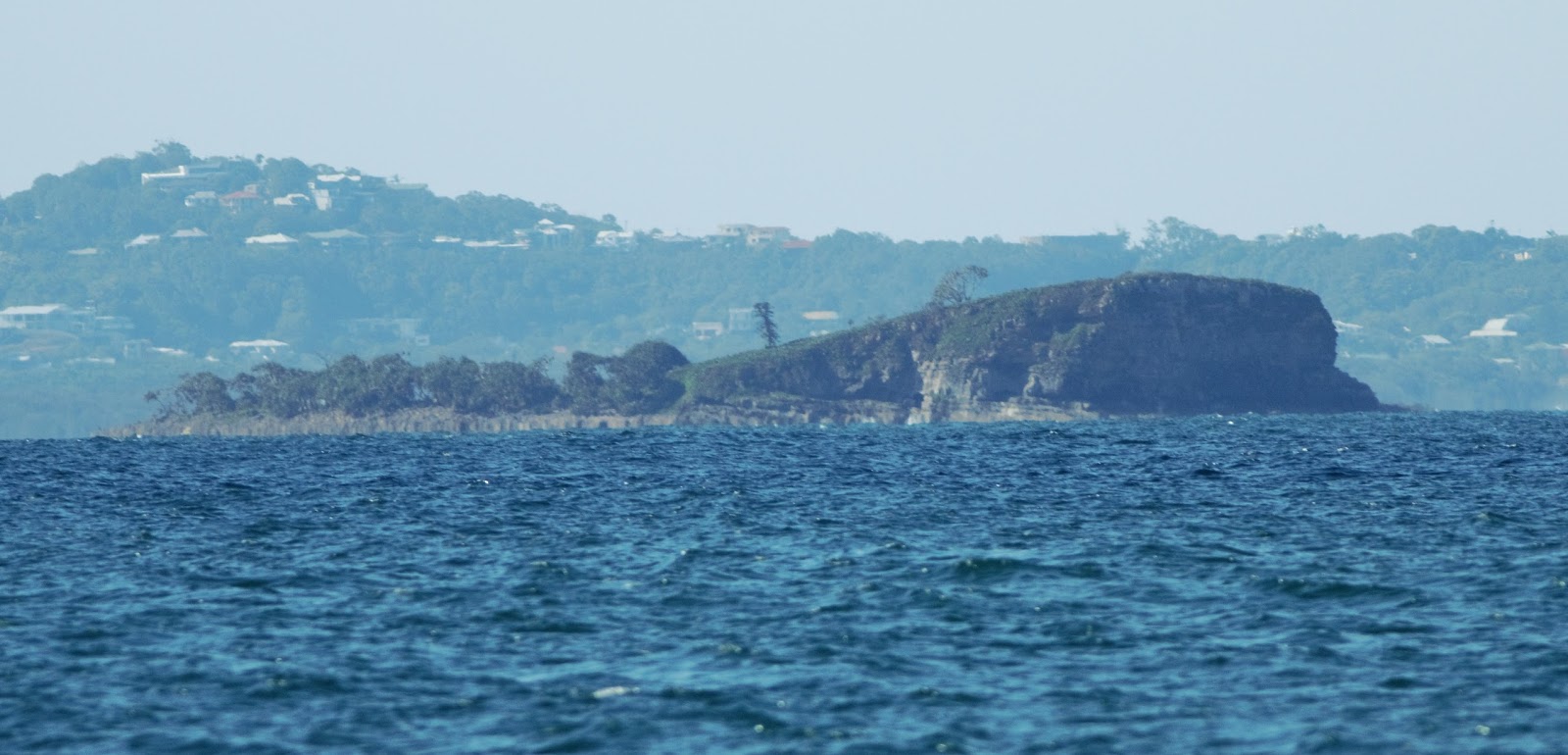
Mudjimba Island
We stopped to lay a berley trail at 9.20am 32 nautical miles offshore in 300 fathoms: 26.4009S, 153.4190E. A fine, sunny day prevailed (max 29) with a 1.5m swell. However, there was no wind, not even a breeze. If there is one thing worse that the dreaded northerlies on these trips, it is no wind at all. I can remember just a handful occasions previously where there has been zero wind all day. Unfortunately, that was our lot this day.

Wedge-tailed Shearwater
A Wilson's Storm-Petrel appeared after 30 minutes but little more, so we ventured further out to 500 fathoms 36nm offshore. It made no difference bird-wise, although we did attract several decent-sized sharks, which appeared to be Bronze Whalers. A handful of Wilson's Storm-Petrels and small numbers of Wedge-tailed Shearwaters and Crested Terns were all the birds we saw before we turned around at 12.30pm. We tried our luck again with a third berley trail in 250 fathoms before heading back at 12.50pm.

Wilson's Storm-Petrel
A dark phase Arctic Jaeger, a pod of Short-beaked Common Dolphins, and several more flocks of Short-tailed Shearwaters were of interest on the way in. We returned to the marina at 3.30pm. Once again, all aboard were impressed with the comforts and space of our boat, Crusader 1, run by Sunshine Coast family company Sunshine Coast Afloat.

PARTICIPANTS: Greg Roberts (organiser), Toby Imhoff (skipper), Zoe Williams (deckhand),
Margie Baker, Tony Baker, Devon Bull, Locky Cordell, Phil Cross, Jo Culinan, Alex Ferguson, John Gunning, Nikolas Haass, Barrie Harding, John Houssenloge, Mary Hynes, Elliot Leach, James Martin, Maggie Overend, Steve Popple, Carol Popple, Andrew Sides-McHugh, Mary Sides-McHugh, Raja Stephenson, Kevin Webb

SPECIES: Total (Max at one time)
Wilson's Storm Petrel 7 (3)
Wedge-tailed Shearwater 20 (4)
Short-tailed Shearwater 200 (40)
Silver Gull 2 (1)
Crested Tern 15 (4)
Arctic Jaeger 1 (1)


Short-beaked Common Dolphin 6 (6)

Friday, 3 November 2017

Square-tailed Kite Nesting on Sunshine Coast

Square-tailed Kite
A pair of Square-tailed Kites have again successfully raised a youngster at their nest in open forest at Tinbeerwah on the Sunshine Coast.The nest is close to a mountain bike path in what is now Tewantin National Park. Local birders have had the nest under observation for some time but I was unable to connect with it until today, having failed in my first attempt a few days ago to find it.


Square-tailed Kite
An adult kite was sunning itself in the canopy of a tall eucalypt near the nest when I arrived this morning. After a while I heard the juvenile calling about 50m away and the adult flew to join it. Both birds then returned to the nest, where I saw the adult feeding the youngster on what presumably were the remains of a bird or nestling.


Square-tailed Kite
After 40 minutes of so both birds departed the nest, the juvenile clearly very close to independence.
The birds nested in this area last year and have done so in previous years. The species appears to be loyal to favoured nesting sites. A pair have nested at Mt Coot-tha in Brisbane in similar habitat for several years in succession.


Square-tailed Kite
Similarly, a pair of Square-tailed Kites have nested each year in woodland near Bundaberg since 1985, according to local birding legend Eric Zillmann.

Juvenile (L) & adult (R) at the nest


Some observers believe the population of this species, generally considered one of Australia's most rare raptors, may be on the rise. Birdline in NSW no longer bothers to publish records of Square-tailed Kite. I see the kites from time to time in my garden at Ninderry and come across them regularly on and around the Sunshine Coast. They occur mostly over open forest and well-wooded country but I have seen them flying over parks and farmland, in wallum heath and even on the beach at Coolum.

If they are increasing, that would defy a trend in Australia of raptor populations generally being in decline - in some cases severely, with the Letter-winged Kite now in dire straits.

Dingo x wild dog
Also today I called in to Frogmouth Lane nearby, where a dingo/wild dog was seen.

Close by also is the Noosa Botanic Gardens, where a pair of Barred Cuckoo-shrikes have been hanging around for a couple of weeks. I found them easily enough. 


Friday, 27 October 2017

South-East Oz Part 8 – Regent Honeyeater Ablaze at Capertee + Visit to Werrikimbe

Regent Honeyeater
Following our visit to Kangaroo Valley (see following post) we spent a few days sight-seeing in Canberra before continuing north to spend 2 days with our friend Kathy Haydon in Capertee Valley - a renowned birding hotspot. The valley is essentially a vast canyon floor set amid the spectacular sandstone escarpments along the western fringe of the Blue Mountains World Heritage Area.

Capertee Valley near Glen Davis

Capertee Valley near Glen Davis
We camped in the free camp (complete with hot showers!) in the quaintly deserted former mining township of Glen Davis. We visited Gardens of Stone National Park, Wollemi National Park and Capertee National Park. We birded along the Glen Alice and Glen Davis roads. Many thanks to Dean Ingerwersen and Ross Crates from BirdLife Australia for birding advice on the area.

Ironbark woodland, Capertee National Park
The key photographic target at Capertee was the critically endangered Regent Honeyeater, with the site being a major stronghold for this fast disappearing woodland specialist. I have seen this species on just 3 occasions previously, and looked unsuccessfully for it earlier in the trip west of Armidale.

Regent Honeyeater

Regent Honeyeater
Two groups were encountered at Capertee – an impressive gathering of 8-12 birds in Capertee National Park, including at least 2 juveniles of different ages - indicating successful breeding this season in the area. A further group of 3-4 birds was found along Glen Davis Road.


Regent Honeyeater
In both areas, the birds were feeding primarily on the red flowers of the Mugga Ironbark Eucalyptus sideroxylon – a tree that the bird has a special affinity with. The honeyeaters would periodically fly to feed briefly on the white flowers of other Eucalyptus species. At the Capertee site it was noted that the Regent Honeyeaters were constantly chased by the much more common Noisy Friarbirds.


Regent Honeyeater
The two juvenile birds were both fed by adults during the time we had them under observation. Some adult birds had been banded as researchers are working on the birds at Capertee. At the Glen Davis Road site, no friarbirds were present and the Regent Honeyeaters turned the tables – aggressively chasing White-plumed and smaller honeyeater species out of their feeding tree.


Regent Honeyeater adult & juvenile
Another nice find near the Glen Davis camp were a couple of pairs of Rock Warblers on the slopes above the camp, where Brush-tailed Rock-Wallaby was also present.


Rock Warbler
Other birds at Capertee included Brown Treecreeper, White-browed Babbler, Red-capped Robin, Rufous Songlark and Crested Shrike-tit.


Brown Treecreeper

Crested Shrike-tit
Red-capped Robin

White-browed Babbler
Reptiles included Jacky Lizard.


Jacky Lizard
Sections of the main roads have recently been upgraded with 100kmph zones, so vehicles travel at high speed through the valley, taking a substantial toll on the wildlife.


Common Wombat roadkill near Glen Davis
We moved on to Maitland for an overnight stay, then drove high into the mountains for a 3-night stay in the Brushy Mountains Camp in Werrikimbe National Park. A female Flame Robin in the camping round was unexpected.


Flame Robin female
I had hoped to photograph Rufous Scrubbird here but it was not to be. The birds were vocal enough but we were plagued by rain, cold and strong winds. I heard a total of 4 scrubbirds between Spekes Lookout on the Scrubbird Trail and the Brushy Mountains camp; 2 birds along the 3.6km loop trail; 1 bird at the campground; and 4 between Brushy Mountains and the Cockerawombeeba Road turnoff. I managed to see 2 of the Scrubbird Trail birds briefly.


Scrubbird habitat at Werrikimbe
Superb Lyrebird, Bassian Thrush and Olive Whistler were common and the place is worth a visit just for the beautiful camp ground and surrounding forest. 


Brushy Mountains camp
Our final stop was the caravan park at Wooyung near Pottsville on the NSW North Coast, where a feisty Buff-banded Rail was unusually tame. We had been on the road for 52 days, travelling more than 8000km through NSW and Victoria.


Buff-banded Rail

Sunday, 15 October 2017

South-East Oz Part 7 – Wombats of Bendeela

Common Wombat grazing
With its stunning scenery and wildlife attractions, it is surprising that the Bendeela Recreation Area in Kangaroo Valley in the NSW Southern  Highlands is not a major tourist attraction. This free camping and picnic reserve operated by WaterNSW is truly delightful.


Juvenile wombat
Here is Wombat Central. I know of nowhere else where this endearing marsupial can be seen in such numbers and with such ease. The wombats emerge from their burrows up to two hours before sunset to graze on the extensive grass lawns of the reserve.


They are utterly oblivious to the human interlopers, wandering and feeding among the tents and caravans. They will bowl through your camping site without giving you a look. They love getting under vehicles and caravans to scratch their backs. At night you can  hear them squeal as they chase each other around, or your van rocks slightly as they have a scratch.


Wombat under caravan
From one point at the western end of the reserve, I counted 25 wombats an hour after sunset. Judging by the area available, there would be at least 100 in the vicinity of the reserve and many more on surrounding properties.


Wombat with mange
Some are suffering a kind of mange, the spread of which may be facilitated by the large population.


Burrows amid revegetation efforts

Wombat burrow
The periphery of the reserve is potted with dozens of burrows. Attempts at revegetation are challenging because new burrows are constantly being dug among newly planted shrubs and trees.


Up close and personal
The animals are so trusting that some idiot in 2015 slaughtered 13 wombats at Bendeela by driving around at night and running them over.

Bendeela Recreation Area
Bendeela

Bendeela

Among the birds here were Superb Lyrebird and a Square-tailed Kite flying over.


Square-tailed Kite


Thursday, 12 October 2017

South-East Oz Part 6 - Lakes Entrance to Jervis Bay

Eastern Bristlebird
Following our visit to Terra Bulga (see following post) we headed south-east to Lakes Entrance in East Gippsland, a place I last visited in the mid-1980s to tick a vagrant White Wagtail.


Lakes Entrance
 We had 3 days at this delightful spot, visiting Lake Bunga and Lake Tyers, where a Hooded Plover was present along with a few Sharp-tailed Sandpipers, Curlew-Sandpipers and Red-necked Stints. It was annoying that so many people walking their dogs ignored signs making it clear they had to be on leashes..


Hooded Plover
Pacific Gulls were common along the foreshore but nothing else of interest was noted.
We proceeded further east, with the cold blustery weather we have had too much of during this trip resuming after a respite of a few days. 


Pacific Gulls
We called in on Lake Conrad, where a baby Australlian Fur seal on the rocks was nice to see.


Australian Fur Seal

Further east we spent the next night at Mallacoota, where huge numbers of terns were roosting in the estuary at low tide. The great bulk were Crested Terns (2000+) but among them were a sprinkling of about 50 White-fronted Terns.


White-fronted Tern

White-fronted Tern
White-fronted Tern
Small numbers of Bar-tailed Godwits and Red Knots were among the terns.


Red Knots & Bar-tailed Godwits
We crossed the NSW border and travelled north through Eden and Bermagui to the delightful seaside town of Batemans Bay for a 2-day stay. Musk Lorikeets were abundant along the foreshore here. 


Batemans Bay
The waterfowl at the town's Watergarden were most approachable.

Chesnut Teal
Then it was on to the Australian Capital Territory coastal enclave of Jervis Bay, a hotspot for the endangered Eastern Bristlebird. 

Booderee National Park burnt out


We were dismayed to see that a fire last month had devastated much of Booderee National Park; well-known bristlebird sites such as Murrays Beach, Cape St George and the Munyunga Waraga Trail had been burnt out. 


It seemed extraordinary that park authorities had no management regime in place to contain a fire of this magnitude in a site of such importance to the bristlebird and other rare animals such as Eastern Ground Parrot. Once lush wet gullies of sedge and fern were reduced to char.


It seemed extraordinary that park authorities had no management regime in place to contain a fire of this magnitude. Park signs say the habitat is carefully managed with patch control burns, but extensive and destructive fires last month and this time last year paint a different picture. In times of global warming it seems that September is not an appropriate time for control burning.


Under surveillance by the Navy

The rangers told us to look for bristlebirds along the busy Wreck Bay Road which we did, but we were promptly buzzed by a Chinook helicopter from the nearby Australian naval base. They called in security guards who told us the Navy did not like “people with binoculars and cameras”. This seemed somewhat bizarre given we were birdwatching on a public road in a national park, at a time when most of the good tracks were closed due to the above-mentioned fire.


Eastern Bristlebird

Eastern Bristlebird

Two or three bristlebirds were heard and seen briefly along the road and eventually an obliging bird showed well on the main road. The next morning I found a nice pair feeding along a track off Wreck Bay Road. I estimated from calls there were 8-12 birds in this area.

Green Patch Beach, Jervis Bay

Coastal cliffs, Jervis Bay
The beaches (supposedly with the world's whitest sand) and coastal scenery of the national park are nonetheless something to behold.

Humpback Whale calf breaching
An adult and calf Humpback Whale performed nicely off Governor Head, with the calf breaching.

Echidna
A total of 6 Echidnas were encountered.

Glenn & friend, Green Patch
Swamp Wallabies and Eastern Grey Kangaroos were common about the delightful Green Patch camping ground, our base for 3 nights.

Sooty Oystercatcher
Sooty Oystercatcher and White-bellied Sea-Eagle were among the birds about.

White-bellied Sea-Eagle