Sunshine Coast Birds

Birding and other wildlife experiences from the Sunshine Coast and elsewhere in Australia - and from overseas - with scribblings about travel, environmental issues, kayaking, hiking and camping.
Showing posts sorted by relevance for query pelagic. Sort by date Show all posts

Sunday, 5 March 2017

Sunshine Coast Pelagic March 2017

Red-footed Booby
White Tern, Red-footed Booby, Streaked Shearwater and good numbers of Lesser Frigatebird, Pomarine Jaeger and Brown Booby were the highlights of the pelagic trip off Mooloolaba, Sunshine Coast, on Saturday March 4, 2017.

Pomarine Jaeger
We departed Mooloolaba Marina at 6.45am on an unseasonally warm autumn day with hopeful expectations following a prolonged period of fresh south-easterlies offshore over the preceding week. We were not to be disappointed. A gentle 5 knot easterly and a swell of .5-1m made for a relatively smooth ride as we headed east, seeing the first of many Pomarine Jaegers for the day and a dark phase Arctic Jaeger on the way out.

Wedge-tailed Shearwaters with (1) Flesh-footed Shearwater
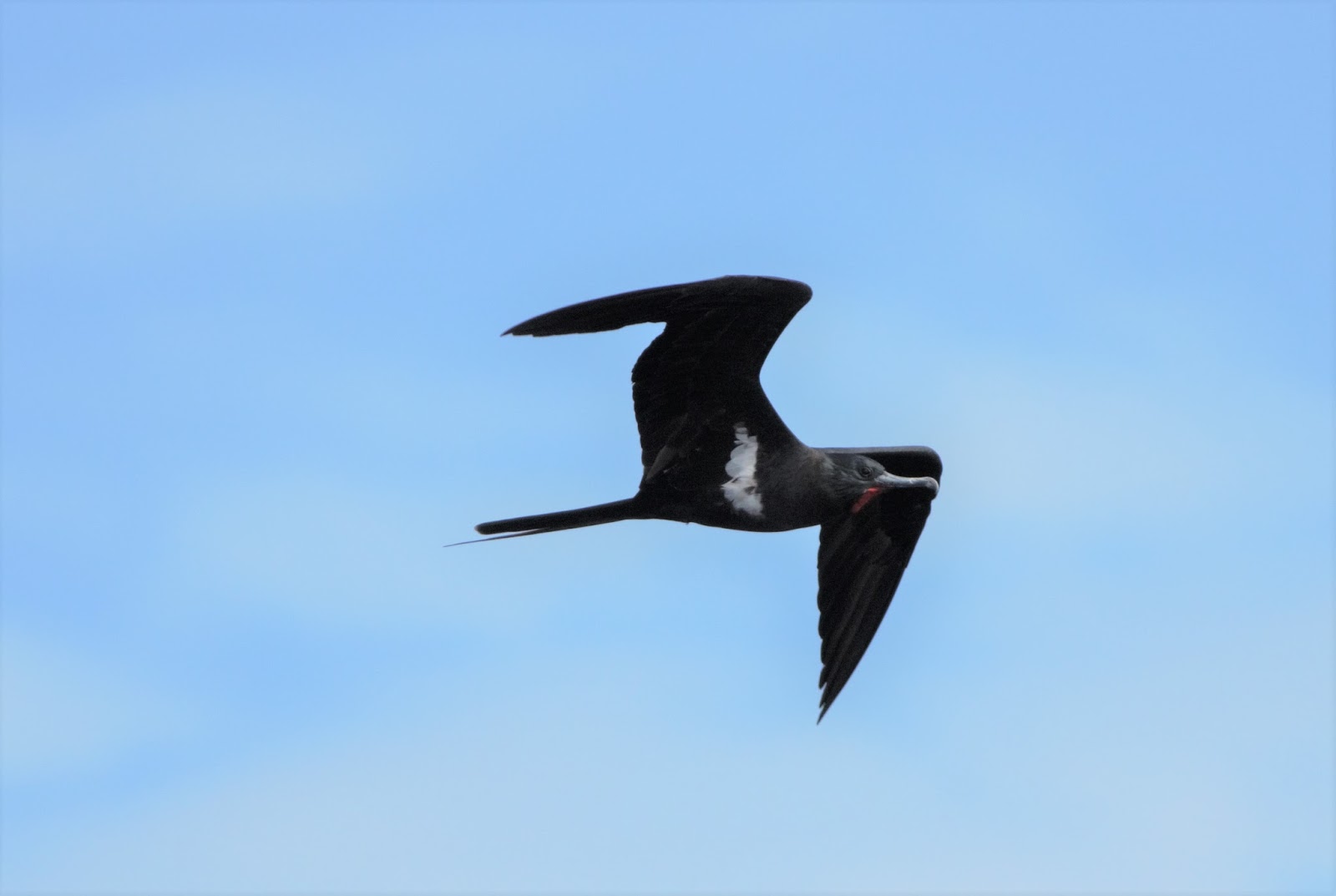
Things started to get interesting in 120m, before reaching the shelf, when we saw a fairly distant pair of Lesser Frigatebirds. A little further on we spotted a collection of Flesh-footed and Wedge-tailed Shearwaters feeding while above them, no fewer than 10 Lesser Frigatebirds graced the sky.

Lesser Frigatebird female

Lesser Frigatebird male

Near here we saw a couple of Brown Boobies perched on a trawler before finding 2 more Brown Boobies accompanied by an intermediate phase Red-footed Booby perched on another trawler further out. A second intermediate phase Red-footed Booby flew by while we watched its perched brethren.

Brown Booby

Red-footed Booby
Red-footed Booby
After these welcome interruptions, we passed a couple of Tahiti Petrels before reaching the shelf at 10am, a little later than usual - 34 nautical miles offshore in 210m at 26.31.436S; 153.44.850E. The swell had picked up to 1.5m and the breeze to a comfortable 5-10 knots.

Tahiti Petrel
More Tahiti Petrels arrived as we began laying a berley trail and good numbers of both Flesh-footed and Wedge-tailed Sheawaters joined us for the whole time we were on the shelf. Unlike recent pelagic trips off both the Sunshine Coast and Gold Coast, birds appeared to be very hungry, attacking the berley voraciously.

Pomarine Jaeger
Pomarine Jaeger dark phase

We were soon joined by a smattering of Pomarine Jaegers in various plumage phases; we were to have as many as 11 at one time about the boat.

Streaked Shearwater
A single Streaked Shearwater joined the fray, coming and going as the morning progressed.

Brown Booby
A couple more Brown Boobies brought the total to 6, along with the 13th Lesser Frigatebird for the day; the highest number I have encountered for either species on a pelagic. Numbers of Pomarine Jaeger and Flesh-footed Shearwater were also unusually high.

White Tern
White Tern
Shortly after midday a single White Tern was a welcome addition to the list as it flew overhead. Other non-bird "sea monsters" included Glaucus, bluebottles, Porpita, Violet Snail, a comb jelly and a pelagic crab holding a spirula shell.
Common Terns
After drifting southwards 5.5 nautical miles we turned around to head back at 1pm, stopping for a feeding flock of Common Terns and Little Terns inshore before arriving back at the marina at 3.15pm.

PARTICIPANTS: Paddy Dimond (skipper), Greg Roberts (organiser),  Ralph Brown,  Devon Bull, Ian Cleary,  Kaya Cleary,  Malcolm Graham,  Matteo Grilli,  Nicholas Haass,  Elliot Leach,  James Martin,  Davydd McDonald,  Steve Pratt,  Raja Stephenson.

BIRDS: Total number seen. (Maximum number seen at any one time).

Wedge-tailed Shearwater 90 (30)
Flesh-footed Shearwater 40 (15)
Streaked Shearwater 1 (1)
Tahiti Petrel 12 (5)
Brown Booby 6 (2)
Red-footed Booby 2 (2)
Lesser Frigatebird 13 (10)
Arctic Jaeger 1 (1)
Pomarine Jaeger 26 (11)
White Tern 1 (1)
Crested Tern 30 (6)
Common Tern 80 (40)
Little Tern 8 (4)
Silver Gull 1 (1)

Monday, 15 May 2017

New Charter Boat for Sunshine Coast Pelagics


Crusader 1
I'm pleased to report that we will be trialling a big new boat for pelagic birding trips off Mooloolaba on the Sunshine Coast. We will be able to take up to 23 people in what would be the largest and most comfortable boat doing pelagic birding charters in Queensland waters. The deal I have hammered out gives us 5 hours out on the shelf during a 9-hour day trip at reasonable cost. We'll have a huge deck, plenty of seating, hand rails and roofing for protection against the elements. The deep-keeled, high speed monohull will permit a relatively smooth ride, allowing us to go out in wind speeds of up to 25 knots at least, reaching the continental shelf in as little as 2 hours.

Ship layout
Many people are aware of the difficulties we've faced in the six years since I've been operating pelagic trips off the Sunshine Coast. Quite a few folk early on opted out of further trips because they thought conditions were too cramped on board, or that there was a lack of seating, or that the absence of hand rails was unsafe. Later, we had problems with reliability when prebooked trips were cancelled, or most recently when promised supplies of berley repeatedly failed to materialise. Also, the small boat meant we could not go out if anything much in excess of 15 knots was forecast, and as it was a catamaran, it could be pretty uncomfortable out there even in a relatively mild swell.

The new boat is Crusader 1, a deep-keeled, high speed Westcoaster designed for rough weather: 55ft long, 18.5ft wide, a draft of 2.1m and weighing 21 tonnes. It is more that twice the size of the boat we used previously. The main deck has a 3m boardroom style table with 6 seating pods, each designed to seat up to 4 people, with extra seating at the back of the deck. The cabin has a 4-person dining area. The water exhaust is dry-stack so the boat is quiet and the impact of diesel fumes on passengers is minimised.

Red-footed Booby, seen on our last pelagic 
There will be access to the bow deck up front as well as the expansive rear deck. There are solid hand railings all around the deck. A sea anchor will allow us to adjust our drifting speed in accordance with movements of birds at the back of the boat. Other bits and pieces include drinking water on the main deck, a rest area for anyone who is seasick, and a separate toilet for ladies. Apart from the skipper we will have a deck hand to help disperse berley. A good supply of berley is incorporated in the deal. I've had a good look over the boat and am most impressed.


Accommodation for six people on board will allow us in time to undertake 2-3 day charters out wide to explore the Coral Sea.

However, as this is a much bigger operation, we will need bigger numbers of people to make it work. For the boat we had been using, we needed a minimum of 13. For this boat, we will need a minimum of 17. The boat can take up to 23 passengers so hopefully nobody should be on a waiting list.


We had been paying $120pp. The cost now will be between $110pp and $140pp, depending on how many people we get. We had previously paid cash on the day but now, payment will need to be in advance, refundable if you are forced to withdraw with reasonable notice.


The operators, Sunshine Coast Afloat, have won multiple tourism awards and their charters are in high demand, so they are able to offer these trips only on a Sunday - not Saturday when we have previously run charters. If forced to cancel due to weather (which would be infrequent given the boat's greater capabilities) we would postpone to the following Sunday, or the next available Sunday.


My intention is to run these trips about once every two months, but we will do a trial run to see how we go with the inaugural charter in terms of attracting sufficient numbers of people; that's the biggest challenge facing this new venture. So the inaugural trip will depart Mooloolaba Marina at 6.30am on Sunday, July 30, returning at 3.30pm. Please email me (friarbird.roberts@gmail.com) if you can make it. I will be overseas from early next week until early July but contactable while away by email. No payments would need to be made until after my return in July.

POSTSCRIPT 16/05/2017

I thought we might be battling to get the numbers but I've been quite stunned by the response. The 23 spots for the inaugural July 30 trip were quickly taken up and there's a waiting list already for this trip. We will see how our initial trial run goes but it bodes well for the future. All going well, I'll set down dates for the 12 months ahead after the July 30 charter.

UPDATE 17/05/2017

Due to the high level of interest in this boat we have scheduled a second charter for Sunday August 27. Please let me know if interested.


Monday, 4 June 2018

Sunshine Coast Pelagic June 2018

Shy Albatross

With fresh memories of a rocky ride on our May 2018 pelagic a week ago, fingers were crossed for a smoother run as we departed Mooloolaba Marina at 6.55am on Sunday June 3 with a brisk 10-knot SW breeze blowing. The wind picked up as we headed out but it was behind us so the trip was relatively comfortable. We encountered a smattering of Crested Terns and Australasian Gannets and two fly-by Hutton's Shearwaters before spotting two Humpback Whales – the first of the season.

Humpback Whales
We were 19 nautical miles offshore in 60 metres when we spotted the first Providence Petrel of the day. Then we picked up a Shy Albatross in 115m 25 nautical miles offshore sitting on the water behind a trawler whose crew were cleaning its catch from the night before. This was the first record of the species for a Sunshine Coast pelagic and the bird was of the race cauta, a scarce visitor to south-east Queensland.

Shy Albatross

Shy Albatross
We began laying a berley trail on the edge of the continental shelf 32 nautical miles offshore in 350 metres (S26.3.1; E 153.43.4) at 9.55am. By this time we had a steady S-SW wind of 15-20 knots and a hefty swell of 2-3 metres which remained the order of the day. We soon had Providence Petrels and Wilson's Storm-Petrels coming to the slick and quite a few of both were about the boat while we out wide.

Providence Petrel

Wilson's Storm-Petrel
It wasn't long before an Antarctic Prion made an appearance and we had this species come and go several times while we were on the shelf.

Antarctic Prion

Antarctic Prion
A Grey-faced Petrel was looking good as it approached the boat – the second sighting of this species for a Sunshine Coast pelagic following last week's first. Satellite tracking of Grey-faced Petrel suggests it does not stray north of Brisbane (it is seen regularly on the Southport pelagics) and today is likely the most northerly Australian record of the species.

Grey-faced Petrel

Grey-faced Petrel
We'd been floating for a couple of hours before a Black-bellied Storm-Petrel showed up, with one or two birds about for the next hour before we turned around to head back at 1.15pm. We had drifted 4.7 nautical miles in a north-westerly direction to 150 metres.

Black-bellied Storm-Petrel

Black-bellied Storm-Petrel
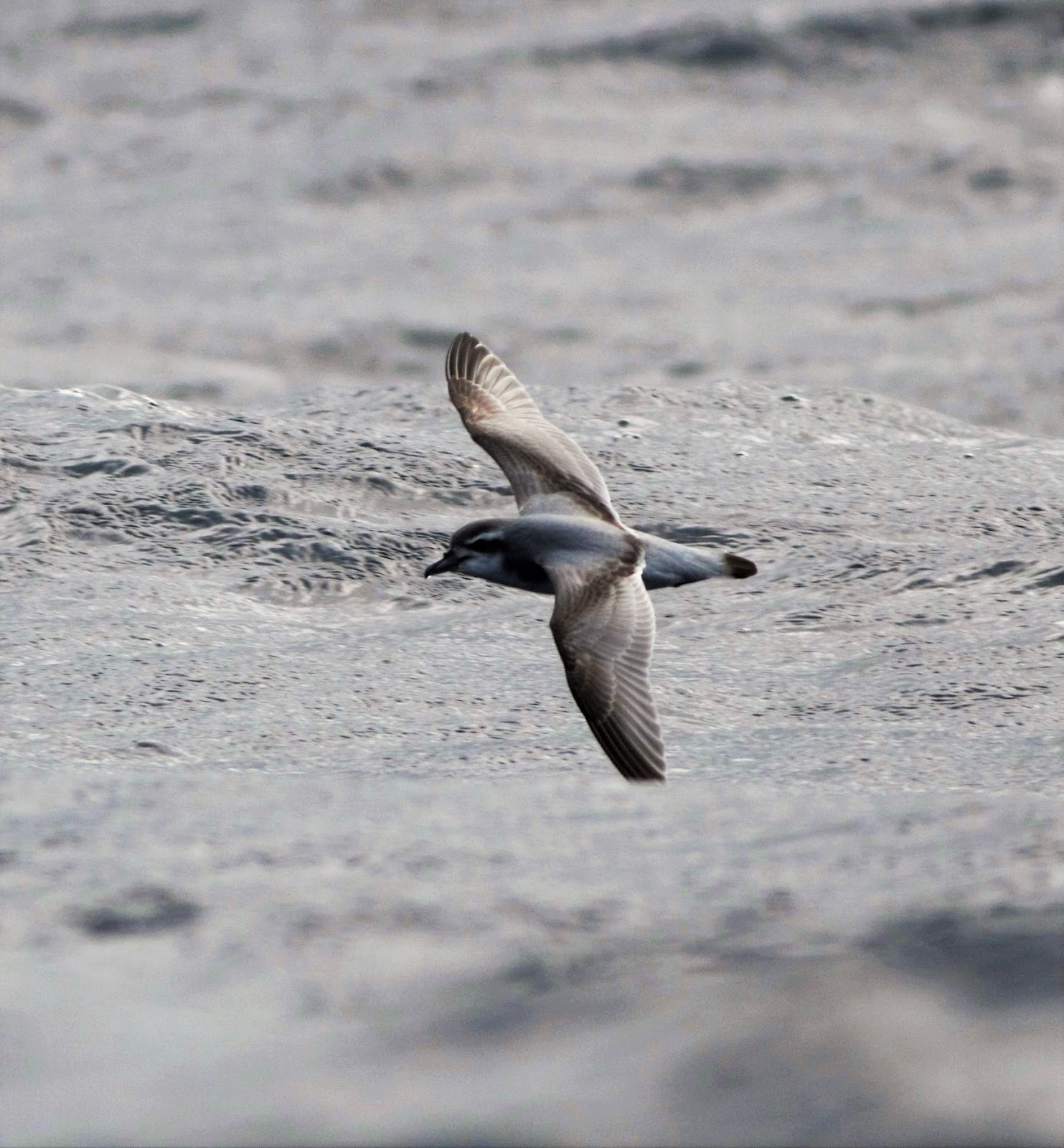
On the way back we had a flock of Hutton's Shearwaters with 2 Fluttering Shearwaters among them; the image here was the best I could manage of the latter. We arrived back at the marina at 4.05pm. Elist.


Fluttering Shearwater
PARTICIPANTS:
Greg Roberts (organiser), Toby Imhoff (skipper), Zoe Williams (deckhand),
Eric Anderson, Margie Baker, Tony Baker, Warren Bennett, Jane Cooksley, Ken Cross, Phil Cross, Rick Franks, Richard Fuller, Malcolm Graham, Geoff Glare, John Gunning, Nikolas Haass, Bob James, James Martin, Paul Marty, Steven Pratt, Allan Pratt, Liam Pratt, Trevor Ross, Esme Ross, Raja Stephenson.

SPECIES: Total (Maximum at one time)
Shy Albatross 1
Grey-faced Petrel 1
Providence Petrel 60 (8)
Antarctic Prion 6 (2)
Hutton's Shearwater 15 (12)
Fluttering Shearwater 2 (2)
Black-bellied Storm-Petrel 2 (1)
Wilson's Storm-Petrel 30 (5)
Australasian Gannet 30 (6)
Silver Gull 4 (4)
Crested Tern 80 (30)

Humpback Whale 2 (2)


Tuesday, 1 January 2019

2018 Sunshine Coast Birds Big Year


#303 Pale-vented Bush-hen
Every now and then I think it's good to take up a challenge: set oneself a goal and go for it. It may take a while to reach your target. It was many years before I finally attained my goal of seeing all 234 bird families in the world; that milestone was notched up in Panama in 2015 with the sighting of Sapayoa.


2018 Zone of Happiness
Birders often embrace a Big Year as a worthy goal. The idea is to see as many species as possible within a period of 12 months. A Big Year might be nation-wide or international, but I thought the Sunshine Coast region would do nicely for 2018. That wasn't the plan initially. Ken Cross, the leader of BirdLife Australia Sunshine Coast, had for a few years been running a competition for local birders to see who could photograph the most birds in a calendar year. Part of the goal was to encourage up and coming birders to improve their skills by identifying images posted on a Facebook page created each year for what was dubbed The Game.


#1 Brush Cuckoo
I thought initially that I'd join The Game in 2018 for a hoot, but that soon morphed into a full-on Big Year. I set a goal of photographing 300 species in the region in the calendar year.


#30 Eastern Grass Owl
The area covered for The Game is the so-called Zone of Happiness. The zone extends beyond the boundaries of the Sunshine Coast and Noosa councils: north to Inskip Point, south to Bribie Island and west to beyond Kilcoy and Amamoor, with an outlier in the Sheepstation Conservation Park south of Caboolture. My first photograph for The Game was a Russet-tailed Thrush behind Yandina. Although identifiable, I thought the image unworthy so discarded it; another seven months went by before I managed another photograph of this species! 


#31 Grey Ternlet
As it transpired, quantity not quality is the order of The Game for photographs. So long as an image is identifiable by someone in the group, that's adequate for it to pass muster; quite a few photographs on the page, including some of mine, are not as sharp as one might wish. That's fine: it's a birding indulgence first and foremost, not a photographic contest.
The winning total for The Game in 2017 was 256 species photographed by Carolyn Scott. I thought then that was an impressive effort. I've seen a total of 348 species in the Zone of Happiness, with observations stretching back to the early-1970s. Two species – Eastern Bristlebird and Emu – are now extinct in the area. Many others are vagrants or rare visitors, especially seabirds. (Birds seen on pelagic trips offshore are counted for The Game.)

#158 Shining Flycatcher
Most species in the region are common and widespread so are not difficult to photograph – the so-called low-hanging fruit. Others are numerous enough but can take a bit of work to nail down: Rose-crowned Fruit-Dove and Russet-tailed Thrush are good examples. Yet others are skulking, elusive and difficult to see, let alone photograph. Rails and owls feature prominently in the latter group.

#200 Brolga
As the early months of 2018 went by, I worked out a plan to boost the prospects of snaring the maximum possible number of birds before December 31. I had some advantages. I'd done a good deal of guiding over the years so knew of reliable sites for cryptic species such as Pale-vented Bush-hen and Black-breasted Buttonquail. I organise the Mooloolaba pelagic trips so was able to amass a reasonable collection of seabirds. On the other hand, I was going to be away from home for more than three months of 2018, so some visiting birds would inevitably be missed (as transpired with the likes of White-browed Woodswallow and Freckled Duck).

#221 Australian Owlet-Nightjar
For many targets, it was a matter of studying ebird records, Google Earth and Google Maps to gather information on distribution, habitat and access. I figured that the dry woodlands north of Gympie, for instance, might work for species that hadn't been recorded in previous years of The Game, like Speckled Warbler and Weebill. Or the paddocks and lightly wooded country around Kilcoy or west of Amamoor might harbour local rarities like Yellow-rumped Thornbill and Black-chinned Honeyeater.

#225 Pectoral Sandpiper
As the year marched on, various pieces of what I imagined to be a big jigsaw puzzle gradually fell into place. Pelagic trips offshore ensured that both summer-visiting seabirds (like Short-tailed Shearwater and Tahiti Petrel) and winter visitors (like Antarctic Prion and Providence Petrel) were in the bag. The odd rarity, notably Grey Ternlet, didn't go astray. Six pelagic trips were undertaken during the year.

#246 Red-browed Treecreeper
I managed to photograph all the region's nocturnal birds: Australian Owlet-Nightjar; two nightjars (Large-tailed and White-throated); two frogmouths (Marbled and Tawny) and six owls (Eastern Grass, Barn, Masked, Powerful, Barking and Southern Boobook). Some of the trickier waterbirds snapped included Spotless Crake, Baillon's Crake, Pale-vented Bush-hen, Australian Little Bittern and Lewin's Rail.

#247 Masked Owl 
I put in some serious driving time. I travelled twice to Bribie Island in one day because I learned after I got home from the first visit that a Radjah Shelduck had turned up at Sandstone Point, just 1km from where I was. I got the shelduck, and it didn't stay around, but I saw the species later in the year anyway at Tin Can Bay.


#250 Powerful Owl
Participating in The Game meant that I disclosed a fair number of sites held close to my chest for many years. But I learned through other participants of sites I'd not known of.

#274 Black-bellied Storm-Petrel
It helped that I went on 10 campouts of 1-3 nights in the region during the year - Charlie Moreland Park, Kenilworth Bluff, Conondale National Park, Amamoor, Yandilla, Brooyar State Forest, Rainbow Beach, Tin Can Bay, Cooloola and Noosa North Shore – as well as overnight stays on Bribie Island and in Kilcoy and Tiaro (the latter outside the zone, but to access the northern woodlands).

#285 Regent Honeyeater

I had just a single shot at quite a few birds - that is they were seen (and photographed) just once during the year: Eastern Grass Owl, Grey Ternlet, Streaked Shearwater, Marbled Frogmouth, Brush Bronzewing, Oriental Cuckoo, Baillon's Crake, Brolga, Fluttering Shearwater, Plum-headed Finch, Superb Fruit-Dove, Pectoral Sandpiper, Barn Owl, Large-tailed Nightjar, Glossy Black Cockatoo, Masked Owl, Sooty Owl, Black-breasted Buttonquail, Red-footed Booby, Red-browed Treecreeper, Shy Albatross, Yellow Thornbill, Barking Owl, Weebill, Green Pygmy-Goose, Regent Honeyeater, Lesser Crested Tern, Grey Plover, Southern Emu-wren, Sanderling, Pacific Swift, Black Bittern. As the year drew to an end, the pickings became few and far between.

#286 Lesser Crested Tern
The vagaries of birding are well illustrated by the very last bird for 2018 – Red-winged Parrot, seen on December 31. One had been seen on the outskirts of Gunalda a few days earlier. I was at the site at the crack of dawn and searched the area diligently without success for two hours. I returned mid-afternoon and there was the bird.

#293 Radjah Shelduck
As for my favourite bird of the year, I can think of a few. Photographing Southern Emu-wren and Brush Bronzewing at Cooloola was uplifting. They weren't great images but I'd not seen the emu-wren in Queensland since the 1970s, and the bronzewing just a couple of times since then. I photographed Eastern Ground Parrot a few times before eventually managing a half-decent image. Pectoral Sandpiper near Toorbul was nice, as were Masked Owl near Yandilla and Eastern Grass Owl at Bli Bli. The Regent Honeyeater at Carlos Pt was an extraordinary out-of-range record.

#300 Black Bittern
I was very happy to bag a Red-browed Treecreeper, in the southern Conondales. This species was once regularly encountered in the Conondale and Blackall ranges but numbers appear to have crashed; in the almost 10 years since I moved to the Sunshine Coast, I'd seen it just once previously. I believe it is one of a number of birds in the region to be impacted by climate change. Probably top of the pops was Black Bittern at Tin Can Bay. I've seen the species occasionally but regularly in the region, though hadn't managed to photograph it before. It was also the 300th species for the year.

#302 Lewin's Rail
I ended up with 310 species photographed in 2018. The Zone of Happiness in 2019 will be quite different from 2018 because its boundaries extend well westward, netting a suite of extra birds, so comparing 2018 with 2019 will not be comparing apples with apples. I spotted but failed to photograph three species – Black-tailed Native-hen, Swift Parrot, Budgerigar - so saw a total of 313 species for 2018 in the Sunshine Coast region. Now it's 2019, and time to move on. Let's see now. Getting my world lifelist up from 7920 to 8000 would be nice.


#310 Red-winged Parrot