Sunshine Coast Birds

Birding and other wildlife experiences from the Sunshine Coast and elsewhere in Australia - and from overseas - with scribblings about travel, environmental issues, kayaking, hiking and camping.

Tuesday, 3 October 2017

South-East Oz Part 5 – Torquay to Tarra Bulga

Pilotbird
Following our visit to Cape Otway (see following post) we continued our journey to the eastern end of the Great Ocean Road at the tourist town of Torquay, where we stayed for two nights in the Foreshore Caravan Park. From here we visited the centres of Ocean Grove and Barwon Heads, but not much was about other than a few immature Pacific Gulls.

Pacific Gull immature
The Breamlea Reserve was similarly disappointing but a Hooded Plover was nice to find at Pt Impossible - at the northern end of one of Victoria's major nudist beaches.

Hooded Plover


Hooded Plover habitat at Pt Impossible
We moved on to Geelong for 2 nights in the Southside Tourist Park. The extensive parklands along the Barwon River impressed. A Collared Sparrowhawk put in an appearance at one of the parks. 

Collared Sparrowhawk
Our visit coincided with the AFL Grand Final; we were content enough with the lively ambience but the unrelenting foul weather was taking its toll.The Moolap Saltworks on the bay were pretty well devoid of birds, as was Belmont Common. Reedy Lake – the western end of the Lake Connawarre system – had some nice birds including Magpie Goose, Brolga, White-fronted Chat and Swamp Harrier.

Magpie Geese 

Swamp Harrier

White-fronted Chat
We departed Geelong and followed a tip from Melbourne birder Michael Gooch to the red cliffs of K Road in Werribee South. The continously blustery conditions weren't helpful but eventually we tracked down one of the Purple-crowned Lorikeets that Michael had nesting here the week before.

Purple-crowned Lorikeet

Purple-crowned Lorikeet
We travelled eastward across Melbourne via its efficient freeway system; apologies to my Melbourne friends for not visiting but towing a big caravan around the city did not seem like a good idea. We ended up in the Fernholme Tarra Valley Caravan Park, a delightful place and base for our visit to Tarra Bulga National Park in the Strezelecki Ranges.

Tarra Bulga
Here the towering Mountain Ash trees – the world's tallest flowering plant - and abundance of tree ferns in the forest did not disappoint, and at last the wind died down. I walked the main tracks leading off from both the southern picnic area and the park visitors centre. My main target, Pilotbird, was quite common, with the area around the visitors centre carpark particularly good.

Pilotbird

Pilotbird
Superb Lyrebird and Olive Whistler were common. I was grateful for the opportunity of watching a male lyrebird in full display but the vegetation prevented photographic opportunities.

Superb Lyrebird

Olive Whistler
Rose Robins were common.

Rose Robin
I saw a few Pink Robins, including some gloriously adorned males.

Pink Robin

Pink Robin

A Flame Robin was about the visitors centre. Other birds included Bassian Thrush, Crescent Honeyeater and Gang Gang Cockatoo. About the campground at night, a Common Wombat was looking good.

Common Wombat


Wednesday, 27 September 2017

South-East Oz Part 4 – Victoria's Great Ocean Road

Rufous Bristlebird
Following our visit to Ballarat (see next post) we continued south to meet the Southern Ocean and the Great Ocean Road for a 2-night stay in the caravan park in the delightful seaside town of Port Campbell.


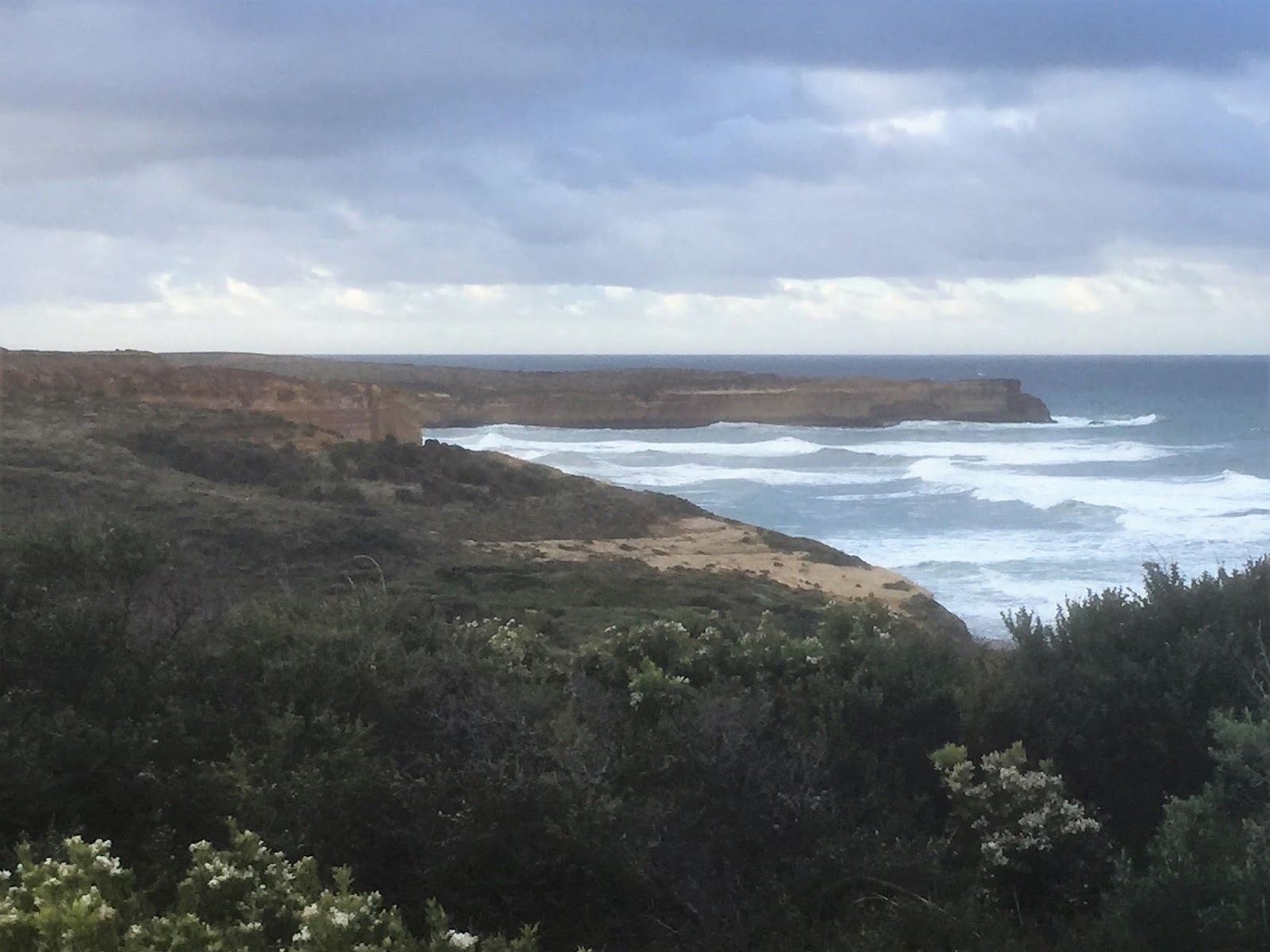
Port Campbell coast
I last saw Rufous Bristlebird at Port Addis in 1973 in the venerable company of John McKean, Billie Gill and Margaret Cameron. So I was keen to become reacquainted with this one. We spent a morning exploring the fabulous coastal scenery just east of the town at Loch Ard Gorge and the famed Twelve Apostles.


12 Apostles
Loch Ard Gorge
We did all the walks at the gorge before finally finding a pair of suitably co-operative bristlebirds on the path to Tunnel Cave. Later in the day I found another pair, though much more shy, along the Discovery Walk on the edge of Port Campbell. Then later still that day I found a third pair at the northern edge of the caravan park.


Rufous Bristlebird

Rufous Bristlebird
Striated Fieldwren was present in the coastal heath above the cliffs just east of Port Campbell.


Striated Fieldwren
Crescent Honeyater was common in the heath along the coast. Other honeyeaters included Red and Little Wattlebirds.


Crescent Honeyeater

We then drove east along the Great Ocean Road for a 1-night stay in the Bimbi Caravan Park at Cape Otway. Warning: do not stay in this overly priced hole unless hordes of noisy children are your thin. Luckily the birds helped ease the pain, and a big male koala along the road into the park was a nice find.


Koala
We walked a back track almost to the Cape Otway Lighthouse and saw a total of 6 Beautiful Firetails in two spots. Rufous Bristlebird was heard and more Striated Fieldwrens were about.


Cape Otway Lighthouse
We toured the historic lighthouse and visited Blanket Bay and Point Franklin, where another Beautiful Firetail was seen, in Great Otway National Park.


Beautiful Firetail

Beautiful Firetail

In the early evening a pair of Gang Gang Cockatoos flew down to drink. More were in the trees about the camp the next morning.


Gang Gang Cockatoo

Gang Gang Cockatoo

That morning I returned to the trails behind the lighthouse where another pair of Rufous Bristlebirds were seen well and 15-20 Beautiful Firetails were spotted, mostly feeding on the grass at a private camping ground 500m from the carpark. A Swamp Wallaby and a Peregrine Falcon were spotted on the way back.

Peregrine Falcon

Swamp Wallaby


Friday, 22 September 2017

South-East Oz Part 3: Bendigo & Ballarat


Black-eared Cuckoo
On our last morning in Deniliquin (see following post) I again checked out the back roads north of the town, seeing Pallid Cuckoo and a nice female Superb Parrot feeding in a flowering eucalypt.


Pallid Cuckoo


Superb Parrot
We headed on further south to the Victorian city of Bendigo for a 2-night stay in the Central City Caravan Park. We did some touristy things here like the Deborah underground gold mine and the trams. I was impressed with how well-wooded and birdy the city was. Grey Currawong and Musk Lorikeet were among birds seen close to the CBD.


Grey Currawong

Musk Lorikeet
A Common Bronzewing sitting on a suburban roof-top is not seen every day.


Common Bronzewing
A spent a morning 30km north of town in the Greater Bendigo National Park, birding along Bendigo Tennyson Road and Campbell Road in the dry sclerophyll-mallee woodlands, ablaze with wildflowers at this time of year.


Greater Bendigo National Park
I pulled up at the spot where my friend Kevin Bartram recently spotted a Black-eared Cuckoo, 100m or so up Campbell Road from its intersection with Bendigo Tennyson Road. Within seconds I had a Black-eared Cuckoo, soon to the joined by a second bird; both were extraordinarily fearless. One of the birds at one point kind of flattened itself out on the branch. I heard a third bird later and also had Shining and Horsfield's Bronze Cuckoos.


Black-eared Cuckoo


Black-eared Cuckoo
I was keen to photograph Purple-gaped Honeyeater and came across several pairs and small groups along Campbell Road.


Purple-gaped Honeyeater
I saw a Black Honeyeater along here and other honeyeaters were plentiful: White-fronted, Yellow-plumed, Brown-headed, Yellow-tufted, White-eared and Tawny-crowned.


Tawny-crowned Honeyeater

White-fronted Honeyeater
Other nice birds included Brush Bronzewing, Red-capped Robin and Crested Bellbird. I had good views of Shy Heathwren at Round Hill Reserve in NSW but was happy to connect with a co-operative individual of this different subspecies here.


Shy Heathwren 
We moved further south for a 2-night stay at the Eureka Holiday Park in Ballarat. Again, a nicely wooded city, this one with the impressive Lake Wendouree in its heart. On the lake were plenty of Great Crested Grebes along with a few Musk Ducsk and Blue-billed Ducks.


Musk Duck


Great Crested Grebe
While plenty of Black Swan families were about.


Black Swan family
Swamp Harriers quartered the reed-bed, where a pair were clearly attending a nest.

Swamp Harrier