Sunshine Coast Birds

Birding and other wildlife experiences from the Sunshine Coast and elsewhere in Australia - and from overseas - with scribblings about travel, environmental issues, kayaking, hiking and camping.

Saturday, 3 September 2016

Nestling Musings: Do Australian Bushbirds Commit Siblicide?

Little Wattlebird adult & young
UPDATED 31/10/2016
We've played host to a family of Little Wattlebirds in our Sunshine Coast garden. Some interesting observations indicate nestling behaviour I had not thought likely, including possible siblicide (the killing or displacement of siblings in the nest), and how well the young bird manages to conceal itself after leaving the nest.

Little Wattlebird
The pair of wattlebirds built their nest in a hanging basket on our back porch. This was outside a bathroom window and on the main thoroughfare to our home entrance. The birds seemed unperturbed, although we tried to minimise interference by walking around the nest.

Wattlebird eggs
Two eggs were duly laid. Fingers were crossed, because last year the wattlebirds built their nest in a nearby shrub, and the single fledgling disappeared, almost certainly being taken by a kookaburra. I believe one of the reasons for the decline in many bushbird species in suburban and semi-rural areas is the unfortunates habit of people to feed kookaburras and other predatory birds. The handouts may displace some native prey but undoubtedly this boosts populations of avian predators that target nestlings.

Twin wattlebird fledglings
Both eggs hatched, but about a week later, when the youngsters were beginning to look a little robust, one disappeared from the nest. It seemed unlikely to have been taken by a predator because the predator would likely have returned for the second, or taken both at the same time. A dead nestling of some species was found a few days later on the ground about 20m away, but this youngster may have fallen from an unrelated nest. Is it possible that the surviving wattlebird nestling evicted its sibling from the nest? Siblicide is well known among nestling birds, including kookaburras and several waterbirds, but I can't find references to it in relation to Australian passerines (perching bushbirds). Siblicide is evidently a natural way of ensuring that potentially scarce food resources are utilised most efficiently to ensure the survival of healthier nestlings.

Wattlebird nestling
In any event, the survivor continued to do well.  A few days after its sibling's demise, it climbed up to the hanging basket hook. I would put it back in the nest but it kept climbing back up. In this position it was clearly exposed and in danger of being nabbed. However, it flew on stubby wings across 10m of open lawn to land in the canopy of a rainforest tree.

Adult feeding Youngster in Garden
It was striking how over the ensuing days, as the bird gradually became more mobile, it would sit motionless and silent in well-camouflaged roosts in various parts of the garden, high up in the canopy. I had thought nestlings would be begging noisily to be fed and flapping about conspicuously. But usually the only way the young wattlebird could be located was by tracking down the soft calls emitted by the parents during feeding.

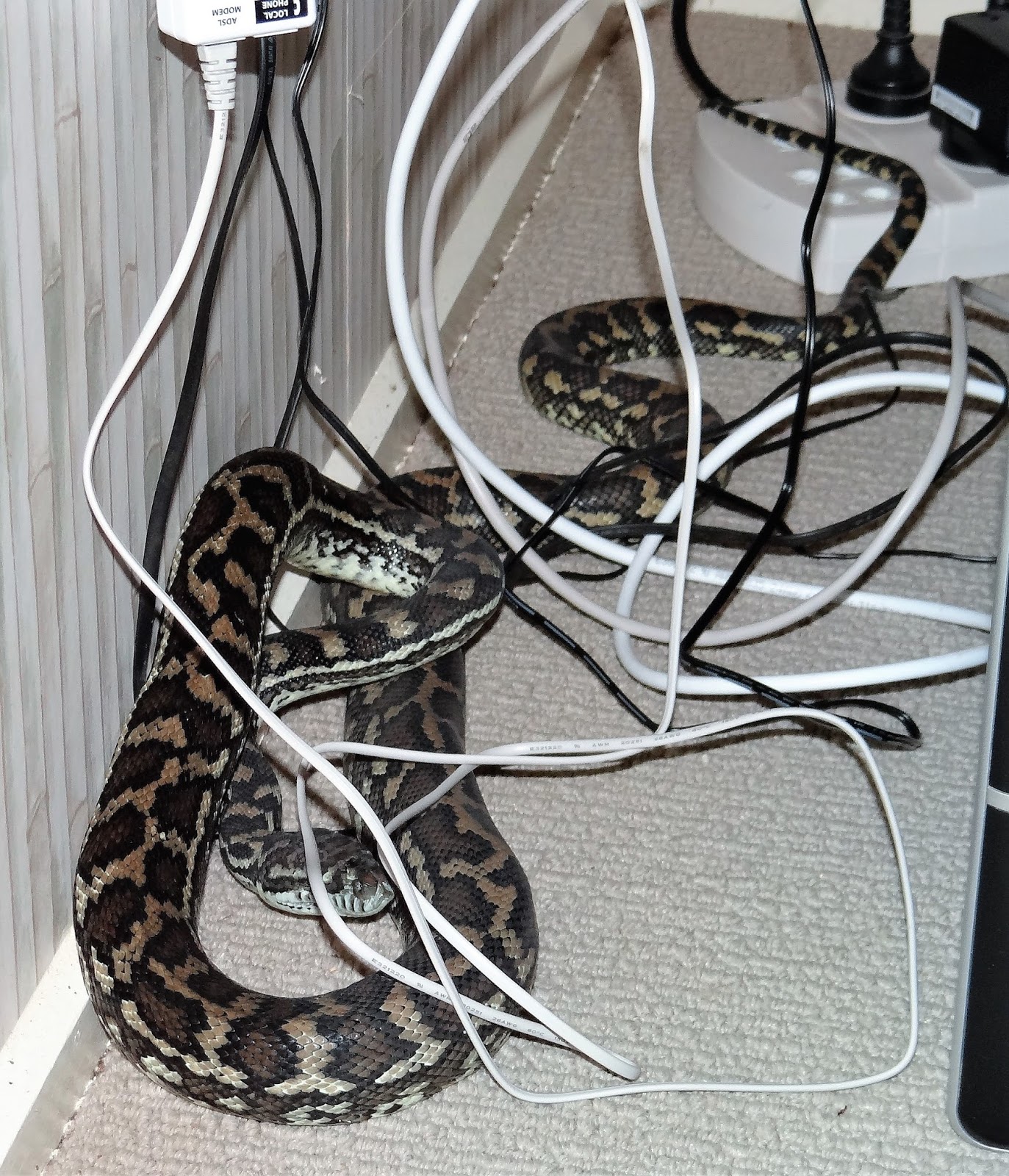
Carpet Python
Also in the garden, in another indication that Spring is here, a Carpet Python found its way into the house, entangling itself in wiring behind the computer hard drive.

Wonga Pigeon
A Wonga Pigeon has come into the feeder for the first time.

Yellow-faced Honeyeater
Yellow-faced Honeyeaters have been particularly numerous this year.

White-eared Monarch
White-eared Monarch and Fairy Gerygone were both singing vigorously in creekside dry rainforest near Cooroy: a further sign of Spring.

Eastern Grass Owl near Toorbul: Pic - Matt Harvey
Following our recent successful owling foray, I was alerted to the finding of a dead Eastern Grass Owl near Toorbul, on the southern fringe of the Sunshine Coast, by the road in unusual habitat. One side of the road was introduced Pinus radiata plantation and the other side was an open grazing paddock, with no grassland of any substance in the area. Was this bird in transit?

Sooty Owl in care: Pic - Matt Harvey
Meanwhile, a Sooty Owl was taken into care after being hit by a vehicle near Peachester, in the Sunshine Coast hinterland.

UPDATE ON LITTLE WATTLEBIRDS NESTING 31/10/2016

The young Little Wattlebird referred to was successfully raised. Its parents then built their second nest for the season in a different hanging basket, again on the porch. Again, two eggs hatched and again, one fledgling disappeared.

Brown Tree-Snake
We were on hand when the second fledgling was attacked one evening last week by a Brown Tree-Snake. We rescued the bird, removing the snake to a spot in the garden 30 metres away. Within an hour it was back. We rescued the bird a second time, this time removing the snake to the bottom of the property, 150m away. It nonetheless returned the next night, this time succeeding in killing the nestling.

Monday, 29 August 2016

Winter Visit to Lockyer Valley

Yellow-billed Spoonbills
A foray to the Lockyer and Brisbane valleys before winter expires. In the series of pools along Cove Road, Stanmore, were a few Glossy Ibis and Yellow-billed Spoonbills, with 7 Cotton Pygmy-Geese in one pool. This was about the best of the waterbirds for the trip as most of the usual spots (including Jahnke's Lagoon, Seven Mile Lagoon and Peachey's Lagoon) were bone dry.

Red-tailed Black Cockatoos
Along Gregors Creek Road near Kilcoy were 2 female Red-tailed Black Cockatoos, always nice to see in south-east Queensland. This road has some nice habitat along it and is worth checking out for anyone heading that way.

Yellow Thornbill
Given the dry conditions, I would have thought Lake Galletly near Gatton might be promising, but there was little there other than large numbers of Magpie Geese. A Yellow Thornbill in the shrubbery around the hide was nice as this is another species seldom encountered east of the Great Divide in southern Queensland.

Common Bronzewing
I called in at Pobblebonk, the property we formerly owned near Coominya, and it was good to see that Common Bronzewings were still plentiful there.

Jacky Winter
Jacky Winters were also present.

Dusky Woodswallow
In the dry woodlands along Adare Road near Gatton were a few Dusky Woodswallows. Near Peachey's Lagoon I found a party of 4 Red-rumped Parrots. Some of the more common species that were about are below.

Striated Pardalote

White-throated Gerygone

Yellow-rumped Thornbill
On the outskirts of Coominya (the first houses on the left coming from the east) was a party of 3 Apostlebirds.  This is another species that is surprisingly uncommon in south-east Queensland. Over several years of weekend stays at our property nearby, I had not seen Apostlebirds previously in the area.

Apostlebird


Friday, 19 August 2016

All Four Australian Tyto Owls in One Night (Plus Marbled Frogmouth)

Sooty Owl
An extraordinary night of owling was had last night in the company of Luke Bennett and Bob Sothman in and around the Sunshine Coast. We scored all four Australian Tyto owl species - Masked, Sooty, Eastern Grass and Eastern Barn. As well as Marbled Frogmouth, Tawny Frogmouth, Southern Boobook and Australian Owlet-Nightjar. We had a full moon. Some have suggested owls are less active on such nights; our experience was that they are about and much easier to find as they fly about.

Masked Owl
We were positioned at dusk in wet sclerophyll forest above the Booloumba Creek camping areas in the Conondale Range in the Sunshine Coast hinterland in an area where I have had both Sooty and Masked Owls previously, but not at the same time. The first Tyto of the night was a pale male Masked Owl that flew through the spotlight.

Masked Owl 
Then a typically darker female Masked Owl made an appearance, and was seen several times over the next 30 minutes or so we were here.  A Sooty Owl was heard in the same spot and it was tracked down low in the canopy. The bird was seen twice but briefly and while vocal enough, it proved to be less co-operative than its cogener.

Tawny Frogmouth
We moved further up the road and a Tawny Frogmouth appeared roadside.

Marbled Frogmouth
 Just 200 metres further on we heard a pair of Marbled Frogmouths and the female showed herself nicely. At the same time, the second Sooty Owl of the evening was heard but not seen.

Marbled Frogmouth
At a third roadside stop, a Masked Owl was heard but not seen: the third record of this species for the night. Soon after a Sooty Owl was seen well as it perched in roadside rainforest.

Sooty Owl
Then at a fourth site, we had good views of a pair of Sooty Owls close to the vehicle. One of the birds perched at what may have been a nesting hollow entrance. An Australian Owlet-Nightjar was heard here, and a Southern Boobook was also seen roadside.

Sooty Owl
All up we recorded 3 Masked Owls with 2 seen, and 5 Sooty Owls with 4 seen. On a roll, we thought we would go for 4 Tytos in one night, which may be something of a first.

So we headed over to the coastal lowlands and the sugar cane farms of the Bli Bli area. Here we quickly saw one, then two Eastern Grass Owls flying high over the grasslands. This was about 11pm, much later (early evening) or earlier (early morning) than I usually look for this species. However, a full moon meant the owls were easy to see in flight.

Eastern Grass Owl
At another roadside stop we saw another pair of Grass Owls. It is highly likely these were different birds given the distance from the first sighting, although it is remotely possible that the first pair covered a good deal of ground in a short time. Then we tracked down and flushed two fledged juvenile Grass Owls that were calling from the ground in long grass. We found a hollowed out retreat in the grass that they had been sheltering in.

Eastern Barn Owl
Really on a roll now, we went to the other side of Mt Ninderry to my regular Eastern Barn Owl site and saw a bird perched, albeit distantly, in its nesting tree. The pic here is of another bird seen at the site last year. A brilliant night of owling.

Sunday, 14 August 2016

Sunshine Coast Pelagic August 2016

Black-bellied Storm-Petrel
A pod of wonderful whales and a big fish were the stars of the show for the August 13 pelagic trip off Mooloolaba on the Sunsine Coast, with nice birds including Black-bellied Storm-Petrel, Masked Booby, Kermadec Petrel and good numbers of Sooty Tern.

Providence Petrel
We departed the marina on a crisp winter morning at 6.45am with a gentle 5-8 knot E-SE breeze that varied little during the day. A Fluttering Shearwater and a Brown Booby were seen early on the way out along with small numbers of Wedge-tailed Shearwaters and Australasian Gannets. We reached the shelf at 9am, stopping 32 nautical miles offshore in 360 metres - S 26, 36, 075; E 153, 43, 477 - and began laying a trail of berley.

Wilson's Storm-Petrel
Small numbers of Providence Petrels and Wedge-tailed Shearwaters soon came into the slick, to be joined before long by a couple of Wilson's Storm-Petrels. The gentle breeze in a swell of under a metre did not bode well, but an intermediate phase Kermadec Petrel livened things up. After drifting slowly for a while be decided to move 1.5km eastwards to lay another berley trail.

Sooty Tern
A second intermediate phase Kermadec Petrel appeared, but both birds of this species kept their distance. A couple of Sooty Terns showed before we noticed in the distance what appeared to be a good flock of birds.

Hutton's Shearwaters
We headed towards it, encountering a decent flock of Hutton's Shearwaters. Feeding on what appeared to be schools of fish 37 nautical miles offshore in 900 metres were good numbers of Wedge-tailed and Hutton's Shearwaters along with an unusally solid number of Sooty Terns.

Black-bellied Storm-Petrel
A Black-bellied Storm-Petrel made a welcome appearance, soon to be joined by another. Then a large Manta Ray came to the boat and hovered close by for a while. We didn't know whether it was attracted to us or the berley, but several in the group donned a snorkel (water temperature a mild 21) to get a better look at the huge fish.  

Manta Ray Watching
Manta Ray
Another Brown Booby flew by as did a single Tahiti Petrel, a scarce visitor in winter.

Black-bellied Storm-Petrel
Not long before pulling up stumps, a booby/gannet appeared on the horizon. We thought at first it was too distant to identify, but later examination of Raja's photographs indicated it was a Masked Booby. As we were preparing to head back, a pod of Short-finned Pilot Whales turned up, entertaining us for some time as adults of both sexes and juveniles, clearly curious, circled the boat.  We turned around at 1pm, returning to the marina at 3.10pm.

Short-finned Pilot Whale
PARTICIPANTS: Lachlan Tuckwell (skipper), Greg Roberts (organiser), Luke Bennett, Devon Bull, Phil Cross, Jo Culican, Erin Donaldson, Rick Franks, John Gunning, Nikolas Haass, Elliot Leach, Raja Stephenson, Ged Tranter, Jamie Walker, Chris Watts.

Short-finned Pilot Whale


SPECIES TOTAL [MAX AT ONE TIME]

Kermadec Petrel 2 (1)
Providence Petrel 12 (4)
Tahiti Petrel 1 (1)
Wedge-tailed Shearwater 60 (20)
Hutton's Shearwater 80 (40)
Fluttering Shearwater 1 (1)
Black-bellied Storm-Petrel 2 (1)
Wilson's Storm-Petrel 10 (3)
Australasian Gannet 12 (5)
Brown Booby 2 (1)
Masked Booby 1 (1)
Sooty Tern 30 (14)
Crested Tern 20 (4)
Silver Gull 2 (2)

Short-finned Pilot Whale 10 (6)
Inshore Bottle-nosed Dolphin 2 (2)
Pantropical Spotted Dolphin 1 (1)
Humpback Whale 2 (1)


Thursday, 11 August 2016

Land-Clearing in Queensland: On the Brink

Clearing on Olive Vale Station, Cape York: Wilderness Society 

The fate of vast tracts of Queensland bushland hangs in the balance as a group of Cairns-based indigenous leaders led by Noel Pearson pressures the state MP for Cook, Billy Gordon, to vote against the Palaszczuk Labor Government's new tree-clearing laws.

Gordon was the indigenous Labor candidate elected for the Cape York seat in north Queensland in the January 2015 election but was forced to resign from the party soon after when details of his criminal history were revealed. He now threatens to betray the people of Cook who thought they were voting for a Labor MP by supporting moves to scuttle the tree-clearing laws by the Liberal National Party, the state farmers' peak body AgForce, and Pearson and his acolytes in Cairns. The minority Palaszczuk Government needs Gordon's vote to pass the legislation.

The legislation expected to be voted on soon reverses the gutting by the Campbell Newman LNP Government in 2012 of the Beattie Labor Government's landmark 2004 law to control land-clearing. Since Newman's move, more than 1 million hectares of bushland have been cleared, including almost 300,000 hectares in the year to June 2015 – the equivalent of 360,000 football fields. A third of the clearing took place in catchments adjoining the Great Barrier Reef.

Cook MP Billy Gordon: Cairns Post
The quantity of greenhouse emissions resulting from the relaxed tree-clearing laws rose from 16 million tonnes in 2010 to 52 million tonnes in 2014, undoing much of the reduction in emissions achieved by the federal Government's direct action policy. On just one station on Cape York, Olive Vale, a permit was issued to bulldoze 33,000 hectares of woodland that is habitat for threatened species such as Buff-breasted Buttonquail and Red Goshawk. The consequences overall of the widespread clearing for biodiversity are grave; it is likely, for instance, that populations of many woodland birds will decline precipitously, as they have in south-eastern Australia.

The new law reverses Newman's act of environmental vandalism, which allowed landholders to make their own assessments about whether or not vegetation on their land could be cleared. Newman allowed unlimited clearing for “high value” agriculture, which can mean just about anything.

Gordon's fellow Cairns-based MP, Rob Pyne, also sits as an Independent after resigning from the ALP post-election. Pyne voted with the LNP and the two MPs from Katter's Australian Party last March to defer the government's new law so it could be considered by a parliamentary committee. The move is likely to have prompted “panic” clearing by farmers and has allowed its opponents to launch a concerted campaign against the legislation. The parliamentary committee was unable to agree on a path forward, but Pyne has indicated he will vote for the legislation when it returns to parliament soon.

Noel Pearson: Sydney Morning Herald
Leading the LNP cheer squad has been Pearson and his mates, who control various Cairns-based organisations including the Cape York Institute and the Balkanu Cape York Development Corporation. Prominent among them are Noel's brother Gerhardt Pearson and Cape York Land Council chairman Richie Ahmat. They say the Vegetation Management (Reinstatement) and Other Legislation Amendment Bill 2016 will prevent the development of indigenous agricultural and other development projects. The Government responds that such projects will be able to proceed with environmental safeguards in place.

Noel Pearson also led the charge against the Beattie Government's wild rivers legislation, which protected the catchments of environmentally significant watercourses on Cape York and elsewhere. That law was similarly overturned by Campbell Newman's LNP Government. Pearson claimed at the time he had the unanimous support of north Queensland indigenous leaders, but in fact his stand was opposed by many including Carpentaria Land Council head Murrandoo Yanner, North Queensland Land Council chairman Terry O'Shane, and Mapoon Council chairman Peter Guavara. The LNP and Pearson's mob increasingly sing from the same songsheet.


It wasn't always thus. The founders of the Cape York Land Council in the 1970s were of a different ilk. Highly regarded indigenous leaders such as Mick Miller, the CYLC founding chairman, and boxing champion Clarry Grogan, were at one with the environmental movement in opposing large-scale, destructive development on Cape York and in championing the cause of preserving the outstanding wilderness values of the region. These leaders agreed that at the same time, provisions could be in place to allow development to improve the lot of indigenous communities, and for the active inclusion of communities in environmental management and protection. Kakadu in the Northern Territory is a fine example of how conservation can work in the interests of promoting the economic and social interests of indigenous communities.

In 1984, Mick Miller wrote and narrated a documentary film, Couldn't be Fairer, about his people. The film noted the view at the time of the Queensland Graziers Association that indigenous people should be divided into “true Aborigines” and “hybrids”. The peak farming group these days is AgForce, which has joined forces with the LNP and Pearson in promoting a disinformation campaign to undermine attempts to control land-clearing, although state government figures show that the agricultural sector did not suffer during the years that clearing controls were in place. Many environmentally aware farmers oppose the stand by AgForce.

Mick Miller
That earlier spirit of co-operation between indigenous and environmental groups culminated in the Cape York Heads of Agreement in 1996. The agreement laid the groundwork for co-operation between conservationists and indigenous communities, but how things have changed. Pearson now regards the environmental movement as the main enemy and the big developers as friends and saviours. It is not lost on observers that some Cairns-based indigenous groups have over the past couple of decades been the beneficiaries of lucrative contracts with mining companies and other developers.

Noel Pearson is an articulate exponent of what he regards as the best interests of his people, but he is also a foul-mouthed. homophobic bully. When I was a journalist with The Sydney Morning Herald, I dared to write about connections between some north Queensland indigenous organisations and big mining companies. I was subjected to a 30-minute raging rant on the phone from Pearson, during which he called me a f...ing c..t or a f...ing poofter c..t no fewer than 15 times. As has been written elsewhere, there is a deeply disturbing side to this man which the public has not largely been privy to.


Small wonder that Billy Gordon is feeling the heat. When Gordon ventured the view earlier this year that he might support the new tree-clearing law, he was immediately vilified. He was described as a “blackfella who went walkabout” on his constituents. Pearson warned Gordon that passage of the legislation would mean the “death of a thousand cuts” for indigenous communities; a ludicrous proposition. However, Gordon left little doubt in an interview with The Australian last week that he intends to oppose the bill, effectively sealing its fate.

Anybody concerned about this issue can contact Billy Gordon, asking him to do the right thing by Queensland and his constituents by voting for the legislation. Email addresses: Billy.Gordon@parliament.qld.gov.au and Cook@parliament.qld.gov.au. Phone (07) 4223 1100.

It also would be helpful to contact Rob Pyne along the same lines. Rob.Pyne@parliament.qld.gov.au and Cairns@parliament.qld.gov.au Twitter @RobJPyne. Phone: (07) 4229 0110