Sunshine Coast Birds
Birding and other wildlife experiences from the Sunshine Coast and elsewhere in Australia - and from overseas - with scribblings about travel, environmental issues, kayaking, hiking and camping.
Monday, 4 October 2021
North Queensland Spring 2021 – Part 2: Iron Range & Portland Roads
I had been to Iron Range twice previously but long ago: in February 1975 (for 11 days) and in November 1982 (for 8 days, a Queensland Museum trip with curator Glen Ingram), so was keen to revisit this iconic biodiversity hotspot in the far north of Cape York. We decided to take the easy option and fly in from Cairns for a week-long stay in September 2021 at Portland House in the village of Portland Roads, 22km north of the main rainforest areas of Iron Range.
We flew to Lockhart River and were met by our hosts at the airport with a 4WD hire vehicle for the week. Portland House organises the accommodation/flight/vehicle package. Whether you’re a large group or a single person, you have the whole house to yourself as part of the package. You can buy stores at Lockhart River and prepare your own meals or buy excellent meals at the restaurant next door, owned by the same people. We opted to make our own breakfasts and lunches, with a mix for evening meals. The operators can order in any alcohol supplies you need. The views from the sprawling verandahs over the sea (above) and of the beach and mangroves from the boat ramp up the road (below) are quite something.
The first morning we visited nearby Chili Beach and its busy camping ground. More fine coastal scenery here (below) but none of the Iron Range specialties were encountered.
The first of those was not far from the house when we got back: an immature male Red-cheeked Parrot (below) perched up high.
I tracked down an active Fawn-breasted Bowerbird bower found by Dominic Chaplin by mangroves about 500m from Portland House. I waited 40 minutes before the bird turned up, putting on a fine show of rearranging the bower and the large green berries in place for show.
Around Portland House, the newly split Graceful (from Cryptic) Honeyeater was common in the gardens.
Olive-backed Sunbirds were building a nest on the verandah.
Early most mornings for the rest of the week I drove 30 minutes to reach the rainforest, birded several kilometres of road or track and returned to Portland House around lunchtime. Traffic on the roads was horrendously busy compared to previous visits as indicated by this sign, although early mornings were usually okay.
The Iron Range specialties were out and about from the start. The first was a White-faced Robin making a roadside appearance soon after dawn; several were seen during the week but usually deep in the undergrowth.
Eclectus Parrots (male below) flew overhead occasionally but I only ever saw them perched briefly and distantly.
A flock of Sulphur-crested Cockatoos were unimpressed by a white phase Grey Goshawk.
We saw three Palm Cockatoos on the first morning in the forest but managed just poor views in very windy conditions. An immature Palm Cockatoo showed a little better the next day but surprisingly these were the only encounters with the species.
Quite a few more Red-cheeked Parrots (like the adult male below) were seen but both Eclectus Parrot and especially Palm Cockatoo were much less common than during earlier visits.
As the days unfolded, the target list shrunk. Green-backed Honeyeater was encountered more easily that I recalled from earlier trips and several parties were seen.
Most observations were centred on the area around the Gordon Creek, Rainforest and Cook’s Hut camping grounds in Kutini-Payamu National Park. An old hut at the latter site was my shelter during earlier visits to Iron Range. Gordon Creek and the Claudie River (below) were in full flow and the countryside was unusually green for this time of year, having had quite a bit of dry season rain.
Some differences from earlier visits that were later in the wet season were stark. Species like Northern Scrub-Robin and Yellow-billed Kingfisher were a good deal less vocal, while Magnificent Riflebird this time seemed to be everywhere. A male was regularly at its display perch at the Cook’s Hut camping ground, putting on a fine show (below and fist image in this post).
The 5km Old Coen walking track linking the Rainforest Camp to Portland Road was productive, especially the first 2km. Along here I tracked down a Black-eared Catbird, having heard one the previous day on the main road but failing to see it. These were the only two records of the species for the week.
Also along the Old Coen track I found a co-operative pair of Yellow-legged Flycatchers (below) in the rainforest canopy. White-eared Monarchs and Yellow-breasted Boatbills were about.
Around the Rainforest Camp I spotted a nice pair of Northern Scrub-Robins, although the birds were scarcely calling and getting these less than adequate images took a deal of patience.
Trumpet Manucode was another that was not as vocal as I recalled and it took a while to find a couple, again along the Old Coen track.
Frill-necked Monarch was spotted in several places, including the Rainforest and Cook’s Hut camps.
Tawny-breasted Honeyeater was one of the more plentiful specialties.
One day I left the house in the afternoon to visit the Mango Farm between Portland Road and Lockhart River. Here I saw a large Saltwater Crocodile. A flock of about 20 whistling-ducks flushed and quickly disappeared before I could get on to them, but the first couple had pale bellies and were quite likely Spotted Whistling-Ducks. Lemon-bellied Flycatcher (below) was here.
At the sewage treatment works near Lockhart River, a few Pied Herons were about but not the hoped for whistling-ducks.
Nearby at Quintell beach, the unusual rock formations on the beach are an eye-catcher.
On this day I opted for an evening excursion. As the sun set at the Rainforest Camp, the forest was lit up by countless fireflies and I remembered what a sight they were on earlier visits. A chorus of good numbers of Australian Wood-Frogs resounded from the banks of the nearby Claudie River.
It wasn’t long before I heard the characteristic call of the marmoratus race of Marbled Frogmouth and two or three were present around the camping ground, with one showing nicely.
Using my thermal monocular, I found a couple of Cape York Melomys (below) as well as a Giant White-tailed Rat and a Cape York Rat (Rattus leucops).
Spotlighting along the road back to Portland Roads was not particularly productive, with Spectacled Flying-Fox )above) in the rainforest and several Large-tailed Nightjars (below) lushed.
I had previously photographed Chestnut-breasted Cuckoo and White-streaked Honeyeater so did not spend time chasing these Cape York specialties. The only potential target that I failed to see or photoghaph was Yellow-billed Kingfisher. (It was too early in the season for two others: Black-winged Monarch and Papuan Pitta.) I frustratingly failed to see cuscus although others were reporting them, especially at Cook’s Hut Camp; I had seen both Spotted Cuscus and the Southern Common (Grey) Cuscus during previous visits.
I photographed the northern races of Fairy Gerygone (personata - above) and Tropical Scrubwren (minimus - below), both of which were common.
The distinctive race of Australian Brush-turkey (purpurceicollis) was also plentiful.
As was the ever photogenic Shining Flycatcher.
Relaxing in the beautiful tropical surroundings at Portland House was one of the highlights of the trip. Among the creatures about the house were plenty of Robust or Six-toothed Skinks (Carlia sexdentata).
White-lipped Tree-Frogs (below) were ever present. We were serenaded by constantly calling Large-tailed Nightjars and the occasional Papuan Frogmouth at night.
I didn't tire of the views from Portland Road during my frequent drives.
I was back at Chili Beach on the last morning and surprised to find a male Satin Flycatcher - a little-recorded transient migrant in far North Queensland.
We finished off our stay on the last night with an excellent seafood platter dinner at the restaurant.
Sunday, 3 October 2021
North Queensland Spring 2021 – Part One: The journey north & Atherton Tablelands
We headed up to north Queensland for a month-long sojourn with the central focus being a visit to Iron Range on Cape York. No caravan this time as much of the trip was accommodation-booked. That was handy in some respects but we missed the van. Overnight stops at Mt Larcom and Sarina before Ayr, where the first birding was underway in a fine mix of freshwater wetland and mangroves along Old Wharf Road near the town. Brolga (below) and Black-necked Stork were about.
Of surprise was a grouping of 8 Wood Sandpipers (below) – an unusually large concentration for this species. A few Red-kneed Dotterels and Sharp-tailed Sandpipers were on the wetland.
In the mangroves were Shining Flycatchers (above) and Yellow White-eye (below). The white-eye is inexplicably scarce along the east Queensland coast and indeed this was a state tick for me.
Large-billed Gerygone (below) and Olive-backed Sunbird were common.
We moved on to Ingham and checked out the Tyto Wetlands. A 2.5m Saltwater Crocodile (above) was here; rangers had set a trap with wild pig bait, presumably for this animal. Also about were two big Red-bellied Black Snakes (below) embroiled in what seemed to be territorial fight between males.
Green Pygmy-Goose (above) was common and Northern Fantail (below) put in an appearance.
We moved on to Forrest Beach (below) nearby, a delightful retreat. Mostly we opted for caravan park cabins on this trip, or motel rooms when these were not available. The park here is excellent.
Brown-backed Honeyeaters were attending a nest nearby.
I visited the indigenous-owned Mungalla Station (below) which like the rest of the countryside was lush and green after consistently good rains this year.
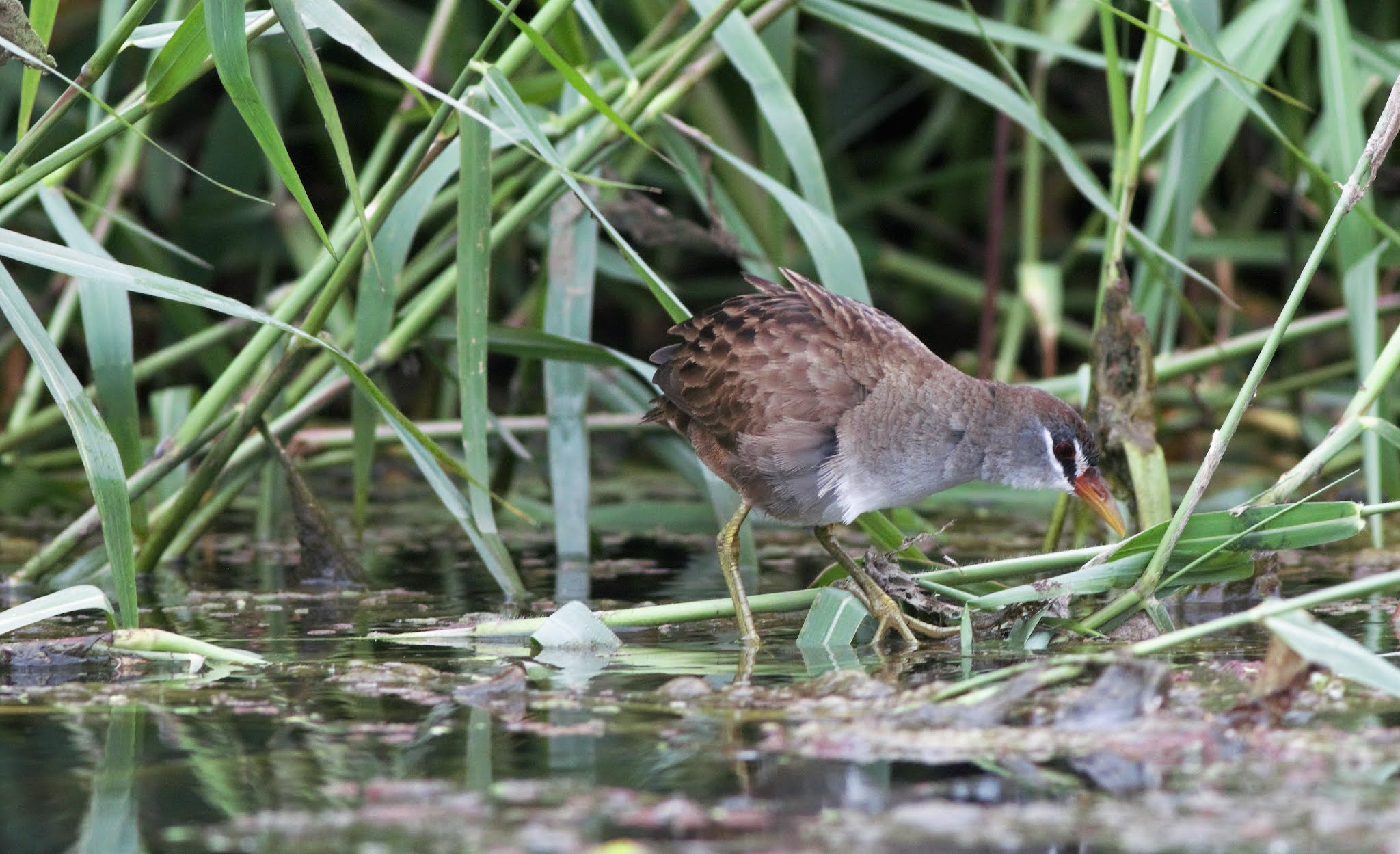
I heard White-browed Crake in a few places and eventually had excellent views of a bird close up.
Crimson Finch showed nicely on lawns around the homestead.
I found a 3.5-metre Saltwater Crocodile hauled up on the banks of a waterhole.
It was then on to the Atherton Tableland, taking a look at the Millaa Millaa (below) and other fine waterfalls along the way.
We called in on the Nerada tea plantations, a hotspot for daytime views of Lumholtz’s Tree-Kangaroo. A tree-kangaroo (above) duly obliged, as a curled up Green Ringtail (below) dozed in a nearby tree.
We settled in to a cabin in the Lake Eacham Tourist Park for a 4-night stay. Grey Whistler (below) and Bower’s Shrike-thrush were among the birds about the cabin.
Spotlighting around the Lake Eacham picnic area turned up a Northern Long-nosed Bandicoot (above). A Coppery Brushtail (below) was seen at the Curtain Fig near Yungaburra.
The cream of the cake came with a Lesser Sooty Owl near the Lake Eacham tourist park. I’d been chasing this species for an image for some time so to have one performing at eye level so well was gratifying.
Another one I’d been chasing for a picture was Tooth-billed Bowerbird, which is difficult to find in the dry season as it is not calling. It was certainly calling during this trip, and a bower was found at nearby Lake Barrine.
We called in on our friends Peter (above) and Val Valentine near Malanda. As usual, Victoria’s Riflebird (below) and other birds coming in to feed obliged nicely.
In the rafters of their home was a delightful grouping of Eastern (formerly Northern) Long-eared Bats.
We headed to Kuranda via Atherton, seeing a few Sarus Crane (below) along the way. We stayed with Alexander Watson overnight where Red-necked Crake was seen and heard – as it was at Lake Barrine – but sadly not photographed.
We had two nights in the Kuranda Rainforest Park. More rails calling but not showing. The Barron River falls (above) outside town were in full flow. The newly renamed and split Cryptic (formerly Graceful) Honeyeater (below) was common.
Wednesday, 1 September 2021
Unusual encounters with Sunshine Coast rodents and backyard critters
I had some excellent encounters with rodents and an antechinus in the Sunshine Coast area over the winter months. A Grassland Melomys (Melomys burtoni - above and below) was much appreciated as it was released from a trap in which it was caught near Bli Bli during environmental surveys conducted by Wildwise Environmental Services. The site was in open forest adjoining a narrow strip of subtropical lowland rainforest that is flanked by mangroves along the Maroochy River.
Also in a survey trap at the site was a Buff-footed Antechinus (Antechinus mysticus - below). This species was recently split from the widespread Yellow-footed Antechinus. Its range and status in South-East Queensland is unclear but it is known from elsewhere in the Sunshine Coast region.
I’ve continued to come to grips with my relatively new thermal monocular. I found the Grassland Melomys’s close relative, a Fawn-footed Melomys (Melomys cervinepes - below) in rainforest near Kureelpa Falls, not far from home. It was sitting motionless in a tree three metres from the ground, about an hour before sunrise. Using the monocular, I found another Fawn-footed Melomys in rainforest at Booloumba Creek along with a Bush Rat (Rattus fuscipes).
The Water Rat, or rakali, is reasonably common but seldom spotted as it is shy and usually nocturnal. I was surprised when one came out into the open in the middle of the busy Lake Alford park in Gympie mid-afternoon. Looking very wet, the animal (below) nonchalantly groomed itself for several minutes in full view of a throng of human passers-by and onlookers.
It’s now 10 months since we moved from Ninderry to Nambour in the Sunshine Coast hinterland. Some of the Ninderry critters are missed, especially the Eastern Grey Kangaroos, but we’re happy with the new home, and there’s a fair bit to watch. The verandah offers fine views from the town’s western hill ridges out over the Nambour valley. The hills are part of the crater wall of an ancient volcano.
Raptors seen from here include Square-tailed Kite (above) and Grey Goshawk (below).
Elsewhere in the garden, a Dwarf Crowned-Snake (below) was a nice fine. Bluetongues like the rock walls around the house and are often encountered. Dark Bar-sided Skinks are about. Frogs including Graceful Tree-Frog and Tusked Frog are attracted to an ephemeral pool that forms in bush at the base of the property after rain. Not much on the mammal front so far but an Eastern Ringtail was located during the day thanks to a flock of hysterical Noisy Miners.
During a visit to Brooyar State Forest I found a colony of Yellow-tufted Honeyeaters (below) on the main state forest road, 2km in from the Wide Bay Highway (second entrance along from Gympie). The species is highly localised in South-East Queensland and rare in the Sunshine Coast region. Fuscous Honeyeater – another localised species - was also plentiful here.
Good numbers of Red-tailed Black Cockatoos were feeding on white cedar berries nearby at Scotchy Pocket.
I enjoyed a walk through the Kawana Forest Environmental Park in the southern Sunshine Coast. A good variety of habitat here includes melaleuca wetland, grassland, subtropical rainforest patches and mangroves.
Nice birds included Fairy Gerygone (above), Dusky Honeyeater (below) and White-eared Monarch. The park is likely the southern-most Sunshine Coast site where the gerygone and honeyeater can be found readily. A pair of Fairy Gerygones, likely to be nesting, were also seen at Port Cartwright, at the northern end of the point’s forest patch.
In other activities we completed an 11.5km hike through Kondalilla Falls National Park. We took two vehicles to the Lake Baroom end, leaving one there and taking the other to the falls end. The one-way walk (below) is beautiful if strenuous. Following good rains this year, the rainforest is looking vigorous and fresh and creeks are running strongly.
A pair of Marbled Frogmouths spotted at their day roost in a tangle of thickets was a pleasant surprise.
Subscribe to:
Posts (Atom)