Sunshine Coast Birds

Birding and other wildlife experiences from the Sunshine Coast and elsewhere in Australia - and from overseas - with scribblings about travel, environmental issues, kayaking, hiking and camping.

Tuesday, 4 May 2021

Eaglehawk Neck double header pelagics May 1-2, 2021

We headed off about 7am on both Saturday May 1 and Sunday May 2 for pelagic trips off Eaglehawk Neck in conditions that were similar on both days: starting off with a gentle 5-10knot NW breeze and little swell, with the wind picking up to 10-15 knots and moving to N as the day progressed and a 1.5-2m swell. Fine, relatively warm (water temperature 16) and sunny, with light cloud sometimes on Sunday. On both occasions we checked out Chevron Rock and the Hippolyte on the way out where the usual good numbers of Australian Fur-Seal, Black-faced Cormorant, Kelp Gull and other inshore birds were present.
Short-tailed Shearwaters were common inshore with smaller numbers out wide, while Sooty Shearwater was widely dispersed but small in number.
On Saturday we laid berley trails at 310, 260 and 470 fathoms. On Sunday the trails were at 235, 540 and 95 fathoms. Great-winged Petrels (below) began appearing well before the shelf but were more frequent out wide, appearing in reasonable numbers on both days.
Grey-faced Petrel was in much smaller numbers.
White-chinned Petrel was common on both days, as to be expected.
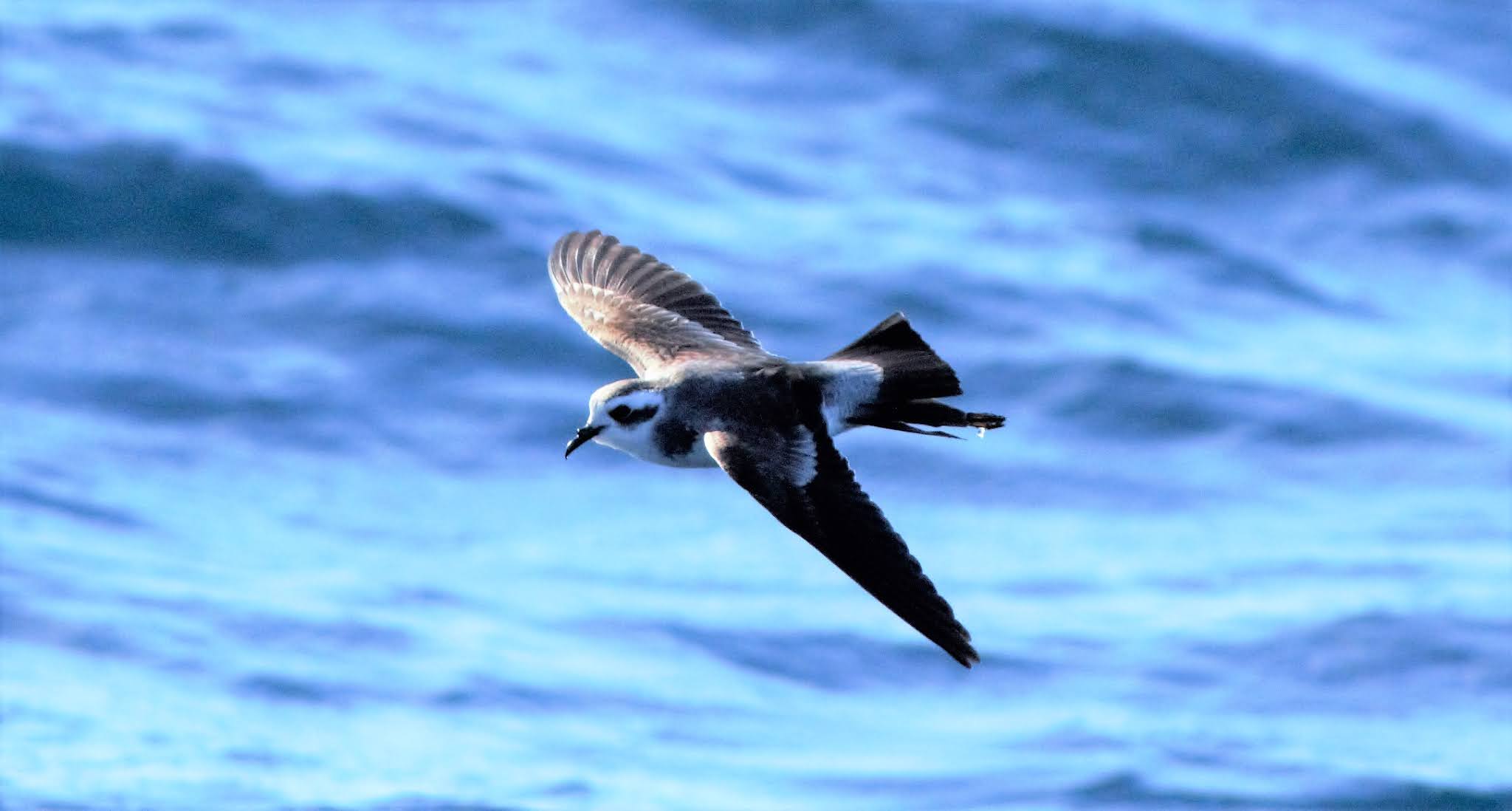
White-headed Petrel (first image and below) was spotted regularly at the shelf, with a couple of birds closer inshore on Sunday; it was a reasonably common species for the day. Providence Petrel was about in small numbers.
A single Cape Petrel (race capense) was about most of the day offshore on Saturday.
Small numbers of Fairy Prions were about off the shelf and closer in.
A single White-fronted Tern appeared over the shelf on Saturday.
Grey-backed Storm-Petrel showed well off the shelf with three birds seen on Saturday.
White-faced Storm-Petrel performed nicely on both days.
Surprisingly just a single Wilson’s Storm-Petrel appeared.
Single Yellow-nosed Albatross were seen inshore briefly on both days, not offering much of a photo opportunity.
Buller’s Albatross was in good numbers, especially on Sunday when several birds were present inshore.
A single Salvin’s Albatross on Saturday was a sight for sore eyes.
Shy Albatross was as usual the most plentiful albatross.
Black-browed Albatross was surprisingly absent on Saturday but adults and immatures were about on Sunday.
Just a single Campbell Albatross was seen over the weekend.
A single Wandering Albatross was recorded, soon after we arrived on the shelf on Saturday.
Two Antipodean Albatross were seen on Saturday and two again on Sunday, all of race gibsoni.
A single Northern Royal Albatross was spotted distantly when we arrived at the shelf on Sunday. The image below is from John Baas.
Two Southern Royal Albatross were also seen at the shelf on Sunday.
Single Brown Skuas were seen out wide on both days and a flock of three inshore on Saturday was unexpected. A couple of people saw a few Common Diving-Petrels inshore on Sunday.
Seabirds aside, the big surprise of the weekend was a Spangled Drongo – a very rare vagrant in Tasmania - appearing off the shelf on Saturday. Also on Saturday, a Blue Shark hung around the boat for quite awhile while we were on the shelf.
The troops: Peter and Margie Appleton, Scott Baker, John Baas, Janet Carew, Michael Kearns, Chris Murray, Cheryl Ponter, Greg Roberts, Nick Thompson, Jayden Walsh, Peter Vaughan, Els Wakefield. Special thanks to Karen Dick for helping me out with the organisation, to Scott Baker for scrutinising the great albatross and to Peter Vaughan for his expert local knowledge and writing up the Saturday elist; I’ve submitted the Sunday elist. All up a good variety of birds with 32 species recorded, including 10 albatross species. Below is an image of some of the Australian Fur Seals, followed by a full species list for the weekend with the total number seen for Saturday first and Sunday second.
Australasian Gannet: 16 and 7, White-headed Petrel: 4 and 14, Providence Petrel: 1 and 5, Grey-faced Petrel: 1 and 3, Great-winged Petrel: 12 and 15, White-chinned Petrel: 8 and 10, Fairy Prion: 5 and 5, Short-tailed Shearwater: 65 and 150, Sooty Shearwater: 4 and 4, Common Diving-Petrel: 0 and 3, Wilson’s Storm-Petrel: 0 and 1, Grey-backed Storm-Petrel: 3 and 0, White-faced Storm-Petrel: 5 and 2, Yellow-nosed Albatross: 1 and 1, Buller’s Albatross: 9 and 17, Shy Albatross: 32 and 30, Salvin’s Albatross: 0 and 1, Black-browed Albatross: 0 and 5, Campbell Albatross: 0 and 1, Wandering Albatross: 1 and 0, Antipodean Albatross: 2 and 2, Northern Royal Albatross: 0 and 1, Southern Royal Albatross: 0 and 2, Crested Tern: 270 and 140, White-fronted Tern: 1 and 0, Silver Gull: 160 and 130, Kelp Gull: 60 and 45, Pacific Gull: 1 and 0, Brown Skua: 4 and 2, Black-faced Cormorant: 270 and 160, White-bellied Sea-Eagle 2 and 2

Saturday, 3 April 2021

Norfolk Island: The Seabirds

Seabirds were an ever present feature during our week-long stay on Norfolk Island. The star attractions during this trip were small numbers of Black-winged Petrels (above and images below) seen from the island’s north-western cliffs (first image below). They were about during the day, especially when the wind was up, flying along exposed cliff faces and grassy hillsides; the birds nest in small numbers here.
One bird was seen to land (below) before scurrying under a rock overhang, where presumably it was tending a chick.
I saw a well-advanced chick during the day (below). It was evidently being fed by parents returning at night. Why some birds appear to attend to young during the day and others at night is unknown.
I found the headless carcasses of three Black-winged Petrels together (below) at the Captain Cook Lookout in Norfolk Island National Park. The species once bred commonly on the island but was decimated by introduced rats and cats. It is making a minor comeback of sorts, but cats especially continue to be a problem. Nankeen Kestrels, self-introduced to the island, have also been recorded decapitating Black-winged Petrels.
I noticed a big difference in seabird numbers from my last visit to the island in 2007. Masked Booby (adults and juvenile below) for instance, was breeding commonly both on the main island and on offshore islands and rock stacks. It was nesting but in much smaller numbers in 2007.
Similarly, Red-tailed Tropicbird was numerous all about the island, and nesting in several places (adults and juvenile below); I recall seeing far fewer birds in 2007.
Frigatebirds were once scarce on the island but with growing populations of other seabirds, their numbers are on the rise. I saw about 80 together at Captain Cook Lookout and scattered birds elsewhere. Most appeared to be Great Frigatebird (below) but several Lesser Frigatebirds were seen.
Other seabirds were in similar numbers on this trip and in 2007. The delightful White Tern (below) was everywhere, nesting in the magnificent Norfolk Island Pines. Although at the tail end of the breeding season, plenty of well-advanced chicks were being fed on their nests.
Many chicks are blown from the frail nests and fall to the ground, like the youngster below. Unfortunately, large numbers die as a consequence.
Black Noddy (below) is also abundant but relatively few nests in the pines with well-fledged chicks were being attended.
Brown Noddy (below) was much less common and mostly on offshore stacks. About 80 distant Grey Ternlets were also on rock stacks off the north shore. A few Wedge-tailed Shearwaters were seen offshore but their nesting season appears to be over. I had hoped to get to Phillip Island to look for White-necked Petrel and a few other seabirds but rough weather prevented a trip.

Friday, 2 April 2021

Norfolk Island: The Land Birds

We had a pleasant week-long stay on Norfolk Island, our first “overseas” escape since the Covid 19 upheaval began in March 2020. We stayed at the pleasant Saints Apartments and had a hire car to get ourselves around this beautiful island, which I had visited previously, in 2007. Some scenic images below.
A highlight was finding a Norfok Island Boobook, or Morepork (first image). This endemic subspecies of the New Zealand Morepork had been reduced to a single female when two male New Zealand birds were introduced in 1987, in the hope of salvaging the taxa. Today an estimated 30-40 owls reside on the island. I first looked for them on the road to Mt Pitt and heard 4-5, some quite close to the road. However, the road’s steep banks made conditions difficult. I eventually tracked one down in forest near the Palm Glen picnic ground (below).
As usual, the endemic specialties were easy to find. Norfolk Island Parakeet (below) was seen near the summit of Mt Pitt and around Captain Cook Lookout in Norfolk Island National Park, as well as in the Botanic Gardens. Numbers appear to be stable these days after a precipitous decline it times past.
The Slender-billed White-eye (below) was in good numbers throughout forested parts of the island, although being outnumbered generally by Australia’s self-introduced Silvereye.
The recently split Norfolk Robin (below, pair and male alone) was similarly co-operative, being particularly easy to see on and around the summit of Mt Pitt.
Another endemic, the Norfolk Gerygone (below) was abundant in forest and gardens all over the island.
A good candidate for a split is the endemic anthoprocta subspecies of the Golden Whistler (below) which sounds nothing like the species in Australia and is unusual in not having brightly plumaged males.
Similarly, the endemic pelzelni race of the Grey Fantail (above) and norfolkensis subspecies of the Sacred Kingfisher (below) were ubiquitous.
Introduced birds are a feature of the island and there are no shortages of Red Junglefowl, Feral Goose, Song Thrush, House Sparrow, European Starling and others, although the quaint California Quail (below) is suitably agreeable.

Tuesday, 9 March 2021

Emus in the Cooloola Region

In the 1960s and 1970s, Emus were seen regularly on what was then called the Noosa Plain, now known as the Cooloola section of the Great Sandy World Heritage Area. However, it has declined drastically in numbers here and elsewhere in the Sunshine Coast-Wide Bay region. For instance, it was formerly common on Bribie Island, but the last emu there was killed by a dog in 2015. The species generally in south-east Queensland and north-east NSW is now very rare. Fortunately, some birds seem to be hanging on in the Cooloola region. I heard a bird drumming on the Noosa Plain in September last year but unfortunately it would not show itself. Prior to that encounter, the last record I can find for the site was during a Birds Queensland outing in 1997.
On March 6 (last Saturday) Christine Burton photographed two Emus – an adult and a well-advanced juvenile – on the edge of a pine plantation in Toolara State Forest (first image above by Christine's Wildscapes Photography). This site is about 15km west of the Noosa Plain. Christine reports that she saw another two birds in a pine plantation, also in Toolara State Forest, in October 2019 (image above). She has also seen in recent years a family with young birds in the nearby Tuan State Forest.Thanks to Tim Howell for drawing attention to these reports. Ebird includes records without further detail for Tin Can Bay in 1989 and Toolara State Forest in 1996, with three birds reported further south at Como in 2014. It seems that a small population of Emu is resident in the Cooloola region.
The causes of the decline of the species in south-east Queensland and north-east NSW are uncertain. Emus have been killed by dogs in the region (including "Eric", the last surviving Emu on Bribie Island, above) but they are well able to survive predation by dingoes and wild dogs further west. Habitat fragmentation could be in play but extensive areas of native habitat remain in the Great Sandy World Heritage Area and on Bribie Island; the birds also seem to be quite at home in pine plantations. There is no evidence that hunting and/or roadkill are important factors in the decline. So this population crash is a mystery yet to be unravelled. Image below of Cooloola's Noosa Plain.