Sunshine Coast Birds

Birding and other wildlife experiences from the Sunshine Coast and elsewhere in Australia - and from overseas - with scribblings about travel, environmental issues, kayaking, hiking and camping.

Wednesday, 6 January 2021

Winding up 2020 Sunshine Coast Big Year with Black Bittern & Pectoral Sandpiper

The Covid-19 pandemic extinguished 2020 travel plans for Africa and Europe. We had local birding for entertainment, however, as well as an excellent winter trip to Cape York and the Atherton Tableland. I set myself the goal of beating my 2018 total of 310 bird species photographed in a calendar year in the greater Sunshine Coast region. This is an annual competition run by BirdLife Australia Sunshine Coast. Photographs in Spring reported previously included Red-backed Buttonquail, Lewin’s Rail and Barn Swallow, while Eastern Ground Parrots showed brilliantly at Cooloola. As November was drawing to a close, I was short of catching my 2018 total of 310. A Short-tailed Shearwater on a Mooloolaba pelagic trip was a belated addition, though nothing else was added out wide and a hoped for December trip was cancelled due to bad weather.
Photographing a Masked Owl in Bellthorpe National Park was a welcome break as I’d heard them several times during the year without even a glimpse.
Nutmeg Mannikin was another I’d searched far and wide for before finally nailing a few in long grass near Bli Bli, while I managed poor but identifiable images of King Quail at Finland Road.
I had better luck photographing a female Red-backed Buttonquail at Finland Road in flight – extraordinary to capture a bird I’d never photographed before, twice within a few weeks.
A trip to Double Island Point was adventurous because I got bogged (and rescued) twice in the soft beach sand, but I did manage to snap a fine Lesser Frigatebird soaring over the light house - Number 310 for the year, equalling 2018. (This species I saw but failed to photograph on a pelagic earlier in the year.)
I did a trip out to Kilcoy, and was pleased to find a Black Falcon at the town abattoir, though I’d photographed one earlier in the year (a species I missed in 2018). A fine pair of Wedge-tailed Eagles put in an appearance nearby.
So the hunt was on in the final days of 2020 to exceed the 2018 total. Success came in the form of two rarities on the same morning. I photographed an adult male Black Bittern along Cranks Creek in Tewantin. I’d seen the species there several times in the past but never managed an image, and I’d looked without success from my kayak at Tin Can Bay, where I photographed one in 2018.
Later that morning I found a Pectoral Sandpiper at Yandina Creek Wetland. This is always an excellent shorebird to encounter and just the third record for our region, so it was a fitting end to the 2020 Big Year, with a total of 312 species. The bird in the following images is in the company of Red-kneed Dotterels and Sharp-tailed Sandpipers. (In 2020 I also photographed Brush Bronzewing at Cooloola, Bridled Tern on a pelagic trip and Red-chested Buttonquail near Nanango - but the images didn’t pass muster.) I regard these indulgences as a personal challenge – the setting of fun goals to achieve – rather than a competition. I won’t be partaking this year and would be very happy for this tally to be overtaken.

Tuesday, 5 January 2021

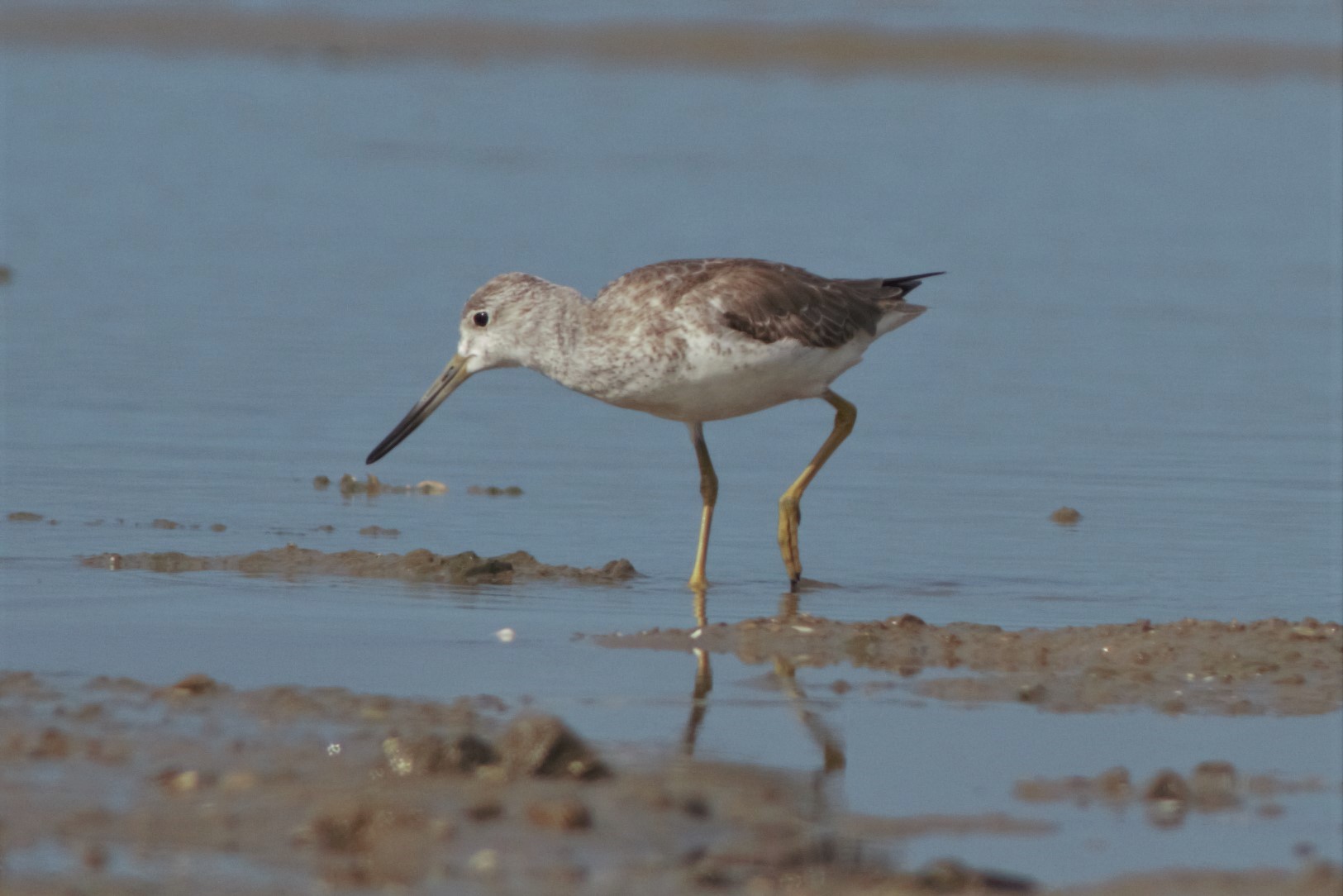
Twitching Nordmann's Greenshank in Cairns

The avian New Year started with a bang when Cairns birder Adrian Walsh photographed a Nordmann’s (Spotted) Greenshank on the Cairns Esplanade. This is a rarity worldwide with as few as 1000 birds surviving. It had previously been known in Australia from a handful of sightings in northern Western Australia. The last two sightings from that part of the world were made at Roebuck Bay by Adrian Boyle in late November-early December last year: the Cairns bird is the first record for eastern Australia and incredibly, the third for the nation in five weeks. Since I’d missed the species at known sites in China, Vietnam and Malaysia, I was particularly keen to see it.
It turned out the greenshank had been present since at least December 26, 2020, when local birders photographed it but assumed they had a Terek Sandpiper. The bird was photographed in the morning of January 1 by Adrian Walsh, who realised he was on to something. It was foraging on exposed mud and sand flats at mid-tide towards the southern end of the esplanade, not far from the Cairns CBD, and associating loosely with a single Common Greenshank. At the right time of the tide cycle in the late afternoon, a large number of local birders saw the bird in the same spot, although it was more distant.
The Nordmann’s was present again in the morning of January 2 so I hopped on a plane that would get me to Cairns in time for the hoped-for afternoon show. I wasn’t to be disappointed. The bird showed brilliantly in the late afternoon sun, and closer than it had been during the earlier encounters. The greenshank was feeding actively for the 50 minutes or so I was watching, with brief spells to preen. It seemed most interested in catching crabs and was often running, its body relatively elongated and close to the ground, indeed recalling a Terek Sandpiper.
Although observers reported earlier that it was in the company of the Common Greenshank, I saw the Nordmann’s join that bird just briefly after flying and landing close to it. The Nordmann’s appeared to be quite relaxed about the large number of observers. It fed over about 200 metres of shoreline while I watched, tending to stick to the same stretch of sand and mud instead of foraging further afield. As the tide receded it became more distant, preferring to feed near the waterline.
The bird was smaller than I expected, being not much bigger than Grey-tailed Tattlers feeding nearby. See size comparisons with that species (above) and with Great Knot and Curlew-Sandpiper (below).
Other shorebirds present were Bar-tailed Godwit, Black-tailed Godwit (the two godwit species below) , Sharp-tailed Sandpiper, Red-necked Stint, Terek Sandpiper, Whimbrel and Eastern Curlew. I was told this morning by Adrian Walsh that the bird is again at the usual spot today, notwithstanding heavy rainfall in the region associated with a tropical low.

Thursday, 26 November 2020

Ground Parrots Galore

The Eastern Ground Parrot is generally a difficult bird to see well, and even more difficult to photograph. Most of us have had to make do with ordinary flight images as a flushed parrot flies swiftly over the heath before disappearing. At the end of the breeding season – about now – the parrots are more readily seen along roads as they appear to feed on seeding grasses along their edges. But still they are hard to nail down.
Not so this year. Multiple observers have obtained top-rate images of very close birds along the renowned pump station track at Cooloola, arguably the best site on mainland Australia to see the species. I began my sojourn just after sunrise at 5am on 25 November. Conditions were cloudy and cool. As is my custom, I walked about 1.5km of the pump station track from the forest edge and a shorter distance along King Bore Road. I flushed a total of three ground parrots and a King Quail, but all were the usual brief flight views.
After doing the walk in both directions, I decided to try it again. This time was very different, although I was simply retracing my steps. I had excellent views of four different parrots within 400 metres of each other perched and on the ground; three of them allowed extraordinary close approach, as these images show. All four were juveniles. They spent a good deal of time walking or running on the ground, often reaching up to feed on seed. They also frequently clambered through and across the heath, stopping and feeding on various seeding plants. Occasionally a bird would utter a short grating call. They clearly were well-camouflaged but these particular individuals were not hard to find, the second time around at least. The key is to walk slowly along the road, carefully checking the verges where they meet the vegetation. I watched these birds for more than an hour.
In close to 50 years of watching ground parrots, I’ve seen them very occasionally and briefly perched on bushes. I’ve not had an encounter approaching this one.

Sunday, 22 November 2020

Eastern Ground Parrot found dead at Noosa

A dead Eastern Ground Parrot (above) has been found at Noosaville on the Sunshine Coast. The bird is one of just a handful of this threatened species that survives in Queensland outside of the Cooloola section of the Great Sandy World Heritage Area. The juvenile parrot, probably recently fledged, was found dead in the garden of Colin Eden in Cooyar Street. Colin says it’s not possible to say how the Eastern Ground Parrot died. It may have been killed by a cat or hit a window while flying. Where the bird died is adjacent to an area of wallum heath - known to be frequented in the past by the species - between Ernie Creek Road and the Noosa Junction shopping centre, though recent surveys have failed to find them there. A small number of Eastern Ground Parrots – probably fewer than 20 – were thought to survive in the area of wallum heath in Noosa National Park and Mt Coolum National Park that extends from Noosa in the north to Marcoola in the south.
An additional ground parrot population of about 15 birds was hanging on in a patch of heath protected by the fence around Sunshine Coast Airport. However, that population is endangered by construction underway for the new airport runway; we don’t know if it survives today. Single birds from this population were hit by vehicles nearby in 2013 and again in 2015. Ground parrots also appear to have gone from known sites including near Mt Emu and Mt Coolum. The savage fires late last year around the Sunshine Coast presumably also had a serious impact on ground parrot populations in their wallum heath habitat (below).
Several sites could be surveyed for Eastern Ground Parrot by interested birders on the Sunshine Coast listening for their distinctive calls at dusk. There is a track crossing the heath behind the police station in Langura Street, Noosaville; this is the area where the dead bird was found recently. Heath behind Sunshine Beach State High School can be accessed from Girraween Court and Grasstree Court; I’ve heard them here several times. I’ve heard them in a couple of spots behind Marcus Beach; check Google Maps for access points to the heath. I’ve also heard them from Woodland Drive, Peregian Beach, and from outside the Sunshine Coast Airport boundary. The most likely causes for the regional decline in numbers are predation by foxes and cats, and habitat rendered unsuitable by fire or, ironically, absence of fire. Heath has been allowed in some places to grow unchecked and unburned for many years, where it is too tall and thick now for the species. It's also likely that the species needs much larger areas of heath, like Cooloola, to survive.

Sunday, 8 November 2020

Sunshine Coast Spring Sightings: Red-backed Buttonquail, Barn Swallow, Large-tailed Nightjar, Nesting Square-tailed Kite

The latest flurry of excellent sightings from the Sunshine Coast-Cooloola region in recent weeks includes Red-backed Buttonquail, Barn Swallow, Large-tailed Nightjar, Southern Emuwren, Lewin’s Rail and nesting Square-tailed Kite. The Red-backed Buttonquail was first spotted by Michael Dawson at the beginning of a walking trail from Landsborough to Ewen Maddock Dam. At the time of writing, it is still being seen along about 100m of trail, without seemingly moving from this small patch.
I’ve seen this species several times around the Sunshine Coast but always in tall, wet coastal grassland. The habitat at Landsborough is a narrow strip of blady grass adjoining the trail in coastal eucalypt woodland; habitat I would not have considered ideal. The remarkable thing about this bird it that it regularly leaves the blady grass to feed on the path and its edges at all the times of the day, allowing extraordinary viewing and photographic opportunities for such a normally cryptic species. Its platelets along both sides of the track are everywhere; image of a platelet with car keys below.
The Barn Swallow was found at Rainbow Beach by Gus Daley and again, at the time of writing, the bird is still present. It perches on overhead wires in the heart of the township, roosting with Welcome Swallows and Tree Martins. The swallow’s presence is far from predictable, however. I failed on my first attempt, and it took 3.5 hours to see it the second time around. The bird appears to be actively feeding early in the morning. It comes to roost mid-to-late morning, and may stay half an hour or a couple of minutes before flying off again. Barn Swallow is very rare in south-east Queensland; this record is evidently the fourth for the region.
From Rainbow Beach I returned home via Double Island Point, photographing a Brown Noddy there, and Teewah Beach.
Barn Swallow twitches aside, I’ve spent time in the Cooloola-Tin Can Bay area. I photographed a male Southern Emuwren at Cooloola at the same spot I photographed it in 2018. While I and others often saw the species in the area in the 1970s, records have been few and far between since then, until the last few years. It is now encountered regularly but can be difficult to track down. I saw a total of 8 Eastern Ground Parrots during two visits but no sign of Brush Bronzewing.
I took the kayak up Snapper Creek in Tin Can Bay. I heard a Black Bittern but failed to see it. I did see a nice pair of Shining Flycatchers.
Large-tailed Nightjar occurs at the southern end of its extensive range on the Sunshine Coast, where it occurs at two sites: Yandina Creek Wetland and the nearby Maroochy Wetlands Sanctuary. I had tried three times to photograph calling birds before eventually snaring a rear-end photograph at the latter site just before dawn.
A pair of Square-tailed Kites is nesting in Tewantin National Park in Tinbeerwah. The species has nested in the area several times in recent years and is known to loyally stick to nesting territories, while changing nests regularly. An adult and a juvenile in advanced plumage were around the nest during my visit. Other observers have reported an active nest in Koala Park, Nambour.
I’d heard Lewin’s Rail several times this year but managed photographs just recently after the first heavy rains of the season. A bird at Peregian Beach showed very nicely indeed.
Other good birds in the area included White-winged Triller at Parklakes. The count continues for the 2020 BirdLife Australia Sunshine Coast photographic competition. My tally stands at 305 species photographed with images of three others – Bridled Tern, Red-chested Buttonquail and King Quail – not making the grade.
Amongst the flurry of feathers has been a house move from our home of 11.5 years at Ninderry to another home in the hills on the western fringe of Nambour, overlooking the town and surrounding valleys. A white phase Grey Goshawk flew overhead on our last day at Ninderry.
It’s good to see old friends again at the new diggings, with White-headed Pigeons quickly taking their place at the relocated feeder.

Wednesday, 14 October 2020

Spotted-tailed Quoll - first confirmed Sunshine Coast record for 70 years

A Spotted-tailed Quoll has been photographed on Queensland’s Sunshine Coast – the first confirmed record of this endangered species in the region for more than 70 years. The image above is of the quoll, captured by a Sunshine Coast Council survey camera on private property in June this year near Coolum. The extraordinary finding is only now being revealed publicly. The Spotted-tailed Quoll was once considered reasonably common about the Sunshine Coast, especially in the hinterland around the Conondale and Blackall ranges. Its small cousin, the Northern Quoll, also occurred in the region. The rapid decline in quoll populations last century in Queensland coincided with the advance of the introduced cane toad; its toxins are deadly to many native predators. Poison in baits for wild dogs is likely to have also reduced quoll numbers. The quoll photographed recently is believed to have been in dry rainforest thickets near the coast in the Coolum-Yaroomba area, where seemingly little suitable habitat for the species remains. Council officers set up cameras in the area as part of the council’s Coastal Fox Control Program, which operates from Maroochy River north to Peregian Beach. The council said through a spokesperson that the program is one of a number of schemes funded by its Environment Levy to protect native wildlife and habitat. The record was reported to the Queensland Government’s Department of Environment and Science. The image below is of a quoll photographed by me last year in New England National Park, NSW.
The University of the Sunshine Coast’s Scott Burnett says there have been no Spotted-tail Quoll records confirmed by specimen or photograph in the Sunshine Coast region since the first half of the 1900s. However, he is aware of several sightings, regarded as reliable, in recent decades from the Bellthorpe, Black Mountain-Cooroy and Widgee areas. Scott Burnett adds: “Potentially the species was quite common and widespread. They used to bother poultry across the Blackall Range and around the Glasshouse Mountains, and no doubt throughout much of the forested Sunshine Coast region.” Regarding the Coolum quoll, observers are surprised that a finding of such significance was not reported earlier by either the Sunshine Coast Council or the Queensland Government. An earlier report may have enabled analysis of such matters as spatial ecology, genetics and breeding status, according to Scott Burnett.
The present advance of the cane toad westward is continuing to wreak havoc in populations of the Northern Quoll (above)in the Northern Territory and northern Western Australia. However, in relatively recent times, the species has become more common and widespread in north Queensland, where it was plentiful before the toad invasion. While still generally scarce, the patchy comeback of Northern Quoll in some areas suggests that predators may be able to adapt to the introduced pests, possibly by learning to avoid eating them.
Plenty of suitable habitat for Spotted-tailed Quoll remains in the Sunshine Coast region, protected in extensive national parks and other reserves in the hinterland (like Conondale National Park, above). The Queensland Government is funding efforts to find quolls through Wildlife Queensland’s Quoll Seekers Network, which is using trained dogs in efforts to confirm reported quoll sightings in the Mary River Valley. The network’s Sunshine Coast co-orindator, Amanda Hancock, describes some claimed sightings from members of the public as “anecdotal but very exciting”.
UPDATE 30/6/2021 The site where the Spotted-tailed Quoll was photographed on the Sunshine Coast 12 months ago can now be revealed. It was found In Yaroomba Park, a tiny area of native habitat wedged between Clive Palmer's Coolum Resort to the south and the bustling tourism centre of Coolum to the north. Thanks to Fiona Henshaw for pointing this record out on the Queensland Wildlife Database. Locals have told Fiona that council monitoring at the site since the animal was caught on camera has not turned up further evidence of its presence in the park. This park is surrounded by housing but not too far removed from extensive areas of native habitat including Mt Coolum National Park, Coolum Creek Conservation Park and Yandina Creek Wetland. See comments below for another relatively recent report from the region - this one an animal shot in a chicken pen in 2007 along Old Cylon Road nears its junction with Forestry Road, West Cooroy, in 2007; this area is well-known to local birders.