Sunshine Coast Birds

Birding and other wildlife experiences from the Sunshine Coast and elsewhere in Australia - and from overseas - with scribblings about travel, environmental issues, kayaking, hiking and camping.

Monday, 13 July 2020

Sunshine Coast Winter Observations: White-browed Crake, Superb Fruit-Dove, Red-chested Buttonquail, Black-bellied Storm-Petrel

Superb Fruit-Dove

A flurry of decent observations in the Sunshine Coast region, most notably a way-out-of-range Torresian Imperial Pigeon, continued in the form of another pigeon. A female Superb Fruit-Dove was found by Esther Horton-Van Der Woude last month at Gardeners Falls, a popular tourist spot near Maleny. While one or two Superb Fruit-Doves turn up annually, the behaviour of this bird was highly unusual. It was feeding in a privet at eye level and hung around for several days in the same spot, allowing most locals to get onto the bird.

Superb Fruit-Dove
Then Tony Baker found a White-browed Crake at Buckleys Hole, Bribie Island. When I arrived a few hours later, I saw the bird briefly before it disappeared. It emerged again and showed well but distantly on the far shore opposite the hide for about 20 minutes. This is the first record of this tropical species for our region and just the second for south-east Queensland.

White-browed Crake

White-browed Crake
I headed out to the South Burnett for a couple days, exploring the newly expanded western sector of the Zone of Happiness. I found Bullcamp Road east of Nanango, and various roads and tracks that run off it, to be particularly productive. The highlight was a covey of Red-chested Buttonquail flushed from well-grassed woodland. Other good birds in the area included a flock of 100+ Plum-headed Finch, Black-chinned Honeyeater, Brown-headed Honeyeater, Brown Treecreeper, Apostlebird and White-winged Chough.

Black-chinned Honeyeater

Plum-headed Finch

Red-chested Buttonquail

White-winged Chough
I also explored the Burnett Highway between Nanango and Goomeri and several roads to its east, notably Kilcoy-Murgon Road and Kinbombi Road, double-tracking the highway to do this. More good birds followed including Red-winged Parrot, Cockatiel, Spiny-cheeked Honeyeater, Striped Honeyeater and Buff-rumped Thornbill.

Red-winged Parrot

Spiny-cheeked Honeyeater
A pelagic trip off Mooloolaba yesterday was worthwhile with a Black-bellied Storm-Petrel being the stand-out. Good numbers of Providence Petrel and Wilson's Storm-Petrel were also seen.

Black-bellied Storm-Petrel

Providence Petrel


Friday, 3 July 2020

Imbil State Forest rainforest plan update – the Government response

Charlie Moreland Park, Imbil State Forest

The Queensland Government has left open the possibility of embracing a plan to stop the logging of hoop pine plantations in the 21,000-hectare Imbil State Forest in the Sunshine Coast hinterland. Under the proposal subtropical lowland rainforest, a critically endangered habitat, would be allowed to regrow in plantations presently being harvested for softwood timber.

The area where plantations occur was formerly rainforest and hoop pine is a native rainforest tree. The plan would lead eventually to an extensive area of hoop pine plantation being replaced by subtropical lowland rainforest. I submitted the proposal to the government last August.

Imbil State Forest falls under the control of two Queensland Government departments. The Department of Agriculture oversees logging licences held by HQPlantations over 14,600 hectares – mostly hoop pine plantation - of the state forest. The remaining 5,900 hectares of state forest is native forest managed for a range of purposes by the Department of Environment and Science.

In a letter to me, Queensland Agriculture Minister Mark Furner makes it clear he opposes the plan. Furner argues that the loss of Imbil State Forest to the timber industry would deprive HQPlantations of about a third of its hoop pine plantations in Queensland. The minister says that would amount to the loss of 200 jobs in production and processing, and about $40 million annually in direct value to the Queensland economy. As well, HQPlantations would be entitled to seek “substantial” compensation from the government for the loss of plantations.

In my reply to Furner, I point out that the Imbil plantations constitute a very small proportion of the 330,000 hectares of pine plantation (most of which is not hoop pine) under licence to HQPlantations. This is not a high price to pay for the restoration of a critically endangered habitat, especially given the area's potential economic value as an ecotourism destination. Charlie Moreland Park, in the south of the state forest, is already the most popular camping ground in the Sunshine Coast hinterland.

Mature hoop pine plantation adjoins subtropical rainforest, Imbil State Forest
Imbil State Forest contains some of the largest surviving remnant patches of subtropical lowland rainforest, which was once widespread in south-east Queensland and north-east NSW. Hoop pine plantations in the state forest are interspersed with remnant rainforest patches, a source of seeding for regenerating rainforest in plantations. Queensland's Liberal National Party opposition was quick to condemn the proposal, without even having read it. However, the plan is backed by ecologists, botanists and zoologists.

The Queensland Government recently oversaw a state forest conservation plan that is not dissimilar to the Imbil proposal. Logging was stopped in the Yuroi and Ringtail state forests near Noosa and 2,400 hectares were acquired as a reserve. HQPlantations was compensated with a $3.5 million payment provided mostly by the Noosa Shire Council and the Noosa Parks Association.

The Queensland Environment Minister, Leeanne Enoch, strikes a more conciliatory note than Furner, her ministerial colleague, about the Imbil plan. Enoch's office tells me the project has been assessed but the department would be pursuing “higher priority” projects. However, the department will maintain a record of the proposal in its Acquisition Enquiries Register. Should future budgetary or policy priorities change, the minister says, it may be considered against other state conservation proposals. A glimmer of hope.

Native forest and recently planted hoop pine near Charlie Moreland Park
I pointed out in letters to Furner and Enoch that nobody is suggesting an immediate shutdown of logging across all of Imbil State Forest. As a starting point, a small area of plantation could be allowed to regenerate while it was monitored. An ideal site for such a trial would be an estimated 250 hectares of plantation south of Sunday Creek Road between Charlie Moreland Park and Conondale National Park – two existing rainforest reserves.

The hillside slopes of Conondale National Park that abut the plantations in this area include one of the most extensive tracts of subtropical lowland rainforest remaining in Queensland. The remnant rainforest around Charlie Moreland Park is renowned as habitat for many rare and elusive wildlife species. These areas could be joined by a trial area of regenerating rainforest. The boundaries in the following maps for a proposed trial area are approximate.


Proposed trial area
There are already in Imbil State Forest, including around Charlie Moreland Park, and in Conondale National Park, several small stands of hoop pine plantation that have not been logged for several decades; they closely resemble rainforest and harbour many rainforest plants and animals. This plan can work if governments are prepared to think outside the box.

Subtropical lowland rainforest, Imbil State Forest


Thursday, 25 June 2020

In Memory of Judith Wright


On this day 20 years ago – June 25, 2000 – Judith Wright died. She was one of Australia's great writers, poets and activists who made a huge and profound contribution to literature and environmental campaigns over many years. She was a friend and mentor to me: I'm marking the occasion of her passing by sharing some notes about our connection.

As a 14-year-old, in 1969, I read Rachel Carson's Silent Spring about the disastrous consequences of pesticides for the environment. It changed my life; I was distraught and in despair. I began to furiously write letters to newspapers and politicians about saving everything from whales to wedge-tailed eagles.

I wrote also to Judith Wright. At the time she was living in a cottage in the Gold Coast hinterland in Long Road, on Mt Tamborine, which was surrounded by subtropical rainforest. Her husband of four years, the philosopher Jack McKinney, had died there three years previously.

Judith Wright at Half Moon in 1984
Judith responded with a long, hand-written letter explaining how happy she was that young people like me were so enthusiastic about protecting the natural world. I was in awe; if her intention was to inflame the activist fire in my belly, it worked. She introduced me to a couple of like-minded rebellious youngsters. We formed the Queensland Conservation Movement, which was to take up the cudgel for various issues in the years ahead, holding weekly meetings at the University of Queensland and later changing its name to the Wildlife Research Group (Queensland). The WRG played an important role in the 1970s campaigning to protect places like the Conondale Range and Cooloola.
We continued to correspond and it's to my great regret that I've misplaced those early letters from Judith, written in her trademark tiny scrawl. I was camped on Mt Tamborine in December 1970 when she invited me to her home for the day. She showed me my first Regent Bowerbird in the garden – a male I described in my notes as “strikingly beautiful”; I regard it still as one of the world's finest birds.
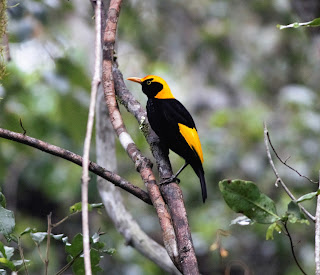
Regent Bowerbird
Judith “told me something of the mountain's birdlife” and introduced me to a birder friend who lived nearby, Hilda Curtis, who showed us a Satin Bowerbird bower. This was another first for me, a newcomer to birding: I enthusiastically recorded how the bower included “2 blue biros, 2 empty biro cases, 1 blue clothes peg, 1 piece of blue wire, 1 toy blue wheel, 1 blue bottle cap”.  My friend Glen Ingram and I were to house-sit the cottage for her in later years.

Judith Wright had a distinctive, clipped voice and dispensed advice forcefully and frankly; she did not suffer fools. In 1972, in my final year of school, I was organising protests against the supersonic Concorde jet, among other things. Judith bailed me up in the Brisbane head office of the Wildlife Preservation Society of Queensland – a venerable organisation of which she was president and co-founder. She told me that noisy demonstrations I was leading on city footpaths were not helping the cause and that I should “pull my head in a bit”, as I noted in a diary at the time.

I left Queensland to move interstate in 1977 due to a combination of relationship commitments and deep disillusionment with the National Party regime of Joh Bejlke-Petersen. When I returned to my home state in 1982, Judith – who had also moved interstate – wrote to me: “Brave of you to go back to Queensland. I am glad it is not my home state; but when the National Party gets to rule Australia I hope New Zealand will accept me for my last years!”

I visited her in 1984 as a journalist with The Sydney Morning Herald for lunch and an interview at her rural property Half Moon, outside Braidwood in southern NSW. I noted in my story that its “bushland ambience is scarcely disturbed by a combination of steeple-shaped roofs, glass-panelled walls and a garden which will never harbour a non-native plant while Judith Wright is alive”.

Part of my 1984 Sydney Morning Herald article
She was born in Armidale and had as much affection for the high altitude granite woodlands of the NSW highlands as for the Queensland rainforests. She moved to Braidwood to be near her lover of 25 years, the great HC “Nugget” Coombs, who lived nearby in Canberra. Coombs died in a nursing home in 1998, suffering dementia.

Judith told me during my visit to Half Moon that the “last place I want to end up” was a nursing home. She was 69 at the time and managing a 41-hectare property – which she was to bequeath to the Australian people through the Australian National University - was challenging. Her hearing was always poor and by then it was difficult to communicate with her. While always amiable and generous, Judith had a slightly patrician disposition: she berated me for bringing a bottle of champagne instead of wine for lunch!

Her first book of poetry, The Moving Image, was published in 1946 while she was working at the University of Queensland as a research officer. More followed including Woman to Man, The Gateway and The Two Fires. She wrote a fine collection of poems about birds, called Birds, while living on Mt Tamborine; I cherish a signed copy of the book that she gave me.

Inscription - Birds by Judith Wright
Her classic tome, The Coral Battleground, was a key milestone in the long-running campaign to protect the Great Barrier Reef. The many contributions of this prodigious woman are reflected in numerous gongs including the Chistopher Brennan Award and the Queen's Gold Medal for Poetry. A federal electorate in Queensland is named in her honour and the Judith Wright Centre of Contemporary Arts in Brisbane stands in her memory.

I can fairly assume what Judith would be thinking now amid the tumult of bushfires, climate change and pandemics. She said this to me in 1985: “Clearly, we are programming ourselves for destruction. I doubt the capacity of the human race to survive and I'm afraid I don't like our chances. Murphy's Law will get us in the end if nothing else does. Einstein once said that the human race was too far ahead of itself. That's still the case.”


Monday, 15 June 2020

Torresian Imperial-Pigeon, Barking & Sooty Owl as the Sunshine Coast avian roadshow rolls on


Torresian Imperial-Pigeon
It's been something of a grim year with Covid-19 but birds are helping to keep us sane. Before the pandemic hit in March, good birds seen locally included Australian Little Bittern, Asian Gull-billed Tern and Kentish Plover. Everyone was in shutdown for several weeks after that, but short visits in the region allowed the birding clock to keep ticking. BirdLife Australia Sunshine Coast's annual birding competition continued apace. A visit to Imbil State Forest failed to produce the hoped for Masked Owl but another Powerful Owl, the second for the year in the region, was a pleasant surprise. Black-striped Wallaby was also good to see here.

Black-striped Wallaby

Powerful Owl
A second visit to Imbil State Forest produced the second Sooty Owl for the year in dry lowland rainforest - unusual habitat for this species, which prefers wet forests at higher altitudes.

Sooty Owl
A pair of Barking Owls obligingly put in an appearance at a daytime roost in the Crystal Waters village near Kenilworth (thanks Ian Starling). The birds were around for several days before disappearing.

Barking Owl
Marycairncross Reserve had close up Russet-tailed Thrush which, although quite common, can be one of the tougher birds to photograph. The grasslands of Finland Road and Burtons Road had multiple sightings of Swamp Harrier and Spotted Harrier.
Russet-tailed Thrush
Swamp Harrier
The newly open-to-the-public Yandina Creek Wetland continued to perform with Black-necked Stork  reliably seen there and other birds recorded including Lewin's Rail and Spotless Crake. I was happy with this Forest Kingfisher.

Forest Kingfisher
A trip out to Miva and Scotchy Pocket north of Gympie was as productive as ever, with good birds including Black-chinned Honeyeater, Rufous Songlark, White-winged Chough and Red-tailed Black Cockatoo. A platypus was seen at Widgee.

White-winged Chough

Black-chinned Honeyeater

Platypus
We enjoyed a three-day campout at Peach Trees near Jimna - the first camping trip in three months due to Covid-19 restrictions. The area around the camping ground had Painted Buttonquail and Rose Robin showing well. A profusion of fruiting regrowth plants following intense fires in the area late last year meant that species such as Olive-backed Oriole and Australasian Figbird were in unusually large numbers along with no fewer than 7 Regent Bowerbirds, normally a rare species here.

Painted Buttonquail

Regent Bowerbird
Up the range in the dry woodland of Yabba Road, the usual suspects were in attendance including Brown Treecreeper, Fuscous Honeyeater and loads of Little Lorikeets.

Little Lorikeet
Fuscous Honeyeater
Now the latest star of the show has made an appearance in the form of a Torresian Imperial-Pigeon. The bird was first seen by Patrick Colley on June 7 perched on wires outside a house in David Low Way, Pacific Paradise. It was feeding in a nearby fruiting umbrella tree with Australasian Figbirds. It disappeared for a while before being refound by Lori Australis on June 11 in the same spot. The pigeon was last seen flying off to the east, towards Twin Waters. On July 14, Carolyn Scott found it on the corner of Ocean Drive and Wattlebird Drive, Twin Waters, feeding on fruiting Livistona palm trees. It flew off and Jane Cooksley found it nearby perched in an Allocasuarina tree in the garden of 12 Barcoola Place, which lines a canal. Thanks muchly to Carolyn for calling me: it sat in the tree for the 20 minutes it took me to get there before being chased away by a Noisy Miner. The bird was seen again today (June 15) in the same spot. This was photographed species Number 285 for me locally for the year.

Torresian Imperial-Pigeon
Patricia Kilroy, who lives across the road from 12 Barcoola Place, reports that the bird has been present in the area for "several months at least, I think about a year". She sees it on average once a week, either perched high in a tree or feeding on the many fruiting palms in the area. She said locals initially thought that an owl had moved into the area because they heard the pigeon's loud owl-like call regularly. It comes in to drink at her bird bath on occasions. Pat got back to me later after talking to neighbours to let me know the bird had been around for "a good number of years".

Livistona palms in Twin Waters
Torresian Imperial-Pigeon is a summer visitor to north Queensland, usually occurring regularly no further south than Mackay. This bird has a coloured head, indicating breeding plumage. There are a couple of other Sunshine Coast records and it is occasionally found as far south as NSW.

Torresian Imperial-Pigeon


Friday, 1 May 2020

Yandina Creek Wetland Open to the Public

BirdLife Australia's Ken Cross and Greg Roberts on the new bridge

The Yandina Creek Wetland is finally open to the public, eight years after efforts began to protect one of the Sunshine Coast's biodiversity hotspots. Unitywater, which acquired the site as part of its nutrient offsets program in 2016, has built an 850-metre elevated bitumen walking track that leads to a bird hide from a new carpark at the end of River Road.

Visitors are able to look out over an open area of wetland that is favoured by a resident pair of Black-necked Storks. Some interesting and scarce birds have been recorded in this part of the wetland including Australian Little Bittern, Black Bittern, Lewin's Rail and Australasian Shoveler. Great Egret, White-faced Heron and many other more common waterbirds are numerous. Several pairs of Black Swan nest in this area. To date, 168 species of birds have been recorded from the wetland.

Black-necked Stork pair seen from the hide 
En route, visitors on the wheelchair-friendly track pass through areas of Allocasuarina and Melaleuca woodland and mangroves adjoining Yandina Creek. Signs at the hide illustrate various bird species, while signs along the path highlight vegetation, tidal influence and other environmental factors. Just a small proportion of the 200-hectare site is accessed from the new facilities, with the remainder off-limits to visitors as Unitywater continues to undertake research and other activities. Those areas that remain off-limits include the main feeding and roosting sites used by migratory and resident shorebirds.

The announcement of the opening today allows the public to take advantage of newly relaxed Covid-19 restrictions that begin this weekend.

New wetland bird hide
The wetland is part of the Blue Heart Sunshine Coast project, a partnership between Unitywater, Sunshine Coast Council and the Queensland Department of Environment and Science to protect and manage more than 5000 hectares of natural floodplain in the Maroochy River Catchment.


Yandina Creek Wetland
Unitywater executive manager of Sustainable Infrastructure Solutions, Amanda Creevey, said plants in the Yandina Creek Wetland took up nutrients and sediments from the water to improve water quality and overall river health, adding: “An added bonus of the wetland is the boost in biodiversity we’re seeing, including increased marine life, mangroves and wetland plants, and birds, with some migratory birds even returning to the site.”


Sign in carpark
Ms Creevey said: “The addition of the trail walk and bird viewing hide means we get to bring the community along for the ride, take a walk with nature and maybe spot some of the incredible creatures here. With COVID-19 restrictions easing we’re proud to provide this environmental facility to our community. We see it as the beginning of an environmental hub in this area.”


The Sunshine Coast mayor, Mark Jamieson, said: “Through the Blue Heart we’re continuing to demonstrate our commitment to sustainability and enhancing our natural assets. Importantly, the Blue Heart is another tangible demonstration of how our Council is working with its partners to strengthen our region’s climate resilience and taking real action to assist our communities to adapt to a changing climate.”


Black Swans seen from the hide
The site was natural wetland before it was drained in the 1920s for sugarcane plantations. It was sold to developers in the mid-2000s after the closure of the Nambour sugar mill. Farm floodgates which controlled the flow of tidal water from Yandina Creek to the site fell into disrepair, allowing the wetland to be created by tidal inflows. The area effectively reverted to its natural state.


I began efforts to protect wetland in the area in 2012 when I proposed to the Sunshine Coast Council that it acquire a 12-hectare property at the end of River Road, near where the new car park has been built. I was struck by the variety of birds in the area including the endangered Australian Painted-Snipe.

In 2014, I put to the council a much larger proposal for the acquisition of three properties covering 212 hectares. Both proposals were rejected. At the same time, I began a campaign to lobby the Queensland and federal government to intervene to deter the landholders from proceeding with their initial plan to convert the site to cattle pasture, and later efforts to re-establish sugarcane plantations.


Great Egret seen from the hide
However, the wetland was drained in 2015 when the landholders rebuilt the floodgates. The view of governments at all three levels was that because the wetland was essentially man-made, it was not worth protecting. However, following spirited efforts by BirdLife Australia and others, and intervention by Unitywater chief Jim Soorley, the site was acquired by Unitywater a year later.

The floodgates were reopened and some were destroyed to make way for a bridge over the canal along the new walking track. A full account of the Yandina Creek Wetland campaign can be found here.

Visitors are warned: mosquitoes can be in considerable numbers at this site, be prepared. Unitywater's efforts to protect this important site are to be applauded. It's a big win for the birds!


White-faced Herons seen from the hide