|
| Palau Owl |
Palau is a remote island nation
in the south-west Pacific that is not easy to get to but boasts
the biggest number of endemic birds of
all the Micronesian
states and territories. It
also has
some of the finest coastal scenery in the world so we opted to spend
a week there, interrupting a
three-week trip
to
Taiwan. There
are daily flights between Taipei and Koror, the Palau capital. I saw
all 13 endemics and three other Micronesian specialties in
Palau. I'd previously birded
only Guam and the Marianas in Micronesia.
 |
| Ulong Island |
Seeing the Palau
birds requires visiting two
of the famed Rock Islands – Ulong and Ngeruktabel. I saw all the
endemics
on those islands except the owl and nightjar. Many can also
be seen easily
around Koror, especially
Long Island, an area of forest adjoining a waterside park on the
southern edge of the town.
 |
| Rock Islands |
It's not cheap visiting the Rock
Islands. I organised a full
day visit to Ulong Island
with operator Fish N Fins
for $US130 per person for three of us which included lunch and a $50
government
permit fee. That was a relatively good rate. The Rock Islands are one
of the world's
top diving destinations, as well as offering
spectacular scenery, so tourism
operators in Koror are doing a roaring trade.
We were dropped off at 9.30am on
Ulong Island, the scene for
a season of the American television program Survivor,
as our
boat headed back to sea for diving. The
boat was to return to join
us for lunch on the island
but did not do
so until 2pm. That was a
blessing in disguise because I did not find the coveted
Palau Ground-Dove until 15
minutes before the boat's return. A
single dove
was scratching around in
dense thickets at the far
end of a relatively small area of forest that
extends
from the picnic tables to the end of the beach.
 |
| Palau Swiftlet |
Several hours of searching up to
that point were dove-free, but plenty of good birds were about. A
number of Micronesian
Megapodes were present; this
was the only place I saw the
species. It was also the only site where I saw Rusty-capped
Kingfisher and Micronesian Imperial-Pigeon, although I heard the
latter on Long Island.
 |
| Rusty-capped Kingfisher |
 |
| Micronesian Megapode |
Of major concern is the large
number of black and Norwegian rats on Ulong Island, which swam there
from a sinking ship in 1784. They are
active during the day,
boldly foraging
in the open. It seems something of a miracle that they haven't wiped
out the resident birds, as
they did on Lord Howe and
numerous other islands. The ground-dove, however, has declined
sharply in recent years and is now listed as endangered. The island
has long been
the major site for birders looking
for the species but a
sighting is
no longer assured.
 |
| Black Rat |
Also on Ulong were Morningbird, Palau Flycatcher,
Palau Bush-Warbler, Citrine White-eye, Dusky White-eye and Palau
Fantail.
 |
| Morningbird |
 |
| Dusky White-eye |
 |
| Palau Fantail |
 |
| Palau Flycatcher |
On the way back we enjoyed
motoring through the
wonderful
Rock Islands (
video
here) and stopped for a snorkelling session. Several Palau Flying-foxes were disturbed from their island roosts.
 |
| Rock Islands |
 |
| Rock Islands |
 |
| Palau Flying-Fox |
Fish N Fins was demanding a huge
fee for a half-day visit to
Ngeruktabel. Although it is
much closer to Koror than Ulong, the diving boats don't go there so a
special charter is needed, and a
new government rule requires
that tourists walking
the German Lighthouse Trail on
the island be accompanied by
a guide. I instead found a small operator who took us there for $50 a
head. This is the only site where the enigmatic Giant White-eye can
be seen, unless you take the time-consuming and expensive option of
visiting distant Peleliu.
 |
| German Lighthouse, Ngeruktabel Island |
It
rained
here and the white-eyes were
not easy to find although they were calling. A party was
eventually tracked down near the summit, a
2km walk uphill from where the boat stops.
Also of interest were many relics from World War II on the island
with cannons, bunkers and all manner of objects left behind by the
retreating Japanese.
 |
| Giant White-eye |
I saw Palau Cicadabird on
Ngeruktabel and later another on Long Island, where most of the
endemics were also seen. Blue-faced
Parrotfinches were feeding in casuarinas in the park at
Long Island.I also ran into a friendly Palau
birding group there.
 |
| Palau Cicadabird |
 |
| Palau birding group at Long Island |
 |
| Blue-faced Parrotfinch |
Palau Swiftlet and Palau
Fruit-Dove were all over the place, as
were Micronesian Starling and Micronesian Myzomela.
 |
| Micronesian Myzomela |
 |
| Palau Fruit-Dove |
I visited Ice Box Park, the
sewage ponds outside Koror on Malakal Island, where I found an unexpected Pectoral
Sandpiper. Yellow Bittern was seen a few times around Koror.
 |
| Pectoral Sandpiper |
 |
| Yellow Bittern |
Palau Owl, probably the most
sought
after endemic, is supposedly shy, unresponsive to playback and
difficult to locate. A pair were resident in
secondary growth opposite
our accommodation, the Guest Lodge Palau. They called often and
contrary to expectations were very responsive to playback and easy to
see. I also saw Palau Nightjar here. Thanks to Rob Tizard for tips on
these two. A warning though. The guest lodge is relatively
inexpensive and conveniently close to town, but it's run-down. Our
sheets had not been changed, the taps didn't work properly and the
community kitchen was filthy.
 |
| Palau Owl |
Seabirds like White Tern and
Black Noddy are all about the islands, often flying over the hotel,
as did small groups of Nicobar Pigeons.
 |
| White Tern |
 |
| Black Noddy |
 |
| Nicobar Pigeon |
The
only target I missed was the largely nocturnal Slaty-legged Crake,
although I heard one at Ngernid near
Koror. The forest trail at
the Palau Pacific Resort on Arakebesang Island is supposedly a good
site for the
species but I was refused entry. I
did manage good views of Palau Bush-Warbler here from the carpark.
 |
| Palau Bush-Warbler |
We
hired a car and drove around the main island of Palau, Babelduob. The
local race of Buff-banded Rail, without a buff band, was common
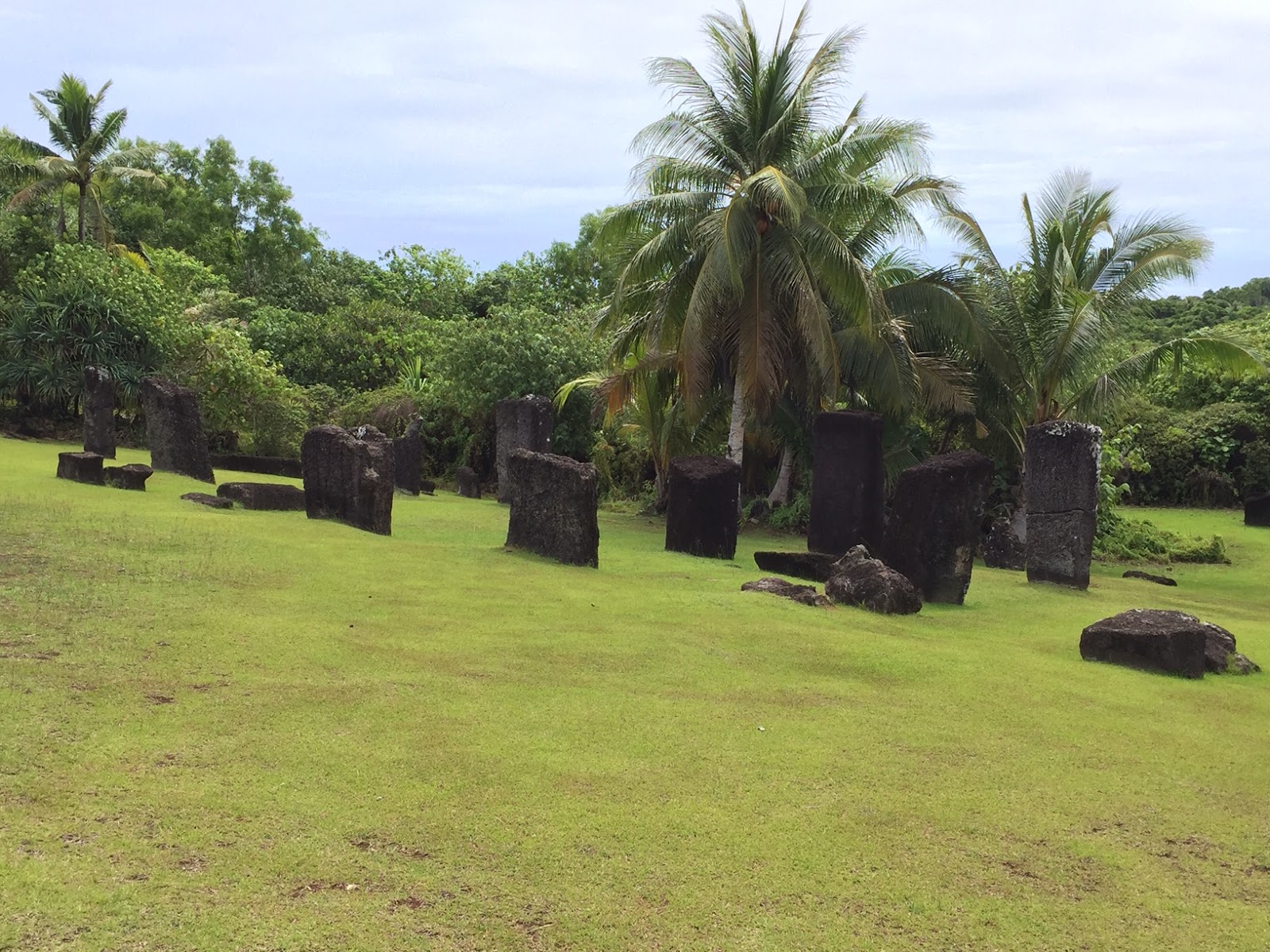
roadside. Cultural sites such as the Badrulchau Stone Monoliths were
of interest.
See here for trip report and list.
 |
| Buff-banded Rail |
 |
| Badrulchau Stone Monoliths, Babelduob Island |