Sunshine Coast Birds

Birding and other wildlife experiences from the Sunshine Coast and elsewhere in Australia - and from overseas - with scribblings about travel, environmental issues, kayaking, hiking and camping.

Saturday, 11 February 2017

Yandina Creek Wetland to be Restored and Protected

Scott, Anna & Sam Dwan at the wetland this week
It's wonderful to report that finally, following a 3-year battle, the 200ha Yandina Creek Wetland is to be restored. What follows is the full text of an article of mine prepared for publication in today's edition of The Weekend Australian. Thanks to various organisations, especially BirdLife Australia, that lent their support to the campaign, along with the efforts of many individuals, notably the indomitable Judith Hoyle.

An internationally significant wetland on Queensland's Sunshine Coast that was destroyed when government authorities dismissed it as unimportant is to be restored in a move which paves the way nationally for a fresh approach to environmental management.

The 200ha Yandina Creek wetland will be recreated by Unitywater in what the Queensland corporation described as a “once in a lifetime opportunity” in the heart of one of Australia's fastest growing tourist destinations.

The Dwan Family at the wetland when it was drained in 2015: Pic Glenn Hunt
The wetland was home to critically endangered wildlife protected under Commonwealth and state laws as well as large numbers of migratory shorebirds protected under several international treaties to which Australia is a signatory.

However, the wetland was drained after the federal and Queensland governments, backed by local councils, determined it was not worth protecting because it had been created artificially.

The failure of three levels of government to protect the wetland sparked debate about a key principle at the heart of environmental decision-making in Australia: whether an environmentally significant area deserves protection if it is shaped by human activity.

The area had been natural wetland before it was developed for sugar cane farms in the 1920s. Two Yandina Creek farm properties were sold to developers in the mid-2000s after the closure of the Nambour sugar mill.

The new owners failed to maintain floodgates that prevented inundation by tidal flows from the Maroochy River. After the floodgates collapsed in 2012, the land was swamped twice daily at high tide, recreating a wetland.

The developers leased the properties back to their original farmer owners in 2015 to repair the floodgates and drain the wetland so cane crops could be re-established. Large numbers of black swans and other protected waterbirds were nesting at the time.

The federal and Queensland governments rejected calls to intervene to block the drainage plan; Queensland Environment Minister Steve Miles dismissed the wetland as “highly modified”.

Government indifference was echoed by mainstream environmentalists. The Australian Conservation Foundation and Queensland Conservation Council ignored the issue; there is no mention of it in the archives of the Sunshine Coast Environment Council.

Drainage canals at the wetland this week
However, a campaign by bird-watching and community groups to rehabilitate the wetland was stepped up, with thousands signing petitions demanding government action.

Government sources said coverage of the issue by The Weekend Australian prompted a rethink by Dr Miles, who inspected the site.

Unitywater chairman Jim Soorley, the former Brisbane Lord Mayor, was approached to examine the rehabilitation proposal.

Unitywater acquired the properties late last year for $4.1 million and is implementing a management plan to restore the wetland, with flood-gates being reopened in stages. Water levels at the site this week were boosted by increased flows through drainage canals.

Dr Miles said he recognised the significance of the acquisition and the Queensland Government was co-operating with Unitywater during the project's early stages.

Unitywater is a statutory authority, owned by local councils, that discharges effluent from sewage treatment plants into the Maroochy River, boosting potentially harmful nutrient levels in the river. The restoration plan allows Unitywater to offset that pollution by extracting nutrients and sediments from the river in water that returns to the wetland through reopened floodgates.

The project will be overseen by Unitywater infrastructure planning chief Simon Taylor, who has wide experience with rehabilitating wetlands overseas.

Mr Taylor said extensive investigations were undertaken into the benefits of restoring the wetland.

As the owners of this land we intend to bring these wetlands back to life,” Mr Taylor said.

Nature will be allowed to take its course in a way that is managed to achieve win-win outcomes. This will translate into benefits for our nutrient offsetting as well as for the environment - a great outcome for everyone.”

BirdLife Australia Southern Queensland convenor Judith Hoyle said the restored wetland will be one of the most important sites for wildlife on the east Australian coast.

BirdLife Australia's Judith Hoyle
There was a belief by government that an artificial wetland was not worth saving but the presence of such a wide diversity of species demonstrated that this was not the case,” Ms Hoyle said.

We need to look at innovative solutions such as creating new habitat or in this case, protecting artificial wetlands, so birds and other wildlife have somewhere to go as natural wetlands around the country continue to dry up or be destroyed.”

Unitywater plans to collaborate with BirdLife Australia and local residents in management plans for the site and to allow public access to the wetland, with authorities believing it has considerable potential as an ecotourism destination.

Scott and Anna Dwan, whose property adjoins the wetland, welcomed Unitywater's restoration plan.

This is exactly the sort of thing we need to do if we want to ensure a sustainable future for our children and grandchildren,” Mr Dwan said.

We want our kids to grow up learning to appreciate birds and the natural environment. It's better than fiddling with Playstation.”

Looking towards Mt Coolum at the wetland this week
The Yandina Creek wetland will abut 440ha of woodland reserves near the tourist heartland of Coolum Beach. The Sunshine Coast Council is examining the prospects of protecting a further 100ha of seasonally inundated land it owns in the area. A council spokesman said the area was presently zoned for sport and recreation, but its future would be determined by the outcome of environmental assessments. 

Wildlife occurring in the wetland before it was drained included the endangered Australian Painted-Snipe and the critically endangered Curlew-Sandpiper.

End of newspaper story; the last few paragraphs were omitted from the published version.
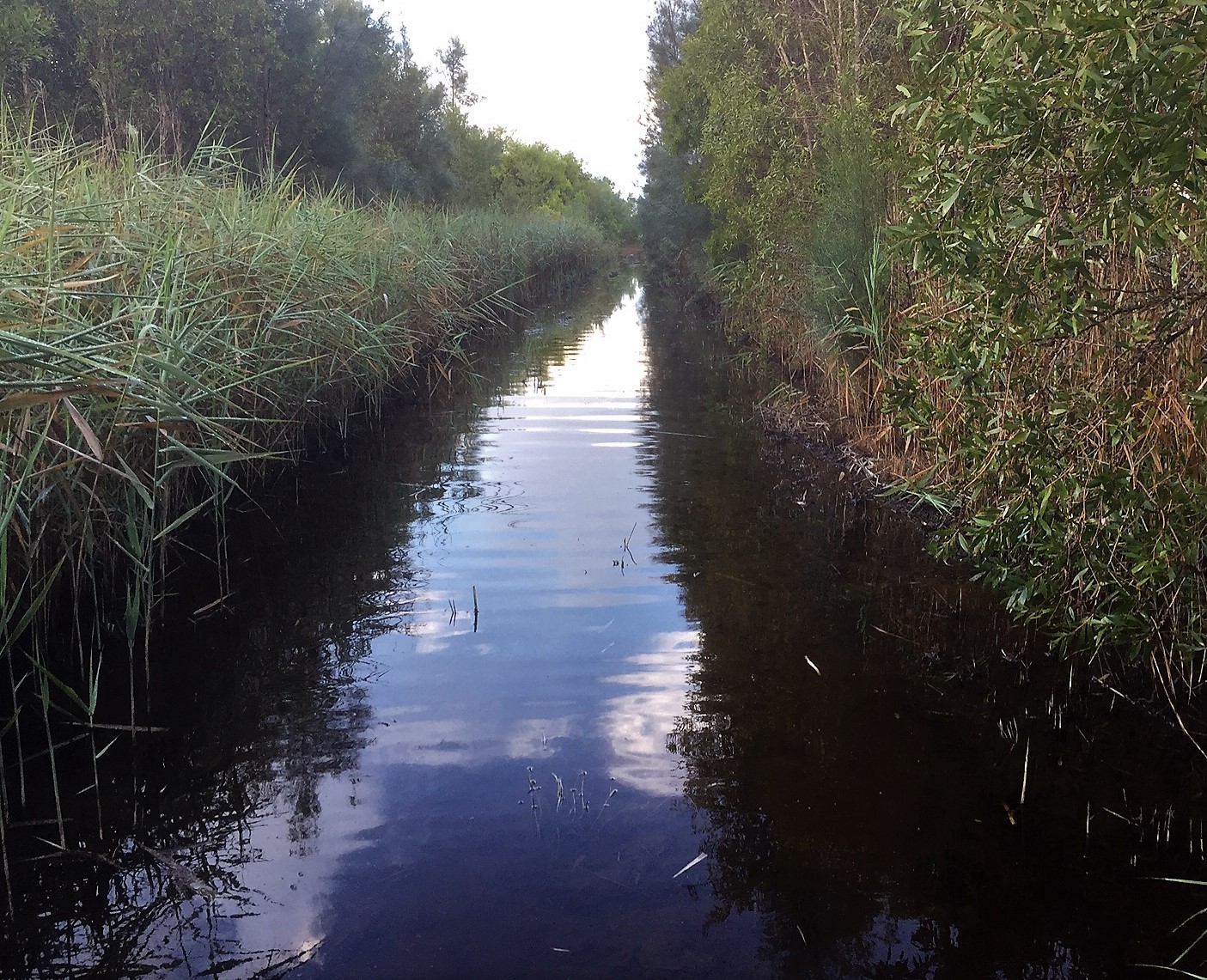
Flooded track in wetland's western sector this week
Please note there is not yet public access to the site. Water has only just begun returning and it will be some time before the wetland is re-established. The main floodgates remain closed at the time of writing but will be opened over time as Unitywater carefully monitors water flows. It appeared this week that a floodgate upstream of the main gates was open as the wetland's western sector was replenished.

Cane on the wetland properties
A small area of sugar cane had been planted in a corner of the properties before they were acquired by Unitywater. This area will revert to wetland or grassland.

Dead Australian Water-Rat
Of concern were a couple of dead Australian Water-Rats that I found on the edge of the properties. I am not sure if this is a water quality issue - acid sulfate levels rose when the wetland was drained and it will take some time for these elements to be washed away - or due to 1080 baiting for wild dogs. I have found a few dead water-rats around the wetland over the years; in all cases, there is no evidence of them having been caught in fish traps or attacked by predators.

1080 baiting


Saturday, 4 February 2017

Night Parrot: Longer Between Drinks Than We Thought


With recordings of calls of the Night Parrot finally if belatedly being released to facilitate wider searches for the species (more on that later) attention has turned to fresh analysis of historical records. Before a road-killed Night Parrot was found in 1990 near Boulia in western Queensland, the evidence now indicates that the last confirmed record of the species is much older than was previously thought.

The word “confirmed” is a little subjective. There have been several definitive sight records of Night Parrots from various sites over the decades, but with a near-mythical species – as would be the case with, say, Coxen's Fig-Parrot or Paradise Parrot as well – it is reasonable to expect photographs or specimens to confirm a record in the absence of solid evidence over a prolonged period.

In the case of the Night Parrot, the last confirmed record prior to 1990 was supposedly a specimen taken in 1912 by amateur ornithologist Martin Bourgoin at Nichol Spring near the Ashburton River; the site is east of Newman in the Pilbara of Western Australia. The next confirmed record post-1990 was a dead bird found in Diamantina National Park, also in western Queensland, in 2006. John Young subsequently photographed and filmed a Night Parrot for the first time in 2013 not far from the national park site in what is now known as the Pullen Pullen Reserve. Since then, Night Parrots have been found in several places across this region.

John Young has questioned the validity of the 1912 specimen, and it seems he has a point. Martin Bourgoin was not on a collecting expedition at the time but was shooting "bronzewings" (most likely Crested Pigeons or Spinifex Pigeons) for the pot. The parrot was one of four flushed from what he described as thick spinifex on limestone hills. Here is the first problem with this "specimen". All the evidence gathered in recent years at the western Queensland sites by John Young, Steve Murphy and most recently by James Watson and Nick Leseberg, suggests it is highly unlikely that four Night Parrots could be flushed simultaneously. With intensive field work in areas where Night Parrots are known to be resident underway over several years now, flushing even a single bird is a very rare occurrence.


Night Parrot: Pic by Rachel Barr
On the face of it, Bourgoin's record looks impressive. His notes describe the plumage as “dark green barred with a light yellow edge on each feather of the back and breast”. The abdominal surface and underwings were yellow. The crop contents were spinifex and herbage seeds. However, the specimen was poorly prepared in Bourgoin's camp and most of its feathers soon fell out. By the time the specimen was shown a year later to Colonel E.A. Le Souef, the only bits remaining were the head, wings, tail and legs; these were evidently disposed of in the belief they were insignificant.

South Australian Museum collections manager Philippa Horton tells me the existence of the specimen can not be traced, adding: “Most likely it was thrown out.”

This means that the 1912 “specimen” can not be regarded as anything more substantive than an unconfirmed sighting. The record has no more or less weight than many subsequent sightings. Anybody can write up a suitably impressive description of a bird. The published records do not contain collaborative material to confirm the record. Western Australian Museum birds curator Ron Johnstone agrees; Ron tells me the most that can be said is that this was "probably" a Night Parrot. 

So we need to go further back to determine the timing of the last confirmed record prior to 1990. The bulk of the 25 known specimens of Night Parrot in existence - 19 in total – were collected by self-employed taxidermist Frederick Andrews in the 1870s and 1880s in South Australia, most from the Gawler Ranges north of Eyre Peninsula. The most recent of these appears to be one in the American Museum of Natural History, New York, with a label noting it was collected “About 1890?” between Lake Acraman and Lake Gairdner.

However, the last of the Andrews specimens appears to have been collected in 1884, which is the closest of the 25 specimen dates to the 1912 record. In that case, the time span between the finding of the Boulia bird and the last confirmed record before that was at least 106 years and not 78 years, as is generally - and, as we can see, mistakenly - assumed.

Meanwhile, the release of Night Parrot call recordings is a welcome development, although it should have been done much earlier. Some of us have argued long and hard that the conservation interests of the species were not advanced by a cloak of secrecy that surrounded its study. A self-appointed elite had refused to release call recordings in the fanciful belief that to do so would unleash an invasion of illegal egg-collectors and over-eager twitchers with no regard for the welfare of the bird. Australia's generally responsible and environmentally aware birding community was unimpressed with being treated with such disdain.


Night Parrot - Pic by Rachel Barr

Call recordings for such a cryptic species are crucial to finding new populations of Night Parrots. What was to stop a huge new mining development going ahead in Queensland or Western Australia because consultants had no substantive means of locating this critically endangered species? A consultant in WA was reduced to cobbling together notes of the Bell Miner in a recording in a sad attempt to copy the parrot's call. 

I was criticised by some when I decided last year to reveal the name of the property where the Night Parrot was photographed by John Young, although I was careful not to identify the specific site on the sprawling cattle holding of almost 500,000ha. My objective in publishing this and a raft of other information was to point potential searchers in the right direction so that other populations could be looked for in the absence of call recordings being available. 

The Night Parrot Recovery Team claimed it was constrained from releasing the calls, variously because of copyright issues surrounding calls collected by researcher Steve Murphy (he was working at the time under a Commonwealth offsets program for Fortescue Metals) or because of opposition from the Queensland Government. 


Night Parrot habitat - western Queensland
Before the calls were released last week, I had learned that Fortescue Metals had no problem with releasing the calls. Neither did the Australian Wildlife Conservancy, for which John Young presently works studying Night Parrots in Diamantina National Park. Most importantly, I discovered that the Queensland Government was happy for calls to be released. A Queensland Department of Environment and Heritage Protection spokesman told me the government had never had the regulatory authority to prevent the release of calls, and that the recovery team had been told as much.

When I put this information to the recovery team last week through Bush Heritage Australia, which operates the Pullen Pullen Reserve, I was greeted by a wall of silence. Steve Murphy has told people that because of my sins of publishing material without permission, I have been blacklisted by the recovery team. Then, two days after approaching BHA, I saw on social media that the calls had finally been released. The timing is pure coincidence perhaps. The recovery team has also published at long last – along with the calls – an informative website with plenty of useful information.

Australia's leading expert on parrots, Joe Forshaw, tells me he is baffled why it took almost four years after John Young's photographs for the calls to be released. “I never did understand why there was an embargo on releasing calls of the Night Parrot,” Joe says. “Paranoia on the part of some persons involved…. The authorities need to be vigilant against feral cats, rats, foxes and wildfire rather than birdwatchers.”


Thursday, 2 February 2017

Superb Fruit-Dove at Cooloolabin, Sunshine Coast


Superb Fruit-Dove
 Superb Fruit-Dove is a rare summer visitor to south-east Queensland but generally I see one or two about the Sunshine Coast per season. Today I saw my first for this summer in lowland rainforest at Cooloolabin, in a spot where I've seen the species previously.

Superb Fruit-Dove
As is often the case, it was a single male detected by its distinctive call that proved difficult to track down. The bird would sit calling high in the canopy - hence the mediocrity of these images - before occasionally flying to another roost. See here for ebird list.

Superb Fruit-Dove
Several Rose-crowned Fruit-Doves were also about and I had Dusky Honeyeater, a regular visitor here.

South Maroochy River, Kureelpa
Earlier I checked out a couple of the tracks that head off into Mapleton National Park from the end of Kureelpa Falls Road, Kureelpa. One track leads to the Kureelpa Falls and another to a ridge with a scenic outlook over the South Maroochy River. I had White-eared Monarch along the first part of the track to the falls, which has been good in the past for birds including Barred Cuckoo-shrike and Oriental Cuckoo.

Monday, 30 January 2017

Sooty Owl & Marbled Frogmouth at Mary Cairncross; Lewin's Rail & Spotless Crake at new Maleny Wetland

Marbled Frogmouth
It's satisfying to report two positive environmental news stories from the Sunshine Coast hinterland. The rare Sooty Owl and Marbled Frogmouth have been seen in Mary Cairncross Reserve in the latest indication that the extensive rehabilitation of cleared farmland in the Blackall Range is reaping rich biological dividends. Meanwhile, a new wetland created by Unitywater in Maleny's community precinct is shaping up as one of the Sunshine Coast's prime waterbird habitats.

 Mary Cairncross Reserve is one of the largest tracts remaining of the extensive rainforests that once covered the northern Blackall Range. It has suffered in the past from being isolated from other rainforest and wet sclerophyll forest remnants, but in recent years extensive areas in the region have been replanted with native vegetation. Valuable wildlife corridors are being created, allowing the spread of wildlife to areas from which they had long been absent.

Sooty Owl
Sooty Owl and Marbled Frogmouths are iconic species of the Blackall-Conondale Range complex. Both species have hitherto been very rarely recorded in Mary Cairncross (I can find evidence of just one record for each) although the habitat is ideal. So I was pleased to have a pair of Marbled Frogmouths and a Sooty Owl calling simultaneously and showing nicely last night in the reserve. I've noticed in the past that Marbled and Tawny Frogmouths do not seem to be at all deterred by nearby Sooty or Masked Owls.

Marbled Frogmouth
Although I've looked in the past for Sooty Owl and Marbled Frogmouth in Mary Cairncross without success, hopefully these species may become long-term residents as the good news story of habitat rehabilitation in the region continues.

Southern Boobook
Earlier in the evening, local wildlife enthusiast Barry Traill (of Pew Charitable Trusts fame, among other things) and I heard another two pairs of Marbled Frogmouth calling from rainforest gullies below the Maleny escarpment. A fine pair of Southern Boobooks were encountered as we left the area.

Common Ringtail
A poke around Barry's Maleny property revealed no fewer than 6 Common Ringtails in the space of a few minutes.

Yellow-throated Scrubwren
I had called into Mary Cairncross earlier in the afternoon. As usual, Yellow-throated Scrubwrens were abundant. See here for Mary Cairncross list.

Barry and I also visited the newly created wetland in the Sunshine Coast Council's Maleny Community Precinct. The wetland has been established by Unitywater for filtrating treated effluent from its Maleny Sewage Treatment Plant. The result is most impressive, with an extensive area of mixed aquatic vegetation providing refuge to what I suspect will be some interesting wildlife. The surrounding slopes are being replanted with native rainforest trees, with plenty of help from community-spirited locals.

Barry Traill at Maleny Precinct Wetland
It did not take us long to spot a couple of migratory Latham's Snipe. We saw a Spotless Crake and heard another 4 or 5. We also heard 3 Lewin's Rails. There are very few records of either of these two cryptic rail species from the Maleny region.

Lewin's Rail (file pic)
This is a spot to keep on eye on and congratulations to Unitywater, the Sunshine Coast Council and local residents for the good work they've done here. See here for the wetland list.

Wild Dogs
 In other news, I was birding with some friends near Kenilworth when we came across a pack of dingo-wild dog hybrids. These animals are rarely encountered in the field and it was interesting to see how dingo-like they were in appearance.

Sulphur-crested Cockatoo
This Sulphur-crested Cockatoo was nesting in a large eucalypt at Ninderry.


Sunday, 29 January 2017

Sunshine Coast Pelagic January 2017

White-tailed Tropicbird
White-tailed Tropicbird, Red-footed Booby and Streaked Shearwater were the highlights of what proved to be excellent pelagic trip off Mooloolaba on the Sunshine Coast on Saturday January 28, 2017.

Sooty Tern
The January pelagic had been postponed three times due to weather so we were pleased to finally depart Mooloolaba Marina at 6.35am on a warm day with a final drizzle early, a water temperature of 26 and a forecast of light to moderate E-SE winds, which proved to be the case as the day progressed. We negotiated a healthy 1.5m swell heading eastwards and soon began picking up large numbers of Wedge-tailed Shearwaters.

Streaked Shearwater
Half-way out we spotted our first Streaked Shearwater for the day in 50m.

Streaked Shearwater with Wedge-tailed Shearwaters and 1 Flesh-footed Shearwater (far right)
It was sitting on the water among a raft of shearwaters which included a single Flesh-footed Shearwater. A Hutton's Shearwater also flew by.

Hutton's Shearwater
We were to see six more Streaked Shearwaters on our way out along with a few Sooty Terns before reaching the continental shelf at about 8.50am.

Flesh-footed Shearwater
We began laying a berley trail in 135m - 26, 38, 698 S; 153, 36, 008 E - 26 nautical miles from shore. A light breeze of 5-7 knots was a bit of a worry but it was coming from the right direction and it picked up as the day wore on. We soon spotted our 8th and last Streaked Shearwater for the day.

Sooty Tern juvenile
Wedge-tailed Shearwaters continued to be plentiful and were joined by an occasional Flesh-footed Shearwater. More Sooty Terns, both adults and young, were about the boat and we chalked up quite a few before the day was out. The first Tahiti Petrel of the day made a belated appearance.

Tahiti Petrel
After a short time we decided to head further out to 32 nautical miles offshore in 310m. The numbers of Tahiti Petrels picked up markedly and they remained about the boat, along the obligate Wedgies, while we were out on the shelf.

Pomarine Jaeger
A Pomarine Jaeger came in to inspect the goings-on; a total of 5 being logged for the day. While out wide we were also distracted by non-birdy Blue Buttons (Porpita porpita) floating on the surface.

Red-footed Booby
A subadult light phase Red-footed Booby flew past and behind the boat and while not as close or inquisitive as we would have liked, this species is always a welcome addition to the list.  The smattering of Sooty Terns were joined by a couple of Common Noddies before we turned around at 12.45pm to try our luck further in, which looked so promising on the way out.

White-tailed Tropicbird
Our skipper Paddy spotted a subadult White-tailed Tropicbird sitting on the water about half-way back - another sought after South-East Queensland rarity.

Brown Booby with Crested Tern
A Brown Booby was hanging around one of several fishing trawlers out for the day. Heading in we saw a few more Hutton's Shearwaters and some Common Terns, arriving back at the marina at 3pm. Many thanks to Nikolas, Raja and Helmut for going the extra mile in helping to sort out our berley supply for the day.

PARTICIPANTS: Paddy Dimond (skipper),  Greg Roberts (organiser), Adrian Brooks, Mike Bysouth, Phil Cross, Jo Culican, Steve Grainger, Nikolas Haass, Guohualing Huang, Sreekar Rachokonda, Helmut Schaider, Raja Stephenson, Paul Walbridge, Jamie Walker.

SPECIES Total for Day (Total at any one time)

Wedge-tailed Shearwater 250 (40)
Flesh-footed Shearwater 5 (1)
Hutton's Shearwater 6 (2)
Streaked Shearwater 8 (2)
Tahiti Petrel 50 (12)
Pomarine Jaeger 5 (1)
Crested Tern 30 (10)
Common Tern 40 (20)
Little Tern 1 (1)
Sooty Tern 30 (4)
Common Noddy 3 (2)
White-tailed Tropicbird 1 (1)
Brown Booby 1 (1)
Red-footed Booby 1 (1)

Offshore Bottle-nosed Dolphin 15 (6)