Sunshine Coast Birds

Birding and other wildlife experiences from the Sunshine Coast and elsewhere in Australia - and from overseas - with scribblings about travel, environmental issues, kayaking, hiking and camping.

Friday, 18 March 2016

Yandina Creek Wetland Update

Yandina Creek Wetland this week looking towards Mt Coolum
This time last year, thousands of waterbirds of many species were frequenting the Yandina Creek Wetlands on Queensland's Sunshine Coast. Among them were more than 120 Latham's Snipe: a sufficiently large number of this species to afford the 200ha site the status of internationally significant, according to federal Government guidelines. Also present was a Pectoral Sandpiper - one of the rarer shorebird species visiting Australia.

During an inspection yesterday, not a single waterbird was present. As has been documented, the wetland was drained last July so the area could be redeveloped as sugar cane plantation when broken floodgates were replaced, preventing the daily flow of tidal water to the wetland. Following national publicity surrounding the fate of the area, state authorities intervened. The wetland began refilling last September when the Queensland Department of Agriculture and Fisheries moved to protect mangroves and other protected plants, with the cane farmer lessees agreeing under pressure to open a floodgate.

Tall grass now covers shorebird habitat of mudflats and small pools
However, the floodgate was shut again in December after acid sulfate pollution was detected on the site; the leaching of toxic chemicals to the surface is a common problem when pollution-prone areas are drained. The landholders have failed to respond to repeated offers of professional assistance to assist in tackling sulfate pollution on the site. Meanwhile, the state Department of Agriculture and Fishers and Department of Environment and Heritage have both said they are powerless to order that the closed floodgates be reopened, highlighting deep flaws in state environment protection legislation.

Dead native vegetation on the site
The cane farmers leasing the land from its owners are unable to proceed with plans to grow cane because of the intervention by Queensland Fisheries, with possible prosecutions pending over the initial drainage. At the same time, the Queensland Government and the Sunshine Coast Council have thankfully backed down from their previous view that the site is not worth protecting because it had been modified by human activity.

The government and council have both indicated a preparedness to contribute funds for the acquisition of the two adjoining properties that comprise the wetland. Negotiations are presently underway with interested parties to facilitate an arrangement which hopefully will protect the main features of the wetland.

Yandina Creek Wetland looking towards Mt Ninderry this week
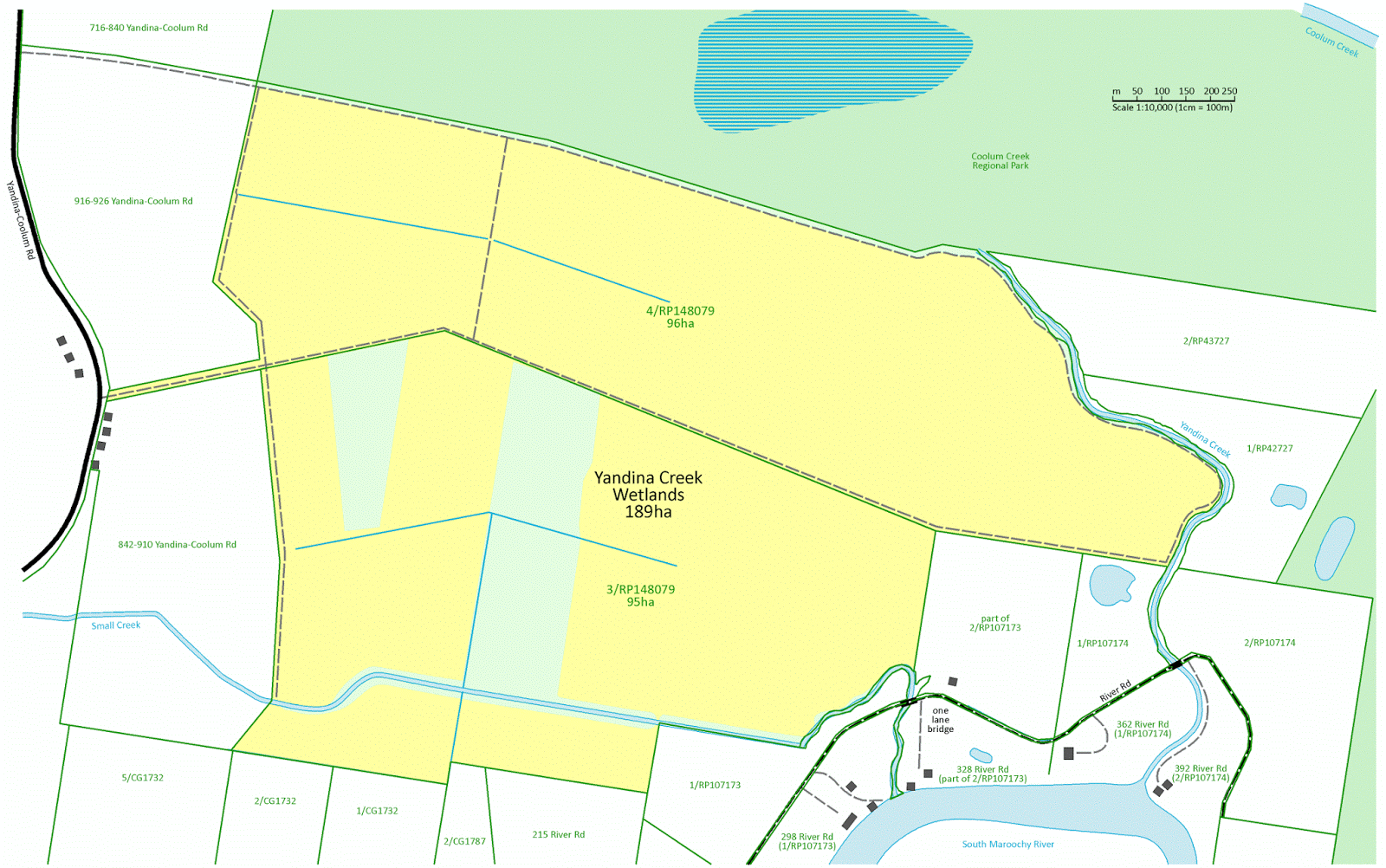
The sticking point, however, appears to be cost. The owners of one of the properties are keen to sell and are realistic enough to appreciate that this highly flood-prone land has limited value. The owners of the second property differ from their neighbours and among themselves about what should be an acceptable price. Hopefully this impasse will be resolved to facilitate the protection and restoration of the wetland. From an environmental perspective, the priority is to secure the protection of one of the two properties: Lot 4RP148079, which abuts Yandina Creek.

Latham's Snipe in Yandina Creek Wetland last year
During yesterday's inspection from the banks of Yandina Creek - the only point of public access to the wetland - it could be seen that extensive areas of shallow pools and mudflats that were utilized by large numbers of shorebirds this time last year are now covered in tall grass. Other areas of tall reed bed were dead, as were numerous native shrubs and trees. There were plenty of rain-filled depressions that looked like reasonable habitat but worryingly, these had not attracted any birds, possibly because of the above-mentioned acid sulfate pollution.

Map of Yandina Creek Wetlands


Monday, 7 March 2016

Brush-tailed Phascogale, Bush-hen Babies, Marbled Frogmouth and more in Sunshine Coast Hinterland

Brush-tailed Phascogale
Brush-tailed Phascogale is one of our more secretive, uncommon and difficult-to-find marsupials. So it was something of a surprise to learn that one had taken up residence in a residential letterbox along Booloumba Creek in the Conondale Range, in Queensland's Sunshine Coast hinterland.

Brush-tailed Phascogale
What's even more surprising is that according to the home owner, Christopher Lee, a phascogale has been resident in the letterbox on-and-off for the past four years. Phascogales are not long lived, with lifespans ranging from 12 months (males) to potentially 3 years (females), so it is highly likely that more that one animal has lived here.

Brush-tailed Phascogale
It is even stranger that the letterbox is in the open, by a road. The phascogale would need to traverse 20-30 metres of open lawn to reach some bush, and there is no shortage of owls, snakes and other predators in the area. It seems possible that the original animal that took up residence in the letterbox was a female and that its young have followed suite.

Home of the Phascogale
The phascogale comes and goes. According to Chris, it can be there for a week, then absent for a week, then back again.

Brush-tailed Phascogale. Pic: Christopher Lee  
Initially, the animal huddled in a corner of the letterbox as the mail was delicately removed daily. Then Chris put a small cardboard box in with some torn newspaper for bedding, which the phascogale took to readily as its abode within an abode.

Barred Cuckoo-shrike
Also about the area were good numbers of Barred Cuckoo-shrike, with a flock of 8 birds at the Charlie Moreland Park turnoff, and 2 birds along Booloumba Creek Road.

Marbled Frogmouth
In the evening I saw a female Marbled Frogmouth along Booloumba Creek at precisely the same spot where I first saw a Marbled Frogmouth in 1977.

Brown Tree-Snake
Also along the road in warm, damp conditions was a lively Brown Tree-Snake.


Great Barred River-Frog
Further up in the mountains, a Great Barred River Frog was on the road, while in the damp surrounding rainforest, numerous Marsupial Frogs were calling.

Pale-vented Bush-hen with young
 I called it at Moy Pocket at a reliable site for Pale-vented Bush-hen, and was happy to see an adult with two well-fledged young.

Pale-vented Bush-hen

White-eared Monarch
Elsewhere in the hinterland, I checked out a new site: Kureelpa Falls Track, at the end of Kureelpa Falls Road behind Nambour. John Kooistra saw an Oriental Cuckoo here last week; coincidentally, on the same day, I saw an Oriental Cuckoo fly over the Bruce Highway at Glenview.


Wompoo Fruit-Dove 
Kureelpa looked very birdy. I didn't see John's cuckoo but White-eared Monarch (along with Spectacled and Black-faced), Wompoo Fruit-Dove and Barred Cuckoo-shrike were nice.

Buff-banded Rail juv
Plenty of juvenile birds were seen including a Buff-banded Rail. Elsewhere about the Sunshine Coast, good numbers of waders were gathering at the Toorbul roost, many in breeding plumage, preparing for their annual journey north.

Bar-tailed Godwit, Black-tailed Godwit, Great Knot

Common Greenshank
Chesnut-breasted Mannikin
This Chesnut-breasted Mannikin was in the reeds at Parklakes.

Plumed Whistling-Duck with young
A Plumed Whistling-Duck was attending a flock of youngsters at the Coolum Industrial Estate wetland; this species breeds uncommonly in South-East Queensland. Two Australian Little Bitterns - an adult male and a juvenile - have also been present in the wetland.

Collared Sparrowhawk
Not a great image but the distinctive tale shape can be seen in this juvenile Collared Sparrowhawk at Yandina Creek.

Rose-crowned Fruit-Dove juvenile

Australasian Figbird juvenile
It's been a good season for the normally scarce Barred Cuckoo-shrike, which has also turned up in the big fig in the home garden, along with juvenile Rose-crowned Fruit-Doves and loads of Australasian Figbirds.

Wonga Pigeon
Wonga Pigeon - a scarce visitor here - has been about the garden recently.

Eastern Koel female

While Eastern Koels in the garden are preparing for their northward migration.


Monday, 22 February 2016

Previously Undisclosed Night Parrot Sighting


A previously unpublished report of a Night Parrot indicates that an extensive tract of spinifex country extending south-west of Winton in outback Queensland may be harbouring a greater population of this cryptic species than is thought.

Glenn Holmes, a highly respected field ornithologist, told me he saw a Night Parrot along the Winton-Jundah Road on May 21, 2012. This is 12 months before John Young filmed and photographed a Night Parrot (the first time the species had been photographed) at an undisclosed site. That site, on a cattle station, is thought to be in the same general region: huge, sparsely vegetated grazing properties in the vicinity of the Diamantina National Park.

Steve Murphy's netted Night Parrot: Pic by Rachel Barr
Like Young, Holmes began searching for the birds after a park ranger, Robert Cupitt, found a dead Night Parrot in the Diamantina National Park in September 2006. Holmes was interested in the prospects of the bird occurring on Brighton Downs station, which fringes the eastern sector of the national park. Brighton Downs is south of and equidistant between Winton and Boulia, near where a road-killed Night Parrot was found in 1990.


Glenn Holmes reported his bird along the Winton-Jundah Road, somewhere between the two red crosses
The Queensland Government's Desert Channels Biodiversity Plan identifies Brighton Downs and Mt Windsor cattle stations as containing potential habitat for the Night Parrot, with extensive stands of spinifex in broken, gravelly plains along with samphire, Maireana spp and other plants which the birds may feed on. The habitat described in the biodiversity plan is not unlike John Young's site: a cattle station where research scientist Steve Murphy is continuing to study the parrot. Bush Heritage Australia has launched an appeal to acquire 56,000 ha of the property for a conservation reserve.

It is understandable that Young's site should remain undisclosed while efforts continue to secure the reserve. Murphy has said that the site is not on Brighton Downs. The purpose of publishing this post is to encourage birders who are travelling through the general region – and in particular along the Winton-Jundah Road – to keep an eye out for Night Parrots.

Glenn Holmes began corresponding with me late last year about his Night Parrot search. Unfortunately, he passed away in December from the cancer which prevented him from following up his May 2012 sighting. Glenn was adamant that the bird he saw along the Winton-Jundah Road was a Night Parrot, and he was keen to publish the sighting. A combination of me travelling overseas at the time of our correspondence and Glenn's illness prevented me from learning the precise site. However, it can be discerned from his correspondence that the parrot was between 23 degrees south and 142 degrees east: that is, between points about 100 and 250 kms south/south-west of Winton along the road to Jundah. In a straight line, the area would be about 160 km from Winton.

Old growth spinifex in Bladensburg National Park
Potentially suitable habitat for Night Parrots is found in and around Bladensburg National Park just south-west of Winton, with extensive tracts of old growth spinifex extending south and west through Opalton to the gravelly plains west of Stonehenge and through parts of the 507,000 ha Diamantina National Park.

Glenn Holmes was keen to touch base with Steve Murphy to ensure that publishing his record would not compromise the conservation program on John Young's site. Murphy, who netted and photographed a Night Parrot at the site last April, ignored my repeated requests to comment on Glenn's report.

Glenn Holmes
There have been many reports of Night Parrots over the decades, mostly unsubstantiated. However, Glenn Holmes had outstanding abilities in the field and those of us who knew him well have no hesitation in believing that the bird he saw on the Winton-Jundah Road was a Night Parrot. 

Murphy has recorded several birds at John Young's site but has backed away from an earlier population estimate of between 10 and 30 parrots there. However, he has heard a Night Parrot 40km from the site: a further indication that the species may be more widespread in the region.

Steve Murphy and associates at John Young's site
Meanwhile, a rift between John Young and Steve Murphy, former collaborators in the field, appears to be widening since Young effectively walked away the site and the research effort early last year. (See here for more on the results of Murphy's ongoing research.) Young's supporters were angered by a Queensland Government media release last November which said the Night Parrot had been rediscovered by a “team of scientists” at the site, with no mention made of the fact that the bird was rediscovered by Young (more on Young's 2013 discovery can be found here). This false claim has since been repeated in several publications.


Steve Murphy
John Young


Now Young has taken to social media to attack Murphy for catching a parrot in a mist net at the site. “It beggars belief that he netted one of the birds from my site,” Young says on Facebook. “What would have happened if it died in the net! We are playing with one of the least known birds in the world. Leave them alone. We do not have to have a human fingerprint on everything.” Young says he will search for a new site this year. Murphy believes that catching and radio-tracking a parrot was essential in order to get some sort of idea of its movements and feeding habits; he found that the birds regularly flew several kilometres to forage, often some distance from the old growth spinifex in which they roosted. 

Clearly the search for further populations of Night Parrot nationwide would be greatly enhanced if John Young, Steve Murphy or state authorities released - however selectively - some of the many recordings that Young and Murphy have made of the bird's call. Many people believe it is time that recordings were made available.

Bush Heritage Australia is continuing efforts to secure funding for a reserve, and is about $1.5 million short of its target. Anyone wishing to assist this worthy cause can access this link. 


Tuesday, 16 February 2016

Hervey Bay, Maryborough & Great Sandy Strait

Greater Sand Plover
Three Asian Dowitchers, 150+ Grey Plover, Wood Sandpiper, Brolga, loads of Greater Sand Plover in breeding plumage and Beach Stone-Curlew were the highlights of birding around Hervey Bay and the Great Sandy Strait in south-east Queensland. We camped for 3 nights by the beach at Pialba in Hervey Bay where we camped at this time last year. Of interest was a flock of 50 Greater Sand Plover on the rocks at Pt Vernon. Most birds were in full or partial breeding plumage and unusually, no other species (including Lesser Sand Plover) were with the flock.

Sooty Oystercatcher
A single Sooty Oystercatcher (northern race) was on the rocks. I looked unsuccessfully for Black-breasted Buttonquail at Mungomery's Vine Scrub; platelets were very old and I suspect well-meaning locals who removed lantana and other weeds from the scrub may have unwittingly subjected the birds to cat predation.

Osprey
Arkarra Lagoons were also unproductive other than a couple of Nankeen Night-Herons although an Osprey showed nicely nearby.

Grey Shrike-thrush
A Grey Shrike-thrush attracted to its image in a car mirror at River Head was a distraction. Rose-crowned Fruit-Dove and Fairy Gerygone were in the vine scrub here.

Wood Sandpiper
I visited Garnett's Lagoon with John Knight. We found a Wood Sandpiper at the same spot where we saw one this time last year. The lagoon was looking good for waders with 300+ Red-necked Stints among those present (full list here). Large numbers of sand plovers of both species were on the salt plan but interestingly, unlike the Pt Vernon birds, none had traces of breeding plumage.

Brolga
Five Brolga - a good number for this species in south-east Queensland - were about.

White-winged Chough
 We moved on to another caravan park for 3 nights by the Mary River in Maryborough. Fairy Gerygone was common in mangroves along the river along with Mangrove Gerygone. White-winged Chough, White-bellied Cuckoo-shrike and Nutmeg Mannikin were among the birds in the area.

Great Egret at nest

Intermediate Egret at nest
Intermediate Egret, Great Ëgret and Cattle Egret were nesting in the same trees at Queens Park in Maryborough.

Gull-billed Tern & Caspian Tern

Bar-tailed Godwit, Great Knot, Greater Sand Plover, Lesser Sand Plover
Waders were in good numbers at the Boonooroo high tide roost, with many coming into breeding plumage. An Asian Dowitcher was seen briefly among the big flocks of larger waders, predominantly Bar-tailed Godwit. Also of interest were 150+ Grey Plover - an unusually large number for a species that is a scarce visitor to south-east Queensland. A large flock of Little Tern was also of interest. Both species of sand plover were in good numbers (full list here).

Grey Plover
I moved on to nearby Maaroom, a few kilometres to the north, while the tide was still high. A found a second  Asian Dowitcher foraging in low mangroves with a small group of Bar-tailed and Black-tailed Godwits. This group flushed and flew into the distance.

Asian Dowitcher & Bar-tailed Godwits
Then, in the main large grouping of waders, I found a third Asian Dowitcher which I saw several times. Unfortunately the above is the only image I managed of any of the three dowitchers: a distant digiscoped snap of the bird (in the centre, left and behind a Bar-tailed Godwit, with its bill tucked away; characteristic plumage differences can be discerned, as demonstrated in the image below).

Asian Dowitcher
This is a better snap of a dowitcher I took a while back at Toorbul.

Beach Stone-Curlew
A Beach Stone-Curlew at Maaroom was another nice find. Interestingly, no plovers of any species were present at this site: See full list here.