Sunshine Coast Birds

Birding and other wildlife experiences from the Sunshine Coast and elsewhere in Australia - and from overseas - with scribblings about travel, environmental issues, kayaking, hiking and camping.

Thursday, 10 September 2015

New England National Park: Flame Robin, Olive Whistler, Forest Raven but no scrubbirds


Following our campout at Goomburra on the eastern slopes of the Great Divide in Queensland (see following post) we headed south, crossing the border, to New England National Park, east of Armidale. We camped here for 3 days at a free camp site by the Styx River near the park entrance at  the suggestion of the NSW NPWS website, which said the park camping ground, Thungutti, would not cater for camper trailers.

As is so often the case, this information was incorrect (we could have easily camped at Thungutti with the trailer) but the scenery around the Styx River was not hard on the eyes.


From here it was a 5-kilometre drive to Pt Lookout and the mosaic of walking trails that criss-cross the national park. It was very cold during our stay, notwithstanding the beginning of Spring. The views from various lookouts across vast tracts of forest wilderness did not disappoint, notwithstanding the weather.


Of particular interest was the extensive areas of Nothofagus beech forest in the park. The large tracts of this forest compare to the isolated patches at high altitudes in the Border Ranges region further north and the Gloucester Tops area to the south. The relatively large number of Olive Whistlers seen and heard (about 20) at various sites was a surprise.


Also surprising was the total absence of Rufous Scrubbird from seemingly ideal habitat; I understood that this site was once favoured by the species, which persists in both the Border Ranges and Gloucester Tops areas where the habitat is much more limited. More in evidence was Superb Lyrebird: many were calling and at least 8 birds were seen around Pt Lookout carpark area, including several immature males which appeared to be competing to establish territories.


Another bird that was surprisingly widespread in the park was Flame Robin, with 12-15 seen in habitat ranging from open meadows to the edge of the beech forest.


Two Scarlet Robins were also seen, while several Rose Robins were seen and heard.


The Forest Raven is another specialty of the region. Australian Ravens were seen to the north of Armidale during our drive south but it seemed that all the ravens in the vicinity of the national park were Forest Ravens.


Red-browed Treecreepers were in small numbers in wet sclerophyll forest along the entrance road, where they were heavily outnumbered by White-throated Treecreepers; see here for a full list of bird species recorded.


Eastern Grey Kangaroo, Swamp Wallaby and Red-necked Wallaby were common.


On the way back we stopped for a couple of nights at the Broken Head Caravan Park near Byron Bay.


The coastal scenery here was as exquisite as always, with rainforest meeting the sea. Seabirds offshore during a strong south-easterly included quite a few Fluttering Shearwaters and Australasian Gannets along with several Common Terns and a probably White-fronted Tern.


Wednesday, 9 September 2015

Goomburra: Masked Owl, Albert's Lyrebird, Musk Lorikeet


Musk Lorikeet
We opted for a three-day campout in the Goomburra section of the Main Range National Park. It had been 20 or so years since camping here and it was nice to get to know the place again.

The birding highlight was a Masked Owl which called several times from along the creek in the Poplar Flat camping ground where we were camped; unfortunately the bird failed to show. Also vocal was Albert's Lyrebird: 3 birds were heard along the road to the lookouts, and another 3 during the 6.5km Cascades Circuit walk.

Cascade Circuit rainforest
The road was an old logging track last time I was here. Now, easy access to the Mt Castle and Sylvester lookouts is available. We were fortunate to strike a clear day so the scenery across the Fassifern Valley was quite something. We were able to see even the Brisbane CBD, about 100 kilometres distant.

View from Sylvester Lookout across Fassifern Valley
Topknot Pigeons were feeding along the road at Mt Castle. Other rainforest birds included Yellow-throated Scrub-wren in abundance, while Australian Logrunner and Paradise Riflebird were about in small numbers. A pair of Crested Shrike-tit were in wet sclerophyll forest.

Topknot Pigeon
One of the attractions of Goomburra is the variety of habitat which includes open forest, wet sclerophyll forest and rainforest. Several birds can be seen here which do not occur west of the Great Dividing Range or generally north of this area.

Red Wattlebird
Those species include Red Wattlebird and Musk Lorikeet, both fairly common in the eucalypts along the entrance road.

Buff-rumped Thornbill

Striated Thornbill
Thornbills put on a good show. Brown Thornbill was plentiful but quite a few Buff-rumped and Striated Thornbills were also seen.

Boebuck
Eastern Grey Kangaroo and Red-necked Wallaby were common. A single Boebuck was spotlighted at night.

Spotted Pardalote female
Spotted and Striated Pardalotes were both breeding in trackside holes. A full list of bird species can be found here.

Turquoise Parrot
After Goomburra we moved south to the Old Wallangara Road at Wyberba for a brief stop. A pair of Turquoise Parrots were seen but did not show particularly well;  I had luck with this species when I had more time during a visit to this excellent site last March.

Saturday, 29 August 2015

Night Parrot Musings


The night parrot recently netted - Pic by Rachel Barr
The following is the text of my news story and feature on the Night Parrot in the 29-30 August edition of The Weekend Australian.


NEWS STORY

Grooming traps to secure site for rare birds 


Newly designed traps that kill feral cats with a poisonous spray will be operating soon at a site in south-west Queensland that is home to the only known population of the critically endangered night parrot.

Sharp-shooters were deployed on the remote property this week and soft jaw traps were set in a concerted bid to eradicate several feral cats that are prowling the area.

The menace of feral cats has emerged as the biggest threat to the survival of the population, with as few as 10 birds at the site on a grazing property south-west of Winton.

The “grooming” traps to be set soon are able to detect and identify cats that pass within five metres, triggering a spray of deadly gel which is ingested when the animal grooms by licking its fur.

The Australian revealed earlier this month new photographs and video footage of a night parrot taken by research scientist Steve Murphy on the property. Bush Heritage Australia is in the process of acquiring 56,000ha of the land so it can be protected as a reserve.

The night parrot was once widespread throughout inland Australia but has disappeared from many places where it was common.

Dr Murphy believes the south-west Queensland population has survived because the rocky terrain has kept wildfires in check. His unpublished research reveals that large, old-growth spinifix patches are the favoured habitat of the mysterious parrot.

Dr Murphy said relatively few feral cats, which were voracious predators of night parrots elsewhere in the past, had been detected at the site. He believes this is because they find it difficult to hunt in areas where the predominant vegetation is prickly, unburnt spinifex – a habitat that was once widespread but is now scarce because of the increasing incidence of fire since European settlement.

“It seems that the parrots may be able to find safe refuge to some extent in this old spinifex,” he said.

However, a single cat could learn how to hunt night parrots and potentially wipe the population out. Bush Heritage Australia north chief executive Rob Murphy said cats were “top of our hit list” of management priorities.

Mr Murphy said the grooming traps, being developed in partnership with South Australian company Ecological Horizons, had promising potential to control cat numbers.

“This is exciting new technology and we hope it will help us to eradicate cats in the parrot's core habitat,” Mr Murphy said.

The night parrot, one of the world's rarest birds, had been known from a handful of records over the past century before it was photographed on the property by north Queensland naturalist John Young in 2013 following a six-year search.

Mr Young, whose discovery made news internationally, had been working with Dr Murphy and Bush Heritage Australia on night parrot management and research at the site but ended his involvement several months ago.

Mr Young has taken to social media to distance himself from the project.

“The whole thing has been very hard for me and every day I begin to wonder whether the heartache, cost and all the effort was worthwhile,” Mr Young said on his Facebook page, without explaining his reasons.

“In the last few years my work has been a living hell and enough is enough now... It has been a long and tumultuous road with all sorts of stuff but I hope I have left something for the world of conservation.”

Dr Murphy acknowledged Mr Young's role in the night parrot's rediscovery.

“John has my complete respect for the skill he demonstrated in finding the bird; for his openness in sharing the experience with me; and for the maturity he displayed in letting Bush Heritage and others get on with the job,” Dr Murphy said.

The Night Parrot before release. Pic by Rachel  Barr
 FEATURE

When a bird in the hand is really rare


It was music to his ears. The high-pitched, melodic, haunting call of the night parrot. When research scientist Steve Murphy analysed the data from audio recorders he had in place across an arid hillside at a secret location in south-west Queensland, he realised that no fewer than four night parrots were calling at the same time.

Four night parrots. That was the equivalent of the total number of human encounters with this most enigmatic of birds over the previous 100 years. Murphy's work on the night parrot is emerging as one of the most exciting developments in Australian natural history research in recent decades.

The curtain is being raised slowly on the ecology and habits of the Holy Grail of Australia's birding world since Murphy and Bush Heritage Australia revealed earlier this month that plans were advanced to secure a 56,000ha reserve over the only site in the world where the parrot is known from. At the time, Murphy released to The Australian photographs and video footage of a netted night parrot.

How has the night parrot survived in this harsh landscape of gibber plain, rocky outcrops and spinifex in Queensland's channel country, south-west of Winton, when it has disappeared from the vast tract of inland Australia it once inhabited? This weekend, Murphy is heading interstate, to South Australia, to see if he can find more parrots.

It was in north-east South Australia that the first specimen of the night parrot was collected, in 1845 during the failed expedition led by Charles Sturt to find Australia's mythical inland sea. And it was in South Australia, in the 1870s and 1880s, that 16 of the 23 known specimens of the bird were collected. The last living specimen was collected in Western Australia in 1912.

Then nothing more but a couple of brief sightings until a dead night parrot was found in 1990, with a second dead bird picked up in 2006. Both were in the same general region of south-west Queensland where bushman John Young heard one calling in 2008. Then, in 2013, after years of effort to track them down, Young revealed the first photographs taken of a night parrot, at the site now being studied by Murphy.

Murphy believes the parrots have hung on at this site because of the terrain, habitat and paucity of introduced predators. His research has established that the birds favour large, old-growth clumps of spinifex. Each bird has its own roost, buried deep within a spinifex clump. The birds leave the roosts soon after sunset, travelling up to 7km during the night to feed.

From sound recordings, Murphy has established that parrots favour certain areas for roosting and other areas for feeding. “We were able to get an idea of where the birds were moving to,” Murphy says. “There was some predictability about their movements and habits.”

In two years of research, Murphy has seen a total of three parrots, including the one he netted and photographed with his partner, Rachel Barr; this bird was seen twice subsequently, including once when it flushed from its daytime roost, which contained a single feather. “This is a bird that is extremely cryptic,” Murphy says.
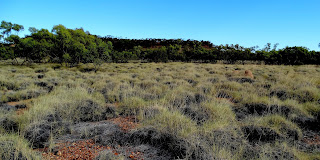
Old-growth spinifex north-east of the Night Parrot site
Most of the parrots are within a 10km radius of John Young's discovery. Murphy now backs away from his earlier estimate of the population at between 10 and 30 birds. “It is impossible to say how many parrots there are,” he concedes. He heard a night parrot 40km from the site, suggesting that a second population may be present in the region. Whatever the number, the known world population is miniscule.

The parrot that was netted was unexpected. Murphy and Barr were at opposite ends of a long mist net soon after sunset during the April Easter weekend when it flew randomly into Barr's end of the net. Netting during the previous three evenings was unproductive.

The old-growth spinifex at the site was formerly widespread in other areas previously frequented by the parrot. As long ago as 1925, the collector Lawson Whitlock searched in vain for a year for the species in one such area west of Alice Springs, where Aborigines had tracked down “porcupine parrots” and cooked them on camp fires. Whitlock described his search as the “most arduous I have undertaken”.

It is likely that by Whitlock's time, the landscape of central Australia was undergoing fundamental change that had dire implications for the night parrot and other arid zone wildlife. Traditional Aborigines had for centuries conducted patchwork burn-offs for various purposes, but the practice ceased with the development of the grazing industry and European settlement.
Researchers at the Night Parrot site: Pic by Bush Heritage Australia
Instead, wildfires of unprecedented intensity ravaged vast areas intermittently. The original habitat has gone and is denied the opportunity to return. The same problem is evident in the savannah woodlands of tropical Australia. The carpentarian grasswren, a small bird, was once numerous in the sandstone screes west of Borroloola in the Northern Territory; as a result of wildfire, the grasswren has vanished.

The Queensland region frequented by night parrots is home to other wildlife in decline elsewhere. The endangered bilby is present; so too is the biggest population of bush stone-curlews in outback Queensland. Murphy believes the survival of the animals is linked to fire control and a dearth of feral predators. The landscape is markedly broken compared to many inland areas; unburnt spinifex clumps are separated by bare rocky areas which may keep the spread of fire in check.

Low level grazing on the property appears to have had no adverse impact on the parrots. Murphy has not seen a fox or a cat at the site, although five cats have been captured on the 30 camera traps in place, which have failed to photograph a night parrot in 15,000 hours of operation. “I carry a gun with me whenever I go out but I've never seen a cat,” he says. “I've seen more night parrots than cats.”

Old-growth spinifex provides the parrots with seemingly effective refuge from predators, which are deterred by its prickly exterior.

Dingo at the Night Parrot site - Pic by Steve Murphy
Murphy believes the presence of dingos in the area is an important factor in controlling cat numbers. The owners of the 1 million-ha property where the parrots occur have agreed not to cull dingoes as part of a management strategy being implemented.

CSIRO arid zone ecologist Chris Pavey agrees the presence of large, unburnt spinifex patches could be keeping cat numbers in check and the key to the parrot's survival. “Mature spinifex allows animals to find refuge so it is likely to be harder for cats to hunt,” Pavey says. “Each cat would need a much larger home range than might be the case elsewhere. It's not too far from this site to where 200 to 300 cats were being shot each night not so long ago.”

With feral cats in plague proportions elsewhere, Murphy regards the felines as the most serious threat to the parrots. Cat numbers are increasing across much of northern Australia – the population nationally is estimated at 20 million - with native wildlife populations crashing in recent years in many places as a result. Earlier this week, before heading to South Australia, Murphy travelled to the parrot site with a team of sharp-shooters in search of cats and to set traps.

Murphy has amassed a substantial collection of night parrot calls on sound recorders. Playback of calls could provide an important role in detecting other night parrot populations; birds may reveal their presence by responding to random playback of their calls.

The recordings are presently under wraps because the secrecy of the site is paramount while efforts to secure it as a reserve are finalised. However, Murphy says they will be made available to other researchers: “Nobody argues about the benefits of doing that and it will be done.”

When the recordings are distributed, efforts will be underway in earnest to find more night parrots, hopefully before this remarkable species succumbs to the twin scourges of wildfire and feral cats.

A link to the video of the parrot can be found here. Bush Heritage Australia needs donations to help secure the reserve -  see here for how you can help.


Saturday, 22 August 2015

Radjah Shelduck on Sunshine Coast plus Bribie Bits

Radjah Shelduck
The Radjah Shelduck is a very rare vagrant in south-east Queensland, so it was with a modicum of interest that I noted Robyn Duff's sighting of 2 birds on the newly built Maroochy River golf course two days ago. I searched in vain yesterday for the birds, both on the golf course and some nice shallow wetlands that have formed following recent rain along nearby Finland Road, Pacific Paradise.

Radjah Shelduck
Two shelducks were seen this morning by Mary Hynes along Finland Road. This afternoon, I found one bird by a small lagoon beside House Number 90, Finland Road.

Radjah Shelduck with Plumed Whistling-Ducks
The shelduck was keeping company with a flock of Plumed Whistling-Ducks. There was no sign of its mate, which Mary had seen earlier flying towards the golf course nearby.

Wandering Whistling-Duck, Little Black Cormorant, Plumed Whistling-Duck
Plenty of ducks were at this spot and in the temporary wetlands just to the south of the house. Postscript: Birders have mixed success since this sighting with the bird; it is not always present. Also present were Wandering Whistling-Duck, Chesnut Teal, Grey Teal, Hardhead and Pacific Black Duck. A full list of species can be found here.

Black-tailed Godwit
Waterbirds were in abundance in the area. It is likely that many of the birds recently displaced by the draining of the nearby Yandina Creek wetlands may be here, taking advantage of the temporary conditions. A single Black-tailed Godwit was present along with a few Sharp-tailed Sandpipers and a Pacific Golden Plover in breeding plumage.

Black-necked Stork
Other nice birds included a female Black-necked Stork. Raptors included a Black Kite and a Spotted Harrier.

Latham's Snipe
The first Latham's Snipe of the season - 4 birds - were present.

Comb-crested Jacanas
An adult and a juvenile Comb-crested Jacana were on a pond near the shelduck.

Mallard
On a pond along nearby Burtons Road, Bli Bli, a male free-flying Mallard was seen with a flock of Pacific Black Ducks. This presumably is the same bird I saw several times at the Yandina Creek Wetlands  (see here).

Common Tern
Earlier in the week we camped for 3 nights in the caravan park at Woorim on Bribie Island. A first-year Common Tern with red legs was regularly roosting on the beach at a spot where this species occurs reliably in winter in small numbers.

Gull-billed Tern
Other terns included this Gull-billed Tern in non-breeding plumage.

Welcome Swallow
At the Buckley's Hole hide, 3 pairs of Welcome Swallows were nesting unusually close and relatively indifferent to human interlopers. A Black-necked Stork was seen on the lagoon.

Beach Stone-Curlews
On the roost near the Kakadu hide, a pair of Beach Stone-Curlews was behaving in a way which indicated clearly that they were nesting. The birds try to nest at this artificially created roost each year with mixed results. A flock of about 20 Double-banded Dotterels was also here.


Glasshouse Mountains & Pumicestone Passage
The view across Pumicestone Passage to the Glasshouse Mountains was quite something.

Saturday, 15 August 2015

White-eared Monarch, Fairy Gerygone, Tasmanian Silvereye atop Mt Ninderry; Eastern Grass Owl


White-eared Monarch
I hiked to the summit of Mt Ninderry near my home and was surprised by the presence of a vocal and inquisitive White-eared Monarch in low trees atop the eastern cliff face.

White-eared Monarch
I've not seen or heard the monarch on the mountain before.

Fairy Gerygone
Also present in the same area was a party of 4 Fairy Gerygones. I've had this species once in my garden but not previously on the mountain. 

Little Shrike-thrush
The monarch and the gerygones were joined in a feeding flock by Little Shrike Thrush, Golden Whistler and Grey Fantail.

View from Mt Ninderry
The view from the summit across the Sunshine Coast to Moreton Island in the distance was stunning on a great winter day.

Silvereye Tasmanian race
Lower down the mountain I came across a flock of 100+ of the Tasmanian race of Silvereye, easily identified by its chesnut flanks. This race is an uncommon winter visitor to south-east Queensland.

Red-legged Pademelon
Elsewhere on the coast, Sarah Beavis and I saw two Eastern Grass Owls in caneland at Paradise Waters about one hour after sunset. One lightly coloured bird flew high overhead; the other, darker bird passed by at head-height. Later, Sarah sent me an image of a road-killed Eastern Grass Owl she found in 2013 not far away on the Yandina-Coolum road at Yandina Creek. This bird was found close to the recently drained Yandina Creek Wetlands.

Eastern Grass Owl roadkill - Pic Sarah Beavis

Spotless Crake continues to show well at Parklakes Wetland. I visited Mary Cairncross Park where this female Red-legged Pademelon with pouched joey was sunning itself on a log.

Australian Logrunner female
Nearby at Kondalilla National Park, a pair of Australian Logrunners showed nicely.


Last Gasp for Yandina Creek Wetlands

Yandina Creek Wetlands: Last Gasp
Last night I gave a talk on the Yandina Creek Wetlands to the Maroochy Wetlands Support Group at Bli Bli. I have decided it will be my last talk on the subject, and this will be last public comment about the wetlands unless the unexpected happens and governments get serious about protecting this place.

This morning I hiked to the summit of Mt Ninderry, which is near where I live. I looked eastwards from the summit towards the coast, where the wasteland that was until recently a biodiversity hotspot - with few if any equals in the region - was clearly visible. I recalled how the Queensland and Commonwealth governments stood by and did nothing to prevent the wetland from being drained  (see here) for sugar cane plantations, notwithstanding the presence of wildlife listed as endangered and threatened under state and federal laws.

With the council's Bill Haddrill at the Bli Bli meeting
In similar fashion, the Sunshine Coast Council decided that the properties containing the wetlands were not worthy of acquisition under its Environmental Levy program. The primary reason for inaction on the part of all three levels of government was essentially that the wetland was created artificially through broken floodgates on fallow caneland, although the result was the recreation of a habitat that was there naturally, as I have commented on at length elsewhere.

After confirming through my optical gear this morning that none of the hundreds of waterbirds that were thriving on the wetland until a few weeks ago were still there, I hiked around the summit of Mt Ninderry to look westward. Below me was a property acquired recently by the council under the levy program for $2.6 million - roughly the estimated cost of acquiring the wetland properties, and of similar size to them. I knew a thing or two about the Mt Ninderry property. Most of it was regrowth, including extensive stands of introduced Pinus and camphor laurel. It had been significantly modified by human hands; the acquisition had aesthetic appeal, to be sure, but there was little value in terms of biodiversity and wildlife.

Unlike the Yandina Creek site, Mt Ninderry was not regarded as nationally and internationally significant under Commonwealth guidelines and the provisions of international conventions to which Australia is a signatory. Yet in the view of council, Yandina Creek was not worthy of a cursory scientific assessment, while according to Mayor Mark Jamieson, Mt Ninderry was a "piece of paradise".

The Bli Bli meeting last night was attended by Bill Haddrill, the council's senior environmental officer who has charge of the property acquisition program. I  knew that either Bill or Councillor Stephen Robinson were likely to in attendance. I had hoped that either of them might be a tad impressed by the images presented during my talk that illustrated the richness, beauty and variety of the wetland and the birds that lived there.

I was wrong. At the end of my talk, Bill restated the council's position: the council would not be spending any money on acquiring the wetland properties, although it was open to offers from the Commonwealth and/or state governments. Bill repeated that the wetland was not a high priority for the council, althought no studies were undertaken to assess its value. It is true that the council's hands were tied to an extent as the property owners had refused permission for a team of experts to conduct a study at no expense to the council. However, there is no evidence indicating that the council urged the landholders to co-operate with a study.

I knew it was the case that the council commissioned studies AFTER acquiring properties, not before. When I suggested that this might not be regarded by the public as a reasonable approach - that it should be the other way around - Bill responded that sometimes there was no choice because landholders refused permission for studies prior to acquisition, and the council considered it was important for acquisition to proceed anyway. Inconsistency in approach is evident here; as they say, what's good for the goose is not good for the gander.

Bill told those at the talk that the council is swamped by proposals for acquisition, with each applicant insisting that their particular proposition is more worthy than any other. The implication is that the hundreds of people who have unsuccessfully urged the council to protect the Yandina Creek wetland are essentially selfish. The argument ignores the point that the worthiness of any proposal should be determined by expert scientific assessment; those of us who have urged the protection of the Yandina Creek site have never asserted that our views should be taken forgranted.

The wetlands can still be saved. The newly installed floodgates can be reopened. However, I am now convinced that the only way this will happen is if the Queensland Government provides the necessary funding (an estimated $3-4 million) to the council to acquire the area.

The council has made it clear it will be not be contributing any of its (read ratepayers) money. The federal Minister for the Environment, Greg Hunt, has indicated he will not only fail to enforce Commonwealth laws protecting federally listed endangered species, but his government will not be contributing acquisition funds. Bush Heritage Australia and the Queensland Trust for Nature have expressed interest in helping, but the price tag is outside the resources of these worthy organisations.  


Environment Minister Steve Miles and MP Peter Wellington at the wetlands site recently
That leaves just one option in my view: state government involvement. The local MP and parliamentary Speaker, Peter Wellington, is onside. His support facilitated a recent visit to the site by the state Minister for Environment and Heritage Protection, Steve Miles. The minister and Peter Wellington both said during that visit that no state funds were available to help with acquisition, but unless they are persuaded to change that view, the fate of the wetlands is sealed.

To that end, I have established yet another petition, this one asking Peter to use his good offices to push for state funding at this link. It would of course help the funding cause if the council desisted from publicly denigrating the site.

Fingers crossed, but I'm not holding my breath.