Sunshine Coast Birds

Birding and other wildlife experiences from the Sunshine Coast and elsewhere in Australia - and from overseas - with scribblings about travel, environmental issues, kayaking, hiking and camping.

Sunday, 3 March 2013

India - Culture, Scenery, People

Town of Dasada - Gujarat
Some images of the culture, scenery and people encountered during our trip to India (Gujarat province in the north-west and Kerala and Tamil Nadu provinces in the south-west) and Sri Lanka. Cattle were a frequent presence on roads in northern India.

Children - Little Rann of Kutch
These kids are from one family. Their home was a tiny hovel in the middle of a vast saltpan in Gujarat.

Hornbill Camp

Glenn at Hornbill Camp
Periyar River, Hornbill Camp
Rubber-making, Thattekkad
Hornbill Camp at Thattekkad, Kerala, was one of our favourite places.

Red Fort
The Red Fort in Agra was impressive.

Taj Mahal
And of course the Taj in Agra is a stunner.

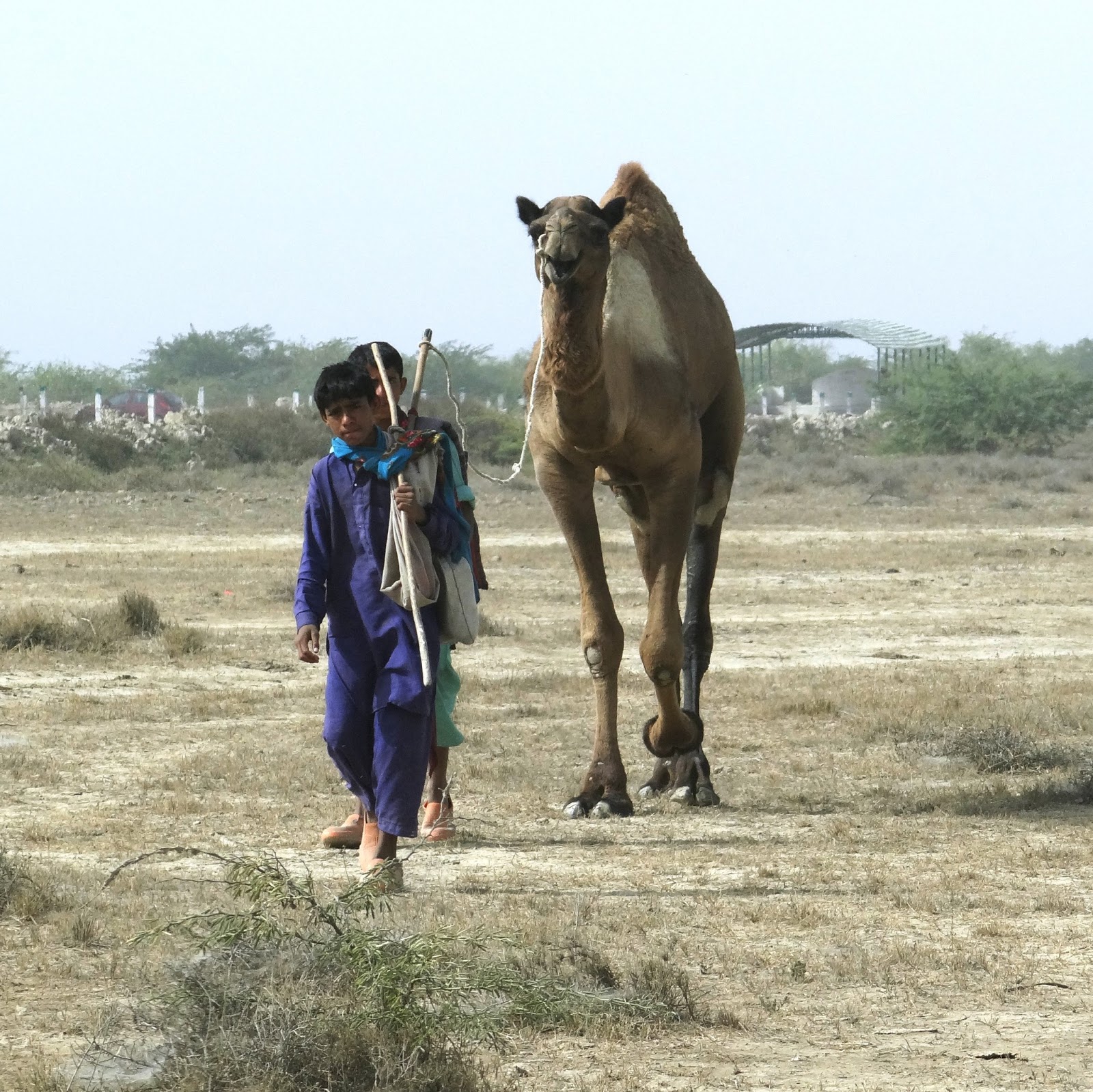
Boys with camel - Greater Rann of Kutch
Camels tended by young boys was a common sight in Gujarat.

CEDO, Gujarat
The Centre for Desert and Ocean was our base for exploring the Greater Rann of Kutch near the Pakistan border.

Chinnar Wildlife Sanctuary
At the Chinnar reserve in Kerala, we went for a strong along the river with a park guide.


Roadside eatery near Delhi 
We generally steered clear of roadside eateries for hygiene reasons but indulged occasionally.

Joji at Mudumalai
The vehicle we drove through south-west India and our very capable driver, Joji.

Jungle Hut
We enjoyed our time at the Jungle Hut, Mudumalai, although a couple of us had food poisoning here. Glenn is at the far left of the pic, Sandra at the right.

Jungle Hut
The Jungle Hut grounds are very birdy.

Greater Rann of Kutch 
Typical thornbush scrub that is found in much of Gujarat, here surrounding a small Hindu temple.

Danish Trogon
Our birding guide at Thattekkad, Danish Trogon, proved to be very good.

Thattekkad
This vegetation, a mix of dry scrub and monsoon forest in rocky terrain, was typical of much of the Western Ghats in Kerala.

Kochi - old fort
A fort built by the Dutch in the 1550s was one of the sites in Kochi.

Kochi
Bath-time at Kochi.

Little Rann of Kutch
The arch that forms the entrance to the Little Rann of Kutch Reserve, Gujarat... It was built 1000 years ago.

Modhba - boy with donkeys

Modhba - camels
The coast of Gujarat offered plenty of interesting people moments.

Olive-Tree Resort
The Olive-Tree Resort at Munnar was a delightful place to stay. Glenn at right of pic.


Tea plantations
Tea plantations were plentiful around the hill towns of Munnar and Ooty

Munnar
Munnar was in festive mood during our visit, with these dancers in the street.

Little Rann of Kutch
Dancing was also the go at the Rann Riders Lodge, where some women put on a show.

Sikandra
The site of Akbar's tomb was another site visited near Agra.

Munnar
Our hotel in Munnar proved to be the venue for a continual procession of traditional Hindu weddings. Here, the groom sits atop his (lame) horse.

Greater Rann of Kutch
 We were to see plenty of sunrises and sunsets in the arid steppes of Gujarat.


Great Rann of Kutch
A rocky gorge in western Gujarat.

 A highlight of our trip was a boat journey through the backwaters of the Allepey region in Kerala for two nights. These were scenes from the trip. Our boat, like other tourist boats, was a converted rice barge.

Allepey
Locals, Allepey

Ex-rice boats, Allepey

Our boat, Allepey

Allepey
At one point our boat had to make its way through a tightly packed flock of thousands of domestic ducklings.


We enjoyed a traditional Keral meal on board.  L-R - Bill, Sandra, Glenn, Greg.

Thursday, 28 February 2013

Mammals of India and Sri Lanka

Leopard
A collection of mammal shots here from our January-February 2013 visit to India (Gujarat in the north-west and Kerala and Tamil Nadu in the south-west) and Sri Lanka. This Leopard was seen in Sri Lanka's Yala National Park. It appears to be a female. We watched as she stalked across a clearing in Acacia woodland. Several Peafowl moved ahead of her as a couple of jackals followed. The leopard's tail twtiched as she eyed a party of Wild Pigs containing several small piglets. She rushed at the pigs, which dispersed in all directions, before disappearing into dense vegetation. We were unable to determine if she snatched a piglet in the mayhem.

Jungle Cat
The other feline seen on the trip was Jungle Cat. Two individuals were seen stalking the Banni Grasslands of the Greater Rann of Kutch.

Wolf
We spotted a single Wolf on the edge of the Tundi Wetlands in the Little Rann of Kutch. The animal disappeared into scrub as we approached. Indian wolves are much smaller than their cousins further north.

Golden Jackal
Golden Jackal was seen in several places in Gujarat and Yala National Park. A stand-out sighting on the trip was a single Dhole, or Asian Wild Dog, roadside at Thattekkad in Kerala. The animal was very close when I spotted it and although I enjoyed a superb view through binoculars, it disappeared into scrub before the camera was out.

Indian Elephant
We saw our first wild Indian Elephants in Mudumalai Tiger Reserve in Tamil Nadu. A group of three - an adult female and her young calf (above) accompanied by a sub-adult female (not pictured, probably the female's older daughter). Many more elephants were heard rumbling, trumpeting or feeding at various places in Kerala and Tamil Nadu, and we had to be alert for them while out and about birding.

Indian Elephant
In Sri Lanka, we saw two adult males in Yala National Park. One was a big tusker, feeding close to the vehicle. Tuskers are scarce in Sri Lanka, accounting for just 5% of adult males.

Indian Wild Ass
Another nice ungulate was Indian Wild Ass. Seriously endangered, Little Rann of Kutch is the place for this animal. We saw quite a few during our jeep excursions to the reserve.

Niligir Tahr
A visit to Eravikulum National Park in Kerala is necessary to see the endangered Nilgiri Tahr, a species of wild goat. They are quite common in the highland grasslands above Munnar.

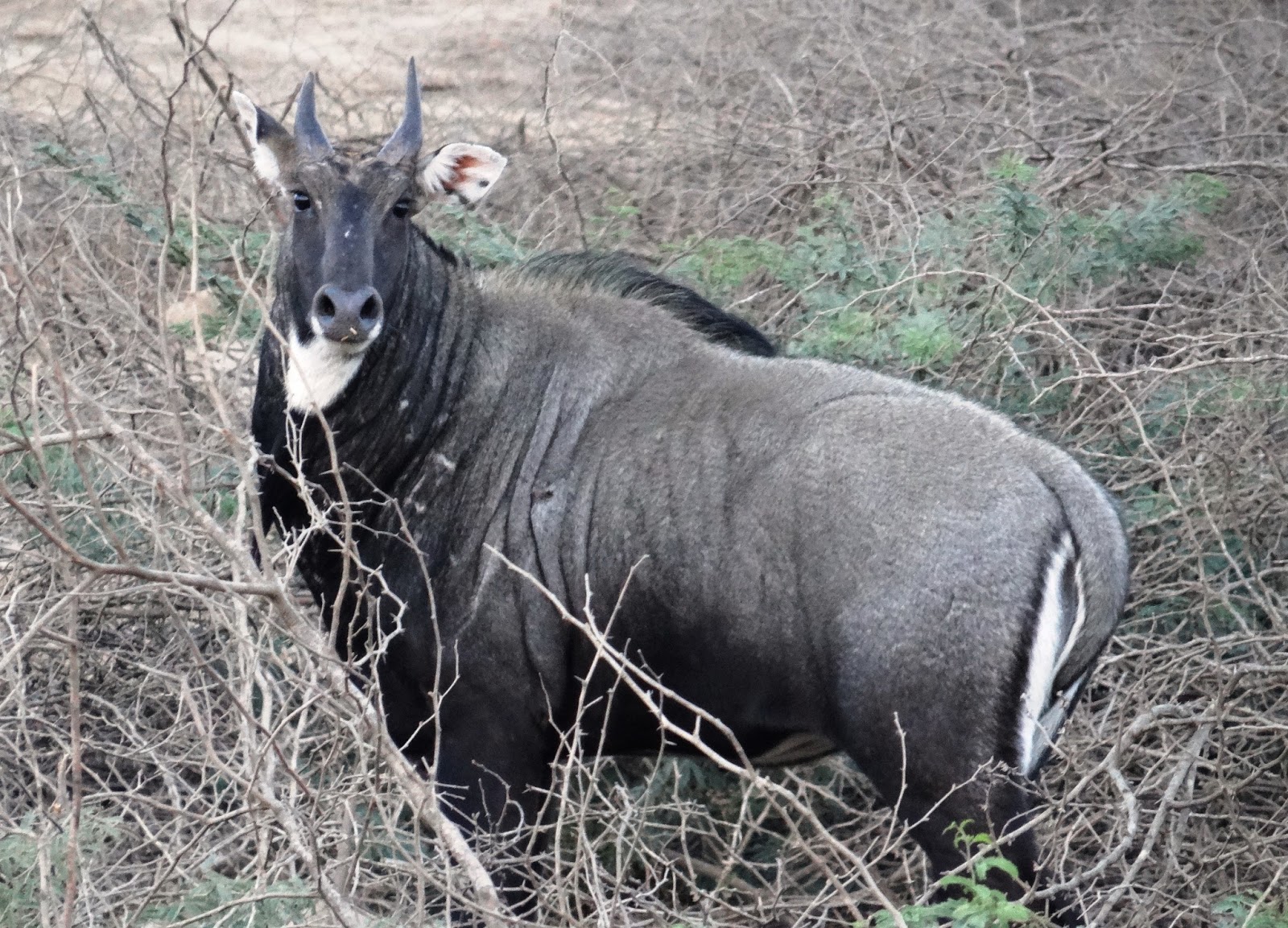
Nilgai
More numerous ungulates include Nilgai, the big Indian antelope. This one was near Mandvi, Gujarat.

Sambar
Sambar deer were not uncommon in places. This one approached our vehicle in Horton Plains National Park, Sri Lanka.

Spotted Deer
Chittal or Spotted Deer were also common. These three in Yala National Park were decidedly nervous, stamping hooves as they stared into the undergrowth, where presumably a predator lurked.
Indian Muntjac
A single Indian Muntjac, or Barking Deer, was seen in the Chinnar Wildlife Sanctuary, Kerala.

Wild Pig
These Wild Pigs were in the Little Rann of Kutch; others were seen in Yala and Mudumalai Tiger Reserve, Tamil Nadu. Other nice ungulates included a group of Blackbuck in Little Rann. A pair of adult male Guar was seen very early one morning in Mudumalai; I had long wanted to see these huge Asian wild cattle.

Commmon Langur
Primates included the widespread Common or Grey Langur. These two were in the Chinnar reserve.

Toque Macaque
Toque Macaque is endemic to Sri Lanka and we saw plenty, including this one in Kandy.

Bonnet Macaque
Its cousin, the Bonnet Macaque, was equally common in the western Ghats. This one was near Hornbill Camp, Kerala.

Purple-faced Leaf-Monkey
Purple-faced Langur, or Leaf-Monkey, is found only in the wet forests of south-west Sri Lanka. We saw several at Sinharaja.

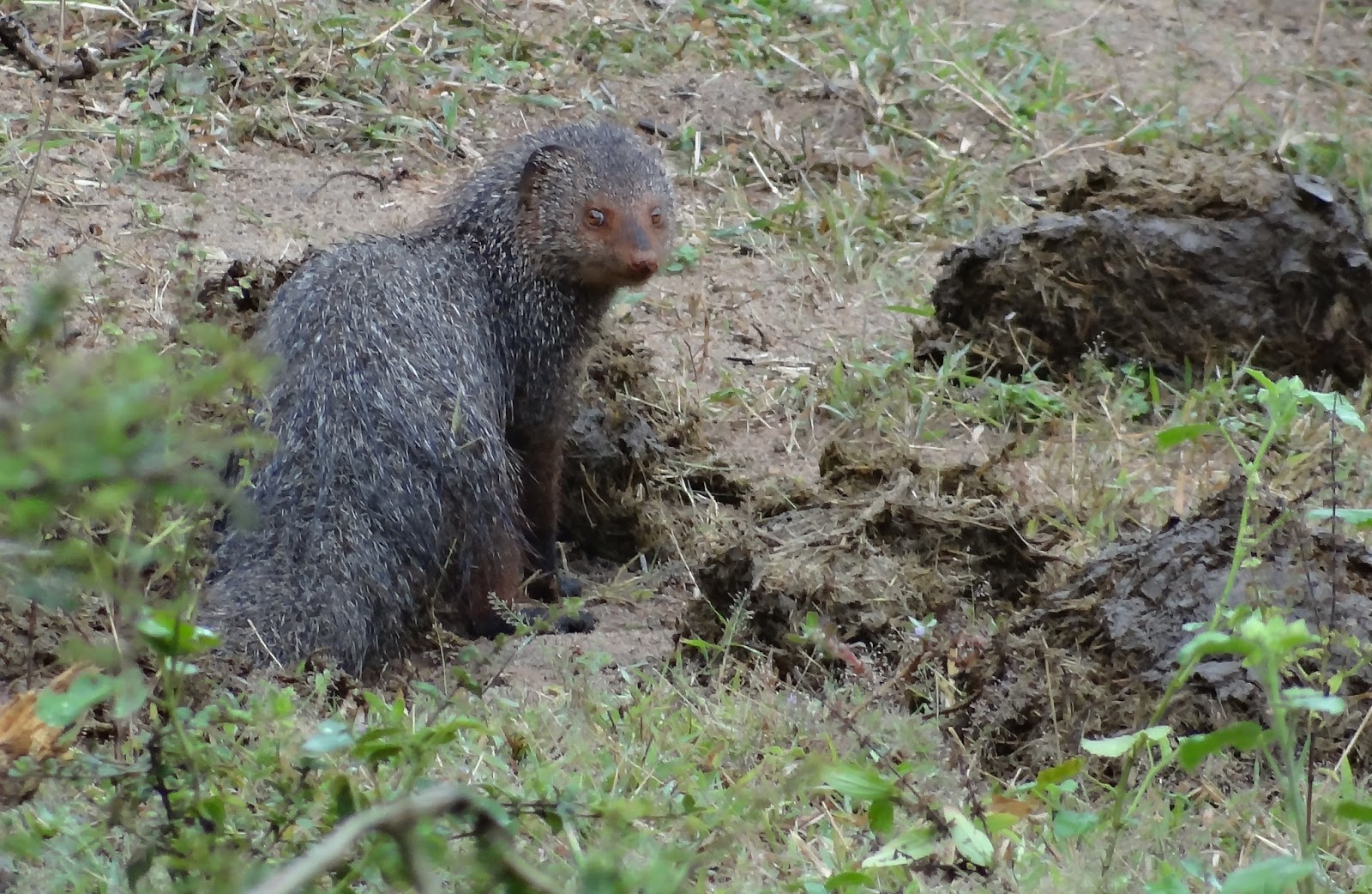
Grey Mongoose
Grey Mongoose was common in Gujarat, with this one seen near the village of Fulay.

Ruddy Mongoose
Ruddy Mongoose was often encountered in south-west India and Sri Lanka. This one fed on elephant turds in Yala. A single Brown Mongoose was seen at Horton Plains.

Malabar Giant-Squirrel
Malabar Giant-Squirrel was seen often in south-west India; this one was in the hills south of Ooty, Tamil Nadu. Its cousin, the Sri Lanka Giant-Squirrel, was also encountered.

Indian Giant Flying-Squirrel
A surprise find was an Indian Giant Flying-Squirrel during the day at Thattekkad. This species is rarely out and about after sunrise.

Five-striped Palm-Squirrel
Smaller fare include Five-striped Palm-Squirrel, common in Gujarat. This one was at the CEDO base in the Greater Rann of Kutch.

Three-striped Palm-Squirrel
Its cousin, the Three-striped Palm-Squirrel, was equally numerous in south-west India and Sri Lanka. These were in Kandy.

Indian Flying-Fox
Indian Flying-Fox was common in Sri Lanka. These were in Kandy.

Blue Whale
The icing on this substantial mammalian cake was Blue Whale. At least six were seen at 1500m off the cost of Merissa, southern Sri Lanka, during a boat trip.

Blue Whale


Wednesday, 27 February 2013

Wet South-West - Birding Sri Lanka Part 2


Serendip Scops-Owl
After leaving the dry woodlands of south-east Sri Lanka (see following post) we headed south-west for a couple of days relaxing around the ancient city of Galle. Then it was on to where the serious endemic-searching is undertaken - the wet forests of south-west Sri Lanka.
We booked into the Rock View Hotel, our base for searching the Sinharaja World Heritage Area. A local man hired by our driver-guide, Chandima Jayaweera, had tracked down a Serendip Scops-Owl at its daytime roost. Perched about 1m off the ground and extremely well-camouflaged, the bird allowed our close approach.

Ketil in action photographing a Serendip Scops-Owl
The bird was so close that one of our group, Ketil, could not use his wonderful cameras to capture its image, instead resorting to a mobile phone. The Serendip Scops-Owl is a recently discovered species with a total population of just 200-300 birds.

Sri Lanka Myna
After the owl encounter, we walked a forest trail in search of some endemics. We tracked down a calling Green-billed Coucal, one of the more difficult to see, in dense undergrowth. Small feeding flocks included Black-capped Bulbul, Sri Lanka Drogo and Sri Lanka Myna.

Southern Hill Myna
As well as the endemic myna, Southern Hill Mynas were seen here and elsewhere as we moved around Sri Lanka.

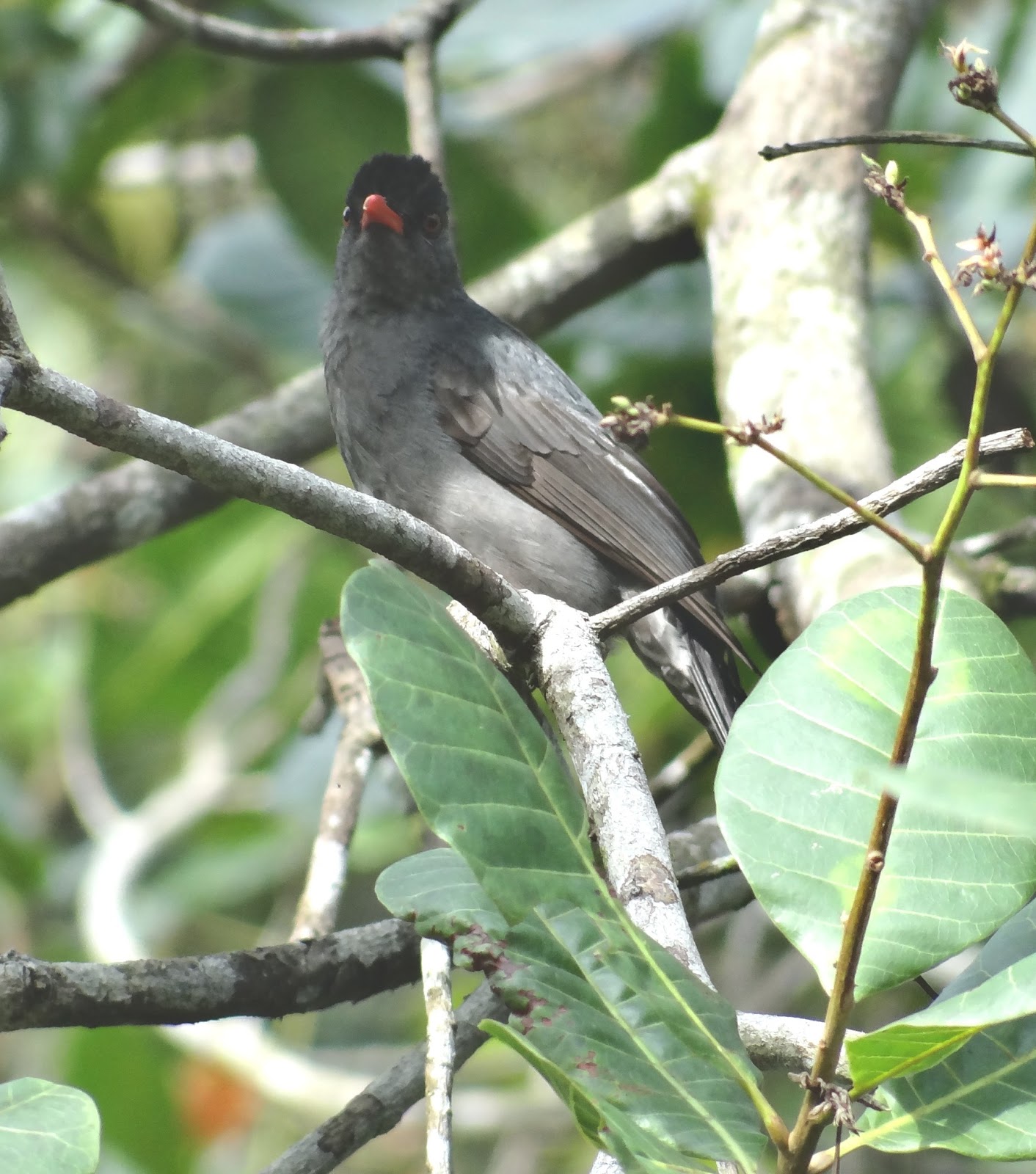
Square-tailed Bulbul
Also about were a few Square-tailed (Black) Bulbuls.

Sri Lanka Grey Hornbill
The next day early in the morning, we met up with the fellow who found the owl and dropped in at the Sinharaja reserve administration centre, where a Sri Lanka Grey Hornill was feeding on fruit left out for the birds and monkeys.

Sri Lanka Blue Magpie
He drove us in his jeep up a steep road to the main Sinharaja birding trail. On the way up we saw White-headed Starling, sometimes a hard bird to find. We stopped at another spot where we enjoyed superb close views of Sri Lanka Spurfowl, another of the trickier endemics. Walking the main trail to a research centre, the specialties came thick and fast. Among the star attractions was Sri Lanka Blue-Magpie.

Spot-winged Thrush
We added the elusive Sri Lanka Thrush, Spot-winged Thrush, Ashy-headed Laughingthrush and the impressive Red-faced Malkoha.

Brown-chested Flycatcher
Nice non-endemics in the forest included Brown-chested Flycatcher.

Sri Lanka Frogmouth
Later in the day, the same fellow who found the roosting owl tracked down a roosting Sri Lanka Frogmouth.

Crimson-backed Flameback
After we returned to our hotel, we found a pair of endemic Crimson-backed Flamebacks across the road from our rooms.

Crested Serpent-Eagle
The next day we transferred to Kithulgula and the nice Plantation Hotel, seeing Crested Serpent-Eagle on the way.

Chesnut-headed Bee-eater
Brown-headed Barbet


In the afternoon, we connected with another endemic, White-throated Flowerpecker. Other birds about included Brown-headed Barbet and Chesnut-headed Bee-eater.

Chesnut-backed Owlet
The next morning, we tracked down a calling pair of Chesnut-backed Owlets, the final remaining endemic on our list.

Black-backed Kingfisher
An unexpected bonus in this area of forest was a Black-backed Kingfisher.

Long-billed Sunbird
We had a few nights at the end of our trip relaxing in a hotel at Negombo. Among the birds here was this Long-billed Sunbird.