Sunshine Coast Birds

Birding and other wildlife experiences from the Sunshine Coast and elsewhere in Australia - and from overseas - with scribblings about travel, environmental issues, kayaking, hiking and camping.
Showing posts sorted by relevance for query noisy scrubbird. Sort by date Show all posts

Saturday, 23 August 2014

Around Oz Part 29 – Albany and Cheyne Beach: Noisy Scrubbird, Western Whipbird, Western Bristlebird, Southern Right Whale

Western Bristlebird
After our visit to the Walpole-Nornalup area (see last post) we continued east to the WA south coast port city of Albany, where we had a couple of nights in the very nice Emu Park Tourist Park, right by the sea with lots of bush around. I was surprised to see that Red-capped Parrot was common and tame, after the bird was so elusive during our earlier visit to Dryandra Woodland.


Red-capped Parrot

Red-capped Parrot

Emu Point, Albany
We had a full day out in the Albany area. Just down the road at Lake Seppings, there were 200+ Blue-billed Ducks and quite a few Musk Ducks.

Musk Duck female
We were impressed by a tour we did of the old whaling station – whaling ended in Australia when this place in King George Sound shut down in 1978. We visited various parts of Torndirrup National Park including The Gap, The Bowholes, Newell’s Harbour and Salmon Holes. More fabulous coastal scenery - as if we  haven’t had enough of it.

Glenn with (Pygmy) Blue Whale skeleton, old Albany whaling station

Newel'sl Harbour, Torndirrup National Park near Albany
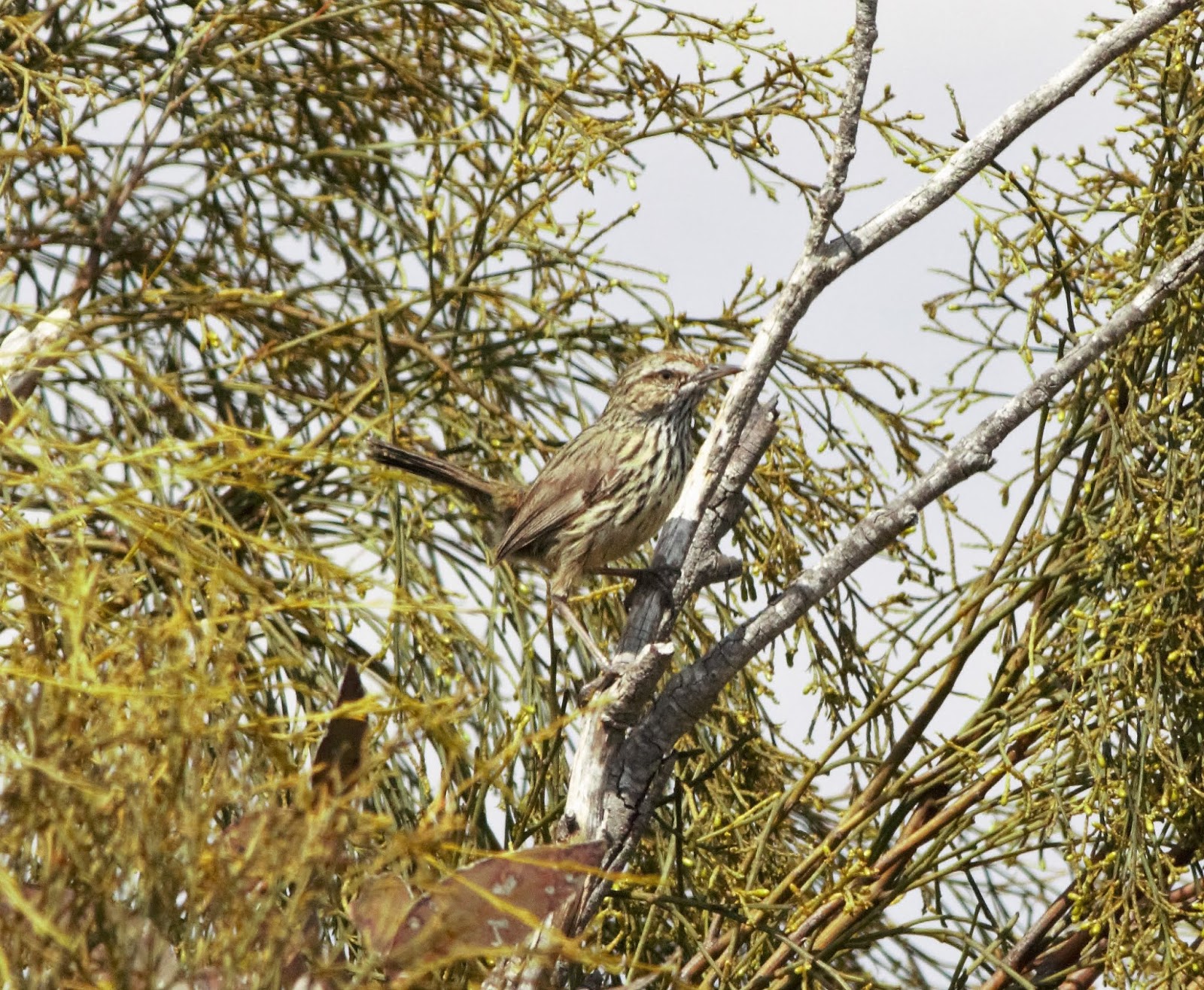
We headed east 60km to Cheyne Beach for a three-night stay in the caravan park. This site is well-known as being particularly good for three of Australia’s more difficult birds – Western Whipbird, Western Bristlebird and Noisy Scrubbird. I had seen all three previously (though not this race ,nigrogularis, of the whipbird - but wanted another look at all three.

Cheyne Beach
We were pleased to see plenty of wildflowers in the coastal heath, although we were a little early for the full show. It’s a lovely setting with a pure white, sandy beach and turquoise sea sweeping eastwards.


Scarlet Banksia - Cheyne Beach

Wildflower Cheyne Beach
 We saw Carnaby’s Cockatoos on the way in. There were plenty of Brush Bronzewings about the hamlet of Cheyne Beach. Around the caravan park were White-breasted Robin, Splendid Fairy-wren, Western Spinebill, Western White-naped Honeyeater and White-browed Scrubwren.

Brush Bronzewing
During our first stroll we had magnificent views of a Southern Right Whale and her calf not more than 100 metres or so offshore, just beyond the waves breaking; they were so close we initially thought they were stranded. A dead Barn Owl was found near the beach. In the evenings from our camper van, we can hear the whales sprouting in the sea nearby.

Southern Right Whale

Southern Right Whale
On the first afternoon I walked the 4-wheel drive track that heads south of the caravan park for about 1.5km. Towards the end of the track I heard Noisy Scrubbird and Western Bristlebird. I had superb views of a Western Bristlebird about half way along on the way back and saw a second briefly, with a third bird heard. I also saw Tawny-crowned Honeyeater, Red-winged Fairy-wren and Southern Emu-wren.

Heathlands of Arpenteur Nature Reserve, Cheyne Beach
My first morning was centred on the track area between the caravan park and beach – the site renowned for Noisy Scrubbird. Three scrubbirds were vocalising at different sites and I saw one  briefly. I also had excellent if brief views of a Western Whipbird, which was calling. One Western Bristlebird was also calling. Later we walked the circuit track via Back Beach. Loads more wildflowers; another Southern Right Whale; and our first Western Wattlebird of the trip. Indian Yellow-nosed Albatross and Flesh-footed Shearwater were seen offshore.

Western Wattlebird
 Seeing the wattlebird means I have seen all the south-west WA endemic species and subspecies on this trip – with the exception of Western Ground Parrot - along with those species that have the region as their main centre of distribution.

Western Bristlebird tracks
We also saw plenty of cat and fox tracks on the sandy tracks, along with bristlebird foot tracks.

On the second afternoon, I hiked to Channel Point, east of the caravan park. I heard a Western Whipbird and a Noisy Scrubbird towards the end of the track and saw a Red-eared Firetail. Coming back I heard a Noisy Scrubbird not far from the caravan park, and saw my second Western Bristlebird; another bristlebird was heard further up the track.

Western Bristlebird
On my second morning, I again walked the track south from the caravan park that I walked the first afternoon. I tracked down a Noisy Scrubbird not far from the park and had three brief but close views. I heard two more scrubbirds further on, where the track levels out along a ridge with plenty of rocks about. I heard Western Whipbird calling twice and saw two other birds briefly, one crossing the track and one in flight over the heath. I saw a total of 6 Western Bristlebirds, hearing about 12 others. A very productive morning; at one point I had bristlebird, scrubbird and whipbird calling at the same spot (among the rocks along the ridge). Southern Emu-wren was also seen again.

Site where  bristlebird, scrubbird, whipbird recorded
On our last afternoon we drove to the mouth of the Waychinicup River and Mt Many Peaks. The river is quite unique in that it is totally exposed to the Southern Ocean, so every wave movement causes a rush of water up the river (that is usually not possible due to a build-up of sandbars at river mouths). I heard Western Whipbird and Western Scrubbird here - 1 of each - this was early afternoon, so I suspect this might be a ood site for both species. There was a camp ground here I had not been aware of. Swamp Harrier and Brown Quail were added to the list.

Mt Many Peaks

Waychinicup River mouth

In the late afternoon,on the tracks between the caravan park and the beach, I heard a single Noisy Scrubird and a pair of Western Whipbirds.
Regarding the three WA endemic skulkers, being careful to avoid double-counting, I saw 2 Noisy Scrubbirds, both calling, and heard 6 others (8 total recorded). I saw 4 Western Whipbirds, 2 of them calling, and heard 4 others (8 total). I saw 6 Western Bristlebirds, and heard 12 others (18 total).

POSTSCRIPT

After posting this I photographed a Western Whipbird and found a Western Pygmy Possum - see here.


Monday, 5 November 2018

WESTERN AUSTRALIA PART 3 – Cheynes Beach to Perth: Honey Possum , Red-eared Firetail, Rock Parrot & three mega-skulkers


After checking out Corakerup Reserve we headed west to Cheynes Beach for a 3-night stay in a chalet in the caravan park. The site is the best known hotspot for three notoriously skulky south-west WA endemics – Western Whipbird, Western Bristlebird and Noisy Scrubbird. We were fortunate to see the whipbird at Corakerup because we failed to see or hear it at all at Cheynes Beach, unlike my last visit there. The coastal scenery was outstanding as usual and the wildflowers put on probably the best display of the trip.

Cheynes Beach wildflowers

Cheynes Beach
The second of the skulkers, Western Bristlebird, is generally the easiest to see. We saw a pair well in Arpenteur Nature Reserve and heard it in three other spots.

Western Bristlebird

Western Bristlebird
We heard Noisy Scrubbird at four sites – two each in Arpenteur and the adjoining Waychinnicup National Park. The usual way to see this bird is to watch the seaside tracks that cut through its territories in the hope one will cross fleetingly. We did this in the late afternoon and saw three crossing within an hour or so, though none offered a photographic opportunity. (I saw my first Noisy Scrubbird the same way in 1979 at Two Peoples Bay, but had to wait two days for one to cross the track!)

Scrubbird vigil
The formidable King's Skink was another regular track-crosser.


Star of the trip was a Honey Possum spotted late one cool morning by Lorna feeding on eucalypt blossums about 1km from the caravan park. I'd long wanted to see this species and just the previous night had wandered about for a couple of hours, checking out numerous flowering banksia flowers without success. The possum fed quietly for about five minutes before quietly disappearing into the foliage. There was no sign of the Western Pygmy Possum that I saw so well in the caravan park during my last visit.

Honey Possum
The caravan park is an excellent place to stay, with easy walking access to all the targets.


 Around our cabin we had a pair of Red-eared Firetail in residence with fully fledged young. This species can be tricky so it was good to nail it.

Red-eared Firetail

Red-eared Firetail
Around the cabin were other good birds including Western Spinetail, White-breasted Robin and Red-winged Fairy-wren.

Western Spinebill

White-breasted Robin

Red-winged Fairy-wren female
Red-winged Fairy-wren male
Brush Bronzewing and Common Bronzewing were equally numerous in the area.

Brush Bronzewing
We found the distinctive western race of Southern Emu-wren several times in the heath.

Southern Emu-wren
After leaving Cheynes Beach we headed north, returning to Stirling Ranges National Park but this time the southern entrance. Here we finally connected with Western (Rufous) Fieldwren which we'd missed in several spots where I'd seen it previously; the bird is evidently in decline.

Western (Rufous) Fieldwren
We had an immature Swamp Harrier close to the road.

Swamp Harrier
We headed south to Albany's Middleton Beach and then west to Conspicuous Cliff, looking for Rock Parrot unsuccessfully in both places. We had beach-washed Flesh-footed Shearwaters on Middleton Beach and had seen a few off Cheynes Beach earlier. Our next destination for an overnight stay was Nornalup. We had pretty well cleaned up the south-west targets so this was a scenic visit to take in the magnificent karri/tingle forests and countless kangaroo paw and other wildflowers in full bloom.

Wildflowers near Nornalup
We decided to take the back roads north to Rocky Gully where we easily found the pastinator race of Western Corella - a potential split - just west of the town along Franklin Road.

Western Corella pastinator
Then it was on to Augusta for another overnight stay. Cape Leeuwin is flanked by the Southern Ocean to the east and the Indian Ocean to the west. The lighthouse grounds are a hotspot for Rock Parrot, the only south-west WA target we still needed. We failed in the late afternoon but sunset over the Indian Ocean was something to see.

Sunset Cape Leeuwin
Early the next morning we had Red-capped Parrot on the way to the lighthouse.

Red-capped Parrot
Then inside and outside the lighthouse grounds we found a total of 15 Rock Parrots, some of which were extremely confiding. They were busily feeding on grass seeds and many had full crops. The birds are nesting on small islands offshore currently but fly to the mainland to feed. Our parrots presumably would be returning soon to feed nestlings.

Rock Parrot

Rock Parrot 
We headed north to Bunbury and Douro Point, where a Eurasian Curlew had turned up a week earlier. The curlew has been visiting this spot for the past three summers. The track in is closed to traffic so we walked to the end of the point. It was low tide so we scanned the mudflats, finding a Eurasian Curlew with a Whimbrel in the scope distantly but the curlew flew and couldn't be relocated.

We continued on to Fremantle for the final two nights of the trip. We checked out the North Mole Lighthouse at the Swan River's entrance and saw a few Fairy Terns in breeding plumage feeding; they nest nearby in a small colony that evidently is thriving. Around Perth we visited Lakes Claremont and Herdsman, seeing plenty of ducks including several Freckled at Herdsman. We tried unsuccessfully for Australian Spotted Crake at the Baigup Wetland but Dodge and Lorna scored it the next morning after dropping me off at the airport for the flight home. Once again, thanks to Dan Mantle, Plaxy Barratt and Frank O'Connor for assistance with some sites.

Fairy Tern


Friday, 27 October 2017

South-East Oz Part 8 – Regent Honeyeater Ablaze at Capertee + Visit to Werrikimbe

Regent Honeyeater
Following our visit to Kangaroo Valley (see following post) we spent a few days sight-seeing in Canberra before continuing north to spend 2 days with our friend Kathy Haydon in Capertee Valley - a renowned birding hotspot. The valley is essentially a vast canyon floor set amid the spectacular sandstone escarpments along the western fringe of the Blue Mountains World Heritage Area.

Capertee Valley near Glen Davis

Capertee Valley near Glen Davis
We camped in the free camp (complete with hot showers!) in the quaintly deserted former mining township of Glen Davis. We visited Gardens of Stone National Park, Wollemi National Park and Capertee National Park. We birded along the Glen Alice and Glen Davis roads. Many thanks to Dean Ingerwersen and Ross Crates from BirdLife Australia for birding advice on the area.

Ironbark woodland, Capertee National Park
The key photographic target at Capertee was the critically endangered Regent Honeyeater, with the site being a major stronghold for this fast disappearing woodland specialist. I have seen this species on just 3 occasions previously, and looked unsuccessfully for it earlier in the trip west of Armidale.

Regent Honeyeater

Regent Honeyeater
Two groups were encountered at Capertee – an impressive gathering of 8-12 birds in Capertee National Park, including at least 2 juveniles of different ages - indicating successful breeding this season in the area. A further group of 3-4 birds was found along Glen Davis Road.


Regent Honeyeater
In both areas, the birds were feeding primarily on the red flowers of the Mugga Ironbark Eucalyptus sideroxylon – a tree that the bird has a special affinity with. The honeyeaters would periodically fly to feed briefly on the white flowers of other Eucalyptus species. At the Capertee site it was noted that the Regent Honeyeaters were constantly chased by the much more common Noisy Friarbirds.


Regent Honeyeater
The two juvenile birds were both fed by adults during the time we had them under observation. Some adult birds had been banded as researchers are working on the birds at Capertee. At the Glen Davis Road site, no friarbirds were present and the Regent Honeyeaters turned the tables – aggressively chasing White-plumed and smaller honeyeater species out of their feeding tree.


Regent Honeyeater adult & juvenile
Another nice find near the Glen Davis camp were a couple of pairs of Rock Warblers on the slopes above the camp, where Brush-tailed Rock-Wallaby was also present.


Rock Warbler
Other birds at Capertee included Brown Treecreeper, White-browed Babbler, Red-capped Robin, Rufous Songlark and Crested Shrike-tit.


Brown Treecreeper

Crested Shrike-tit
Red-capped Robin

White-browed Babbler
Reptiles included Jacky Lizard.


Jacky Lizard
Sections of the main roads have recently been upgraded with 100kmph zones, so vehicles travel at high speed through the valley, taking a substantial toll on the wildlife.


Common Wombat roadkill near Glen Davis
We moved on to Maitland for an overnight stay, then drove high into the mountains for a 3-night stay in the Brushy Mountains Camp in Werrikimbe National Park. A female Flame Robin in the camping round was unexpected.


Flame Robin female
I had hoped to photograph Rufous Scrubbird here but it was not to be. The birds were vocal enough but we were plagued by rain, cold and strong winds. I heard a total of 4 scrubbirds between Spekes Lookout on the Scrubbird Trail and the Brushy Mountains camp; 2 birds along the 3.6km loop trail; 1 bird at the campground; and 4 between Brushy Mountains and the Cockerawombeeba Road turnoff. I managed to see 2 of the Scrubbird Trail birds briefly.


Scrubbird habitat at Werrikimbe
Superb Lyrebird, Bassian Thrush and Olive Whistler were common and the place is worth a visit just for the beautiful camp ground and surrounding forest. 


Brushy Mountains camp
Our final stop was the caravan park at Wooyung near Pottsville on the NSW North Coast, where a feisty Buff-banded Rail was unusually tame. We had been on the road for 52 days, travelling more than 8000km through NSW and Victoria.


Buff-banded Rail