Sunshine Coast Birds

Birding and other wildlife experiences from the Sunshine Coast and elsewhere in Australia - and from overseas - with scribblings about travel, environmental issues, kayaking, hiking and camping.

Saturday, 18 December 2021

North Queensland, December 2021: Chasing wet season visitors

I wanted a few photo ticks from far North Queensland of species that can only or most easily be seen in the wet season, so I flew to Cairns last week on a cheap Covid tourism industry recovery fare ($75!). A hire car (Apex is much cheaper than the big names) was picked up and I was off to the famed Kingfisher Park Lodge at Julatten. I’d not visited there before, but it’s arguably the best site in the country for Red-necked Crake. This time of year is the end of the dry season, hot and with little water about; the crakes (above and below) were seen easily with multiple encounters in forest fragments, on lawn edges and at bird baths. I saw them several times from my motel room deck (first image below).
Another wet season visitor I was after (none of these targets were lifers) was Buff-breasted Paradise-Kingfisher. This glorious bird was happily common, with several active termite mound nests on the property and birds seemingly calling all over the place.
Early the next morning I drove up to the grassy clearing atop Mt Lewis, the go-to site for Blue-faced Parrotfinch. They are not usually there in numbers until late in the wet season so this was a bit hit-and-miss, with just a single sighting of one bird on ebird this season. However, a parrotfinch was literally the first bird I saw in the gloomy light upon arrival. An adult and a subadult fortunately hung about until the light improved, exploring roadside seed along the rainforest edge.
Other birds were somewhat hard to come by but I saw - among others - Chowchilla and Tooth-billed Bowerbird (below).
Others included Bridled Honeyeater and Bower’s Shrike-thrush (below).
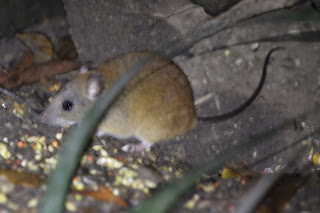
Back at the lodge I spotlighted around the grounds that evening seeing several Bush-Rats (Rattus fuscipes) and Fawn-footed Melomys (above) and an obliging Giant White-tailed Rat (below).
An Amethystine Python put in an appearance (above), as did a gaunt White-lipped Tree-frog (below).
The next morning I had nice views of a male Superb Fruit-Dove.
I headed north to Cooktown, stopping at a lagoon along Hurricane Road near Mt Carbine which can be productive. A pair of Squatter Pigeon by the road were unusually tame.
At the lagoon was a vocal Brown Treecreeper of the distinctive north Queensland race melanotus.
I was given a site for Spotted Whistling-Duck by my friends Kath Shurcliff and David Houghton at Keatings Lagoon near Cooktown. In very hot and humid conditions I tracked down a flock of 18 birds which kept to themselves in well-vegetated backwaters, showing no inclination to join the large numbers of Wandering Whistling-Ducks in more open areas.
Also at the lagoon were a couple of Tropical Scrubwrens.
The next morning I failed to connect with Black-winged Monarch along the road to Walker Bay (above) outside Cooktown, where they had been seen recently, although Kath heard one. I had to make do with a Yellow-spotted Honeyeater on its nest.
Carlia longipes (Closed-litter Rainbow-skink) was common in the leaf litter.
I drove south to Kuranda for an overnight stop with my friend Alexander Watson. A pair of Double-eyed Fig-Parrots showed beautifully at eye level by his back door. Many thanks to Alexander for lending me his camera for this trip after I dropped mine in a creek two days before leaving for Cairns!
I moved on to Cairns. It took a couple of visits to the France Road turf farm to finally notch up Eastern Yellow Wagtail, which had been present here in recent weeks. The first of three birds seen eventually was well-picked up by Martin Cachard.
In and about Cairns, Torresian Imperial-Pigeons were nesting everywhere. This migratory species once nested only on offshore islands, visiting the mainland to feed. An abundance of suitable food (palm fruit mostly) evidently accounts for the change in behaviour.

Monday, 29 November 2021

Buff-breasted Buttonquail: an Update

A scientific report has been amended in response to criticism by some in the birding community that researchers were dismissive of multiple sight records of the extremely rare Buff-breasted Buttonquail (illustration above by Birds of the World). The report published by the Threatened Species Recovery Hub of the National Environmental Science Program last July raised the prospect of all recorded sightings of Buff-breasted Buttonquail from south of Cooktown being misidentified Painted Buttonquail. A newly amended version of the report concedes that some records may be authentic. The Buff-breasted Buttonquail is found only in the savanna woodlands of Queensland’s Cape York Peninsula (below). The July research report by a team of University of Queensland scientists says the last confirmed records of the bird were probably in the 1920s. It argues that the buttonquail population may have crashed due to several factors including the introduction of cattle, changed fire regimes and feral predators. What follows are recent changes [in square brackets] made to the report.
(1) Version 1: “These unverified observations have influenced our perception of the species’ autecology and threats….” Version 2: “These observations have influenced our perception of the species’ autecology and threats….” [unverified is dropped] (2) Version 1: “This research has found sufficient evidence to suggest that all southern records of Buff-breasted Button-quail could involve misidentified Painted Button-quail. Our research has found the features and methods researchers and birdwatchers have used to identify Buff-breasted Button-quail from Painted Button-quail are incorrect.” Version 2: “Our research has found that many of [not all] the features and methods researchers and birdwatchers have used to separate Buff-breasted Button-quail from Painted Button-quail are incorrect. This may suggest that a significant proportion of southern records of Buff-breasted Button-quail could involve misidentified Painted Button-quail.” [The suggestion that all southern records could involve misidentification is removed.] (3) Version 1: “Due to our research there is now considerable evidence to suggest all reports from this region have in fact been misidentified Painted Button-quail.” Version 2: “Due to our research there is now evidence to suggest many, and perhaps most [not all] reports from this region may have been misidentified Painted Button-quail.” (4) Version 1: “Furthermore, this project has determined previous reports from the 1980s to the present day in the Wet Tropics and Einasleigh Uplands Bioregion are likely to be erroneous, suggesting the last confirmed record of this species was probably in the early 1920s.” Version 2: “Furthermore, this project has determined that a significant proportion of reports from the 1980s to the present day in the Wet Tropics and Einasleigh Uplands Bioregion could have been misidentifications.” [“significant proportion” is added; “likely to be erroneous” is deleted] (5) Version 1: “However no contemporary reports are accompanied by verifiable evidence despite the dramatic increase in photography by the birding community.” Version 2: “However, no contemporary reports are accompanied by verifiable evidence, such as a skin or photograph, despite the dramatic increase in photography by the birding community.” [What constitutes verifiable evidence is clarified.] The edited report is here (copy and paste URL): file:///C:/Users/Greg%20Roberts/Documents/BBBQ%20version%202.pdf

Monday, 1 November 2021

Twitching Semipalmated Plover & checking Lockyer Valley hotspots

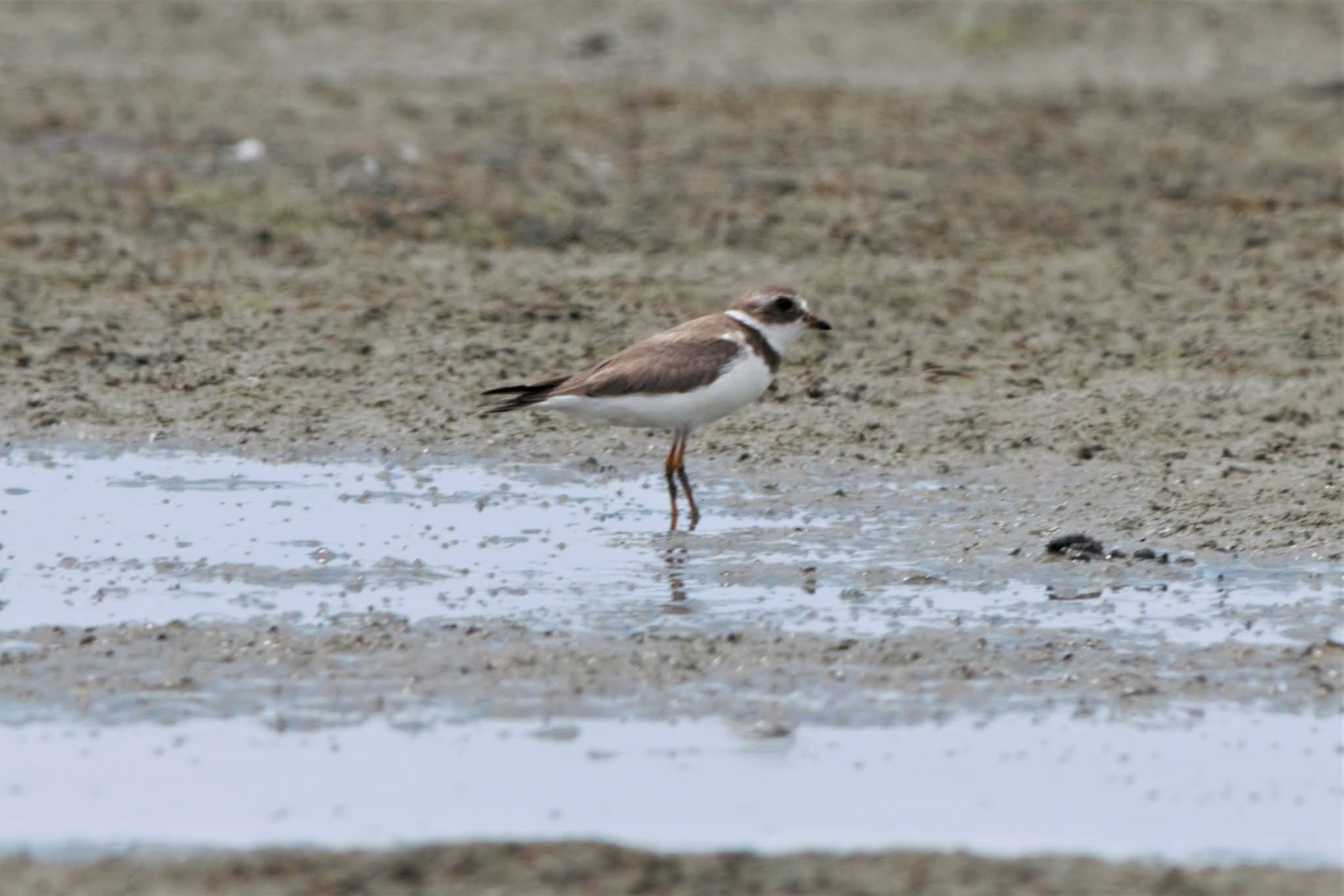
Queensland twitchers were all a flutter when Michael Daley reported last night (October 31, 2021) that he had found a Semipalmated Plover at the Geoff Skinner Wetlands Reserve, at Wellington Point by Moreton Bay, not far from Brisbane. It is only the second record of this vagrant from Queensland and there are just a handful of sightings for Australia, mostly in Western Australia.
By the time I got there about 11am today, it was low tide. Apart from the initial sighting late yesterday, quite a few people saw it early this morning, but all sightings had been at or close to high tide, when large numbers of shorebirds roost here. So whether it would be around all day was an unknown quantity, although Red-capped Plovers and some small shorebirds often remain at high tide roosts throughout the day, providing there is sufficient feeding habitat around. I ran into a couple of local birders; we spread out and I spotted the plover through my scope about 10 minutes after arriving.
The Semipalmated Plover appeared quite settled, feeding with a couple of Red-necked Stints and Red-capped Plovers on one of a small number of shallow pools that were scattered around the large claypan. Apart from these three species, the only other shorebirds were 2 Sharp-tailed Sandpipers; just a few hours earlier, hundreds of shorebirds were present. The plover was flushed by a council mosquito inspector and settled on a nearby pool, where we watched it for about 30 minutes before the small group flew off to another pool 50 metres away. We left the birds there. Harsh light conditions in the middle of the day did not make for ideal photographic conditions. Gum boots are strong advised for this site! The species elsewhere in Australia has sometimes (but not always) hung around for long periods of time. The image below is the plover with stints.
At the end of last week I checked out some of my favourite sites in the Lockyer Valley, west of Brisbane. Bird of the day was Ground Cuckoo-shrike – a party of 4 feeding close to the road, just south of the junction between Watsons Road Boyces Road, near Atkinsons Dam. This species, a rarity in south-east Queensland, is resident in small numbers in the valley but always difficult to come across.
Also on Watsons Road, a Little Red Flying-fox was found dead after evidently striking a barbed wire fence.
At Lake Galletly near Gatton, 6 Blue-billed Ducks were present. The birds have long been attracted to this site but are absent for lengthy periods. They’ve been there for several months now and were recently reported to have young but I saw no ducklings; they may have been eaten or were hiding.
Pink-eared Duck was in good numbers on the lake, with 140 counted. This is another species that fluctuates wildly in numbers in south-east Queensland, often being absent for lengthy periods.
Plenty of Short-necked (Brisbane River) turtles (Emydura macquarii) were on the lake edges.
Australasian Shoveler was found with ducklings at Karasch’s Lagoon. Better still were the 14 Hoary-headed Grebes present here. The birds have evidently been on the lagoon since early this year. During my last few visits this lagoon has been dry so it was nice to see it full.
Other birds at Karasch’s included about 10 Red-kneed Dotterel and more Pink-eared Ducks.
Rains this year have been patchy, however, and other wetlands like Lake Clarendon and Seven Mile Lagoon remain dry. A small dam near Lake Clarendon had good numbers of Whiskered Tern in breeding plumage.
A Spotted Harrier was close to the road at Seven Mile Lagoon.
At Peach’s Lagoon, few waterbirds were in evidence but Red-rumped Parrot (above) and White-winged Triller (below) were about.
On the home front, a pair of Square-tailed Kites are nesting for the second year in a row at Koala Park in Nambour, not far from home.