Sunshine Coast Birds

Birding and other wildlife experiences from the Sunshine Coast and elsewhere in Australia - and from overseas - with scribblings about travel, environmental issues, kayaking, hiking and camping.
Showing posts with label buttonquail. Show all posts

Monday, 12 February 2024

Notes on the outlook for Coxen’s Fig-Parrot, Night Parrot & Buff-breasted Buttonquail: links between their fate and the “Blue-browed Fig-Parrot” fiasco


The following is the transcript of my news feature in The Weekend Australian of 10-11 February, 2024.


Coxen's Fig-Parrot

A 17-year-old mystery surrounding the identity of a tiny parrot is having unforeseen consequences for the welfare of endangered Australian wildlife. Self-promotion by high profile individuals and poor decision-making by Queensland Government authorities have combined to threaten rare and mysterious species, and deep divisions within the natural history community are laid bare.

Just one variety of bird, the paradise parrot, is confirmed as having become extinct on the Australian mainland since European settlement; it was last seen in the 1930s in south-east Queensland. Now, the fate of three more birds – the Coxen’s fig-parrot, night parrot and buff-breasted buttonquail - hangs in the balance. Two of the three are possibly extinct, contrary to confused government advice, with the third teetering precariously on the brink.


Buff-breasted Buttonquail

The celebrated naturalist Steve Irwin died in September 2006 when he was struck in the heart by a stingray barb on the Great Barrier Reef. Soon after, as a journalist working for The Australian, I was phoned by Tom Biggs, a Brisbane medical specialist who was providing commercial advice to controversial north Queensland naturalist John Young and his company, John Young Enterprises. Biggs asked if I was interested in breaking a “really big” story for this masthead concerning Young and a parrot; no further details were offered.

Biggs and Young were aware I had publicly suggested the Coxen’s fig-parrot might be extinct. The brightly coloured parrot once frequented the rainforests of south-east Queensland and north-east New South Wales but there had been no confirmed records of the bird for three decades at the time. Young claimed in the 1990s to have photographed the fig-parrot in NSW but did not produce convincing images. Young also asserted in the 1970s that he found a population of paradise parrots in north Queensland, but no evidence was forthcoming. Assuming Young was again claiming to have rediscovered the Coxen’s fig-parrot or paradise parrot, I politely declined Biggs’s offer.


Night Parrot

A few days later, in November 2006, Brisbane’s The Courier Mail newspaper splashed the story across its front and inside pages. It was not about those two birds but something more eye-catching: Young had supposedly discovered a species of parrot unknown to science - the blue-browed fig-parrot. The “discovery” was announced amid much fanfare at a function at O’Reillys Guesthouse in the Gold Coast hinterland by Queensland Environment Minister Lindy Nelson-Carr. Scientists from the state government’s threatened species unit hailed the discovery as ground-breaking and pledged to work with Young on publishing scientific papers.

But it wasn’t true. Investigations by The Australian, aided by Melbourne ornithologists Jeff Davies and Andrew Isles, indicated that Young’s image was an altered photograph of a much more common species – the double-eyed fig-parrot from north Queensland. Gale Spring, a leading forensic photographic expert, concluded there was little doubt the image was altered. Ornithological experts from a range of disciplines were unanimous in dismissing the claim. The Queensland Government withdrew its support for Young.


John Young

Young’s large number of supporters in the wider natural history community were furious. Fellow North Queensland naturalist and author Lloyd Nielsen declared on the online platform birding-aus that articles in The Australian were “despicable”, insisting Young’s claim was genuine: “This special bird really does exist as depicted in the published photograph.”

Now it is possible to throw further light on the matter. Nielsen relates how the day after the O’Reilly’s announcement, he and others were led by Young on a long hike through Lamington National Park to be shown a “blue-browed fig-parrot nest”. Young pointed to a small hole at the top of a tall tree and said it was the nest entrance. When no birds appeared after a short time, the group headed back. Nobody saw the bird, including government scientists who had endorsed Young’s claims.

Young pledged on his website in February 2007 to produce a "body of evidence, including photographs of multiple birds, recordings and biological material together with a nest site" at some future date. The evidence has failed to materialise 17 years on, but many nature enthusiasts continue to believe Young’s new parrot is out there. The big unanswered question: “Why would a claim like this be manufactured?”


Lloyd Nielsen

Young has told me and others in recent years that the bird he photographed was in fact a Coxen’s fig-parrot. He admitted that his claims of a new species were bogus. Young showed me a photograph of a dead bird in a nest hollow that resembled a Coxen’s fig-parrot - a species that has never been photographed. Nielsen told me he was also aware the new species claim was false, even when he was publicly asserting the opposite. Nielsen remains unsure if Young photographed a Coxen’s fig-parrot or if he “coloured in” a double-eyed fig-parrot image. Colours aside, parrot experts point to descriptive features, such as the bill shape in the pictured bird, indicating a double-eyed fig-parrot.

Young and Nielsen say Young succumbed to pressure to make his false claim. There were discussions about him emerging as the “new Steve Irwin” after the naturalist’s death and that a natural history discovery of epic proportions was needed to boost his profile. Something sexier than a Coxen’s fig-parrot. Young told me his “commercial backers” hatched the idea that he discovered a new species. Nielsen agrees, insisting he and Young did not want to go along with the ruse.


Coxedn's Fig-Parrot specimens (Neil Hart)

Tom Biggs rejects the suggestion that he urged Young to manufacture the parrot claim. Biggs tells Inquirer: “I am far from an expert. I don’t have 100th the experience that John has, and I am disinclined to think it was my suggestion. I have no recollection of suggesting it was a new species. I doubt that I would have suggested that on the basis of John’s claim, based on a photograph, that it was a different species from Coxen’s.” Biggs adds: “To the extent that he photo-shopped or deliberately manipulated colours, I wouldn’t know. It’s easily done these days.”

Young and Nielsen are among many naturalists who insist the Coxen’s fig-parrot is doing well in the wild. That view resounds with officialdom: Queensland Government threatened species experts – the same ones who believed in Young’s blue-browed fig-parrot - insist there are scores of reliable records of the species in recent decades. In 2018, the state took the extraordinary step of downgrading the status of the fig-parrot from Critically Endangered on the basis that its estimated population of between 50 and 250 had not changed for many years. The estimate was and remains misguided; not one of the reports has been confirmed by a photograph, sound recording or other evidence. The downgrading was executed at a time when many experts believe Coxen’s fig-parrot was likely to be extinct.

Young’s focus of attention shifted soon after the blue-browed fig-parrot debacle when The Australian revealed in February 2007 that a dead night parrot was found in Diamantina National Park in north-west Queensland by Robert “Shorty” Cupitt, a bulldozer operator. The bird was decapitated by flying into a barbed wire fence. Other than another dead bird found in 1990, also in north-west Queensland, the night parrot had not been reliably recorded for a century. At the time, it was considered more rare and mysterious that the Coxen’s fig-parrot.


John Young at the site where he photographed the Night Parrot in 2013

The Queensland Government had suppressed news of this remarkable discovery for several months, and would have continued to do so indefinitely, while failing to make meaningful efforts to find and protect populations of birds in the wake of Cupitt’s find.

The discovery was potentially a golden opportunity for Young to restore his bruised reputation by tracking down this enigmatic species - one of just two nocturnal parrots in the world and apart from Coxen’s fig-parrot, the only parrot never to be photographed. Young located parrots by call in the Diamantina area and eventually photographed a night parrot in 2013 - a remarkable feat that attracted international recognition. The site where the parrots live was acquired by Bush Heritage Australia and called the Pullen Pullen Reserve. BHA and the Australian Wildlife Conservancy are Australia’s two big organisations devoted to acquiring properties for wildlife conservation.

Young’s initial close working relationship with BHA was short-lived and he was hired by AWC to search for night parrots. Young quit the AWC in 2018 when an inquiry commissioned by the organisation expressed doubts about photographs he claimed to be of night parrot nests and eggs. The inquiry doubted Young’s claims to have discovered the parrot in South Australia. The AWC ditched two years’ worth of material that Young had gathered. Nielsen again came to his defence, saying at the time: “It's shameful that all that work was discarded.” Young continues to claim new night parrot records: in a blog post last April, he said he had discovered birds at 11 additional sites in outback Queensland since his 2013 photographs.


Fence at Pullen Pullen where a Night Parrot was killed

Parrot experts believe Young and his backers have set back the cause of night parrot conservation with unsubstantiated claims of finding them at multiple sites. “Young’s data was being used to inform decisions about funding and planning for night parrot conservation,” Australian National University researcher Penny Olsen told the ANU Reporter last March. “The bird might feel mythical but it lives in the real world, and the consequences of misrepresenting its population size and distribution are serious.” Young and Nielsen declined to respond to requests to comment.

At Pullen Pullen, the outlook is bleak: the total parrot population was estimated in 2022 to be between 10 and 20. Numbers have not increased since the 2013 photographs, and surveys have failed to locate additional populations in Queensland. BHA refuses to say what the population is now, or to comment on whether a recent explosion of feral cat numbers on and around Pullen Pullen has had adverse consequences for the tiny population.

In 2019, another night parrot was killed after flying into a barbed wire fence on Pullen Pullen; the fatality may have constituted between 10 and 20 percent of the population. Barbed wire fences on the property separate night parrot roosts from each other and from surrounding feeding grounds. Fences are located within a few hundred metres of parrot roosts. BHA built a new barbed wire fence along Pullen Pullen’s western boundary in 2017.


Entrance to Pullen Pullen

Useful data was provided when researches in the reserve put transmitters on two night parrots which were tracked, one in 2015 and one in 2016. That work revealed parrots fly long distances at night from day roosts to feeding grounds. Pullen Pullen researchers travelled to Western Australia to do the same with a third bird at a newly discovered site in 2018. As lead researcher Nick Leseberg told podcast host Thomas Doerig in 2022: “We went over there, put the tag on it and never saw it again. It flew away and disappeared.” Extensive searches failed to find the bird and it was not heard calling again at its roost.

BHA has now thrown a veil of secrecy over its Pullen Pullen operations. The organisation will not say if other parrots have died on barbed wire fences or been lost after being fitted with transmitters. “Unfortunately none of our staff are available to help with this story,” said BHA spokeswoman Coco McGrath. BHA has in the past declared that its operations are “utterly transparent”, but the secrecy surrounding the night parrot that kicked off with Cupitt’s find continues. BHA has the back of the Queensland Government, which introduced a $353,400 fine or two-year jail sentence for entering the 56,000ha Pullen Pullen Reserve without permission.


Double-eyed Fig-Parrot

John Young had been through the windmill with the Coxen’s fig-parrot and night parrot controversies. Next he set his sights on the third critically endangered species in this saga – the buff-breasted buttonquail. Young and Nielsen claimed to have had multiple encounters with the small ground bird since the early-1990s in a large area of woodland north of the Atherton Tableland in north Queensland. Those reports set the birding world on fire. Hundreds of bird enthusiasts from around the world claimed to have spotted the buttonquail after travelling to the area.

It was seemingly a mirage. Again, not a single record was supported by a photograph or other evidence. University of Queensland researcher Patrick Webster undertook extensive surveys of the area and found no evidence of the bird’s presence, instead repeatedly seeing a closely related and much more common species - the painted buttonquail. Webster and his colleagues conclude that none of the reports are likely to be genuine.


Painted Buttonquail

This made no difference to Queensland Government authorities which, largely on the basis of records from Young and Nielsen, refused over many years to upgrade the status of the species to Critically Endangered. The last confirmed record of the bird was in 1922, when specimens were collected near Coen on Cape York. The government’s faith in the integrity of claims by the two naturalists was unaffected by the fig-parrot and night parrot rows.

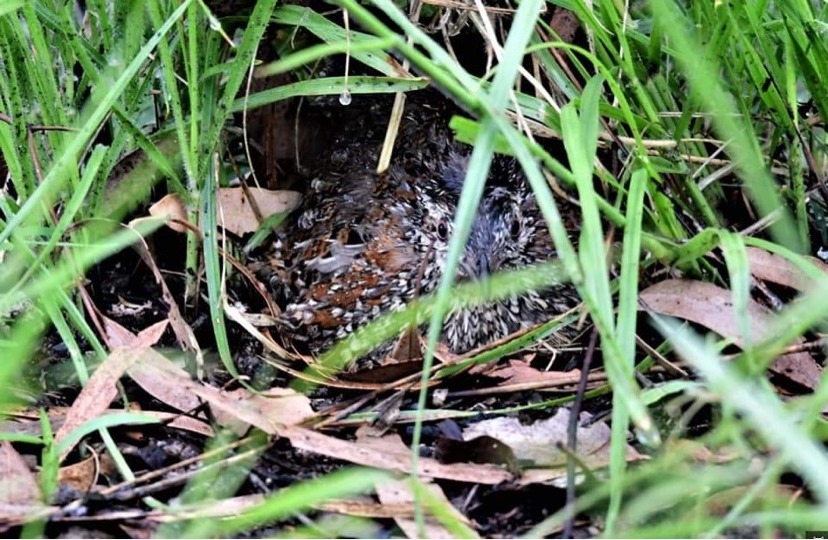
In the face of Webster’s research, Young and Nielsen doubled down on their buttonquail records. Like the night parrot until 2013 and the Coxen’s fig-parrot, the buttonquail had never been photographed. But Young said he had photographs of the nest and eggs of a buff-breasted buttonquail as well as multiple images of the bird itself, which he shared with Nielsen. In July 2022 Inquirer called into question a published image of what Young described as a buff-breasted buttonquail nest that proved to be the nest of a painted buttonquail.


The nest that John Young claims to be that of a Buff-breasted Buttonquail

I later published one of his images of the bird on my blog, sunshinecoastbirds. Experts agreed it was likely a painted buttonquail. Nielsen again responding angrily, saying on Facebook he was “thoroughly disgusted” at what he described as “gutter journalism”. However, following these revelations, the Queensland Government was finally motivated to intervene and upgrade the status of the buff-breasted buttonquail to Critically Endangered, in November 2022. At the same time, it reversed its 2018 decision to downgrade the status of Coxen’s fig-parrot, restoring it to Critically Endangered. It may be too late, however, for all three special birds.


Sunday, 10 July 2022

Buff-breasted Buttonquail: An image claimed to be of this species revealed

A previously unpublished image above and below (cropped) is claimed by north Queensland naturalists John Young and Lloyd Nielsen to be a Buff-breasted Buttonquail. It was taken at a secret site late last year on a camera trap in north Queensland where Young claims to have encountered Buff-breasted and Painted Buttonquail together, along with the nests of both species.
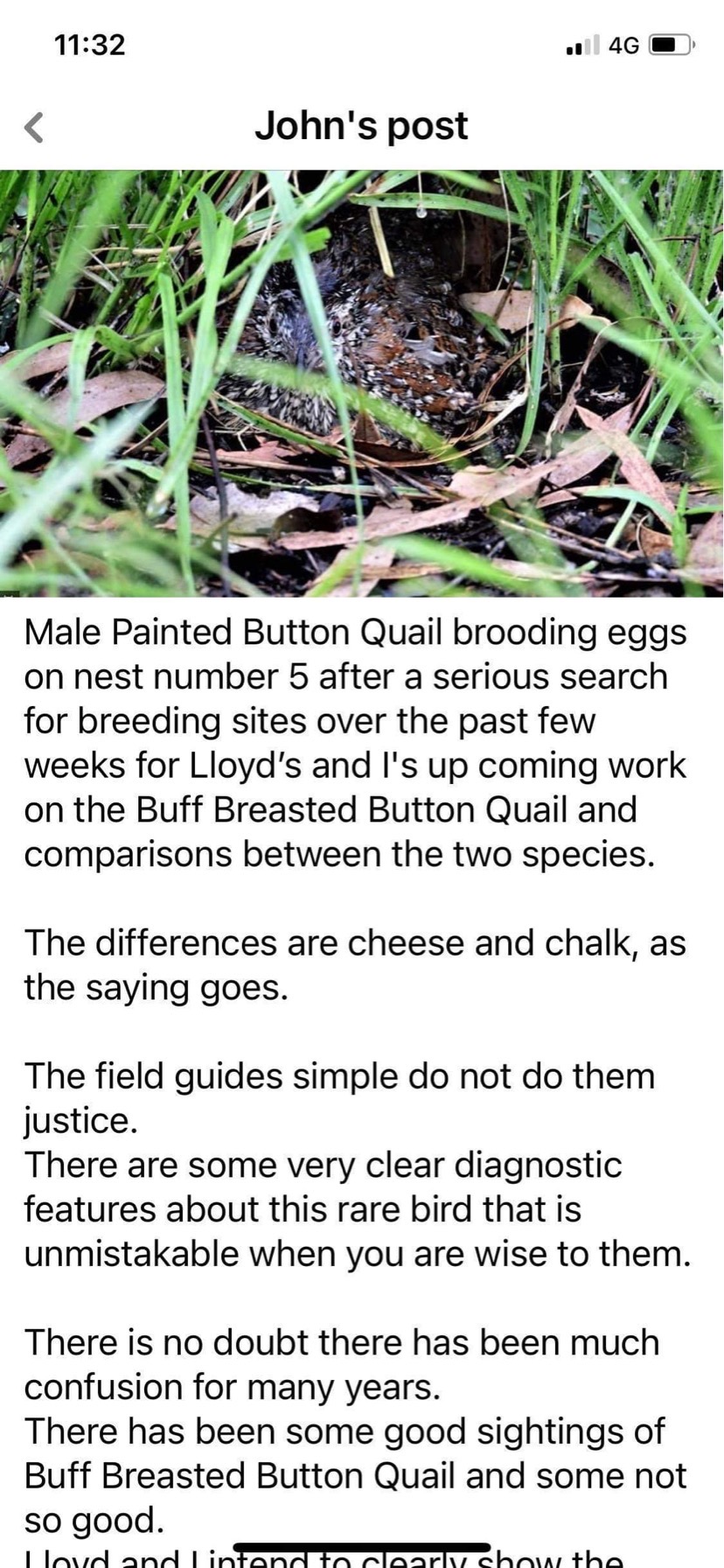
As I reported last week - in the following post on this blog and in the pages of The Weekend Australian - Young published an image earlier this year of what he said was a Painted BQ on its nest at this site, labelling it on Facebook: “Male Painted Buttonquail brooding eggs on nest Number 5 after a serious search for breeding sites over the past few weeks.” When that image is “flipped” or inverted, however, it is clear the nest is the same as one in an image published in 2018 that Young claimed to be that of a Buff-breasted BQ at Brooklyn, a different site. The composite below shows the many features common to nests in the two images. In response to this publication, Young and Nielsen, who have launched a public appeal for funds to aid Young’s research at the secret site, directed a torrent of personal abuse at me - referring to me as "subhuman" and plenty more in similar vein - but neither denied its substance.
Following this report, much discussion ensued about what happened to multiple images of Buff-breasted BQ claimed to have been taken by Young at his new site. Young showed me the camera trap image on his phone during a visit to my home (below) last December. At the time I was initially impressed; the bird looked different and did not appear to me to be a Painted BQ. However, I was concerned that key facial features, especially eye colour, were obscured in the image and therefore I could not be certain. Young was insistent that I publicly agree with his identification and I did so after receiving an iron-clad assurance that he had other images showing the key missing features. My request to retain a copy of the image was denied.
As I freely admit, that was a mistake on my part. I subsequently looked again at the image on a bigger screen on Nielsen’s home computer, and considered buttonquail identification material from various sources. Those included notes published recently by Patrick Webster about plumage phases not previously known for Painted BQ, and useful commentary from my friend Chris Corben, an astute observer of the finer features of feathers. It seems likely this image in fact depicts a Painted BQ (below). The rump and upper tail of a Buff-breasted BQ should be sandy-rufous rather than brownish-grey. The relative absence of dark bars on the upperparts of Buff-breasted BQ suggest the species should be more sandy-rufous than Painted BQ. I discussed this in a previous blog post: https://sunshinecoastbirds.blogspot.com/2021/12/painted-or-buff-breasted-buttonquail-in.html
The claimed image of BBBQ is one of what Young insisted was a collection of 17 images taken from camera traps at the time. What happened to the others? They have not surfaced. Young (below, at his new site) said publicly they would be kept in safe hands by himself and Nielsen, until a joint paper they are working on about the Buff-breasted BQ is complete.
To my surprise, when I saw him in December, Nielsen said he was shown just the single image – the one featured in this post. Young claims more recently to have taken further images. He has furnished an unknown number of these in the form of colour prints on paper to Nielsen and others. One friend, Alwyn Simple, described the eyes of a bird in one print as “large milky yellow” and not the red eyes of a Painted BQ; below is a composite showing these differences.
Nielsen says he is “100 percent” convinced the latest images are that of Buff-breasted BQ. He initially said the earlier camera trap image was also “100 per cent” a Buff-breasted BQ; when I asked why, he referred to its “uniform and plain” tail and “streaky, dark” wing pattern. Later, Nielsen said that “perhaps I should have said 80 percent”. Last week on Facebook, Nielsen seemed to be having second thoughts about the adequacy of images produced to date, saying: “We need to get good high quality photographs...” and “we are hoping to get high res images this coming breeding season”. The waiting game continues and like many others, I would be delighted if these images eventually emerge. Nonetheless, it is curious that among the many BBBQ nests supposedly found over several decades, not a single image of a bird on a nest has surfaced, when organising this at night especially should not be difficult. In anticipation of further personal vitriol as a consequence of this post, I have no intention of personally attacking Young nor Nielsen but am endeavouring to stick to facts which should be in the public arena.
It's worth recalling what John Young said on 28 November last year when he found the image that kicked off this thread: "I had 3 camera traps set up on 3 different hills about a kilometre apart and today I finally got a chance to go through the images, some 3000+ on the last camera trap. Half way through I became absolutely speechless..there in full colour taking up nearly a quarter of the frame was an image that I have only dreamt about. A huge Buff Breasted Button Quail!!! Lloyd and I just looked in astonishment as this was not the only image, I got a third bird also. Lloyd and I almost had tears running down our face. We have both worked so hard to get this thing and now..WE HAVE GOT THEM...WOW WOW WOW. I have them in 2 locations now a kilometre apart. EXCITING I have everything on 3 harddrives that are hidden away, " To which Lloyd Nielsen (below) added: "Wow! Absolutely mind blowing. First authentic colour pictures of a Buff-breasted Button-quail ever taken! Such an accomplishment! I knew John would pull it off!"

Saturday, 2 July 2022

Buff-breasted Buttonquail: Smoke & Mirrors

What follows is a transcript of my story in today’s edition of The Weekend Australian (2-3 July, 2022). The first three images in this blog post are central to the story. The first image is of a nest taken by John Young at Brooklyn in north Queensland, published in 2018 and claimed to be that of a Buff-breasted Buttonquail. The second image is of a Painted Buttonquail on a nest taken by Young at a different, undisclosed site where he says he has also photographed Buff-breasted Buttonquails and their nests; this was published last January. The third image is the second one “flipped” or inverted, so what appears on the left in the second image now appears on the right, and vice versa. When this image is compared with the first one from Brooklyn, many similarities are obvious, suggesting they are the same nest. The fourth image is a composition by Clive Hallam pinpointing some similar features.
QUAIL’S FLIGHT OF FANCY Queensland Government authorities are refusing to classify the most mysterious and rare bird in Australia as “critically endangered” although its own experts conclude it may already be extinct. A row over the fate of the buff-breasted buttonquail, a small ground bird found only in the woodlands of Queensland’s Cape York, erupted as doubts emerged over the authenticity of photographs claimed to be the first ever images of the buttonquail and its nest. The bird is the only one of the estimated 900 bird species recorded from Australia for which there are no verified photographs. State authorities believe numerous sightings of the buttonquail – especially a spate of recent reports by prominent north Queensland naturalists John Young and Lloyd Nielsen – rule out the need to classify the bird as Critically Endangered, a status that would generate funds and management plans to save the species.
However, University of Queensland scientists studying the bird told authorities that many or all the sightings are questionable or baseless because of confusion by observers with a closely related but much more common species - the painted buttonquail. An expert team from the university’s Recovery of Threatened Species group says the buff-breasted species has not been reliably seen for 100 years, when the naturalist William McLennan found birds in the Coen area of Cape York in 1922. The team headed by PhD student Patrick Webster has not found a trace of the bird during four years of intensive surveys across Cape York.
Young was propelled to international fame in 2013 when he took the first photographs of a night parrot, regarded then as the country’s rarest bird. Nielsen is a well-known natural history author and a recipient of the Medal of the Order of Australia for services to conservation. After his parrot discovery, Young was employed as an ecologist by the Australian Wildlife Conservancy to study both the night parrot and the buff-breasted buttonquail.
Young (above) claimed to see 25 buff-breasted buttonquail and find nine nests between 2016 and 2018 at Brooklyn, an AWC-owned property near Mt Carbine in north Queensland, in addition to multiple sightings in other places since the 1970s. He also claimed numerous night parrot records from north-west Queensland and South Australia. Young left the AWC when doubts surfaced about some of his parrot records. A 2019 inquiry by the agency found those records were false or questionable, with the likelihood that eggs on one nest in Young’s images were fake. Young and Nielsen have since focused attention on the buttonquail, launching a public appeal recently for donations for research at a secret new north Queensland site where Young claims to have found the bird. The AWC in 2018 published an image taken by Young, claimed to be one of the first of a buff-breasted buttonquail nest; it contained eggs. The agency also published what it said were the first images of the buttonquail itself, photographed in flight (below), but ornithologists concluded they were of such poor quality that the bird could not be identified.
Last January, Young published on social media an image of a nest with a painted buttonquail in it which, he said, was part of a collaborative effort by him and Nielson to compile a detailed publication about the birds, including comparisons between the two buttonquail species. Young said the image demonstrated how differences between the nests of buff-breasted and painted buttonquails are “like chalk and cheese” (see his post below). But critics believe the photographs depict the same nest.
Forensic photography expert and RMIT University professor Gale Spring said metadata containing dates and other information were removed from the two images, so he could not be certain they are the same nests. However, “there are some landmark similarities between the egg photo and the bird photo that support the proposition that the two photographs are of the same nest”. Young dismissed as “crazy” any suggestion that the images depicted the same nest. “They are two totally different nests,” Young said, declining to comment further. However, his colleague Nielsen (below) said the nests appeared to be the same, pointing to an identical small white stone in both imaes: “I can’t imagine how John made the mistake. He knows the buff-breasted buttonquail well.”
Respected wildlife researcher Chris Corben said there are many features common to the two images : “It is evident to me that it is the same nest .” Young has not photographed buff-breasted buttonquails in any of the nests he claims to have discovered, although scientists say this is often possible by approaching the nests at night or setting up camera traps. Webster and his team were given the GPS co-ordinates for Young’s sites at Brooklyn by the AWC and searched them thoroughly, spotting only numerous painted buttonquail. Young claimed late last year to have taken multiple photographs of a buff-breasted buttonquail at his new site. None were released publicly. Some ornithologists who saw one image say it is likely a painted buttonquail. Although Queensland authorities dismissed the need for action to protect the species, two of their own experts sit on a national panel of scientific experts who conclude in a newly published paper that it is one of 16 wildlife species where there are no recent verifiable records, with a greater than 50 per cent chance they are already extinct. A Queensland Department of Environment and Science spokesperson said the application to upgrade the buttonquail’s status was deferred because of the need for “further information justifying discounting some records and inconsistencies with recent publications”.
Asked about its experts believing the bird may be extinct, while at the same time declining to change its status, the department said : “There was no overlap of experts on the two processes and the processes involved differ and had different objectives.” University of Queensland professor James Watson, who is overseeing the buttonquail research, said Webster’s team had carefully assessed numerous buff-breasted buttonquail reports. Watson said there had been unsubstantiated sightings in recent years: “These observations when investigated have no substance and have continued to contaminate the record.” The failure to list the bird as Critically Endangered means “it is very difficult to get any traction with practical, on-ground conservation actions.” The university team last week submitted a fresh submission to the department seeking a status upgrade for the species. Nielsen said that unlike himself and Young, doubters and “so-called scientific experts” had never seen a buff-breasted buttonquail and were in no position to pass judgement on the sightings of others. Extensive modification of the Cape York woodlands by changed fire management and cattle grazing has drastically reduced populations of several bird species and is likely responsible for the demise of the buff-breasted buttonquail. Young, with Nielsen’s support, claimed in 2006 to have discovered a new species of parrot in south-east Queensland – the blue-browed fig-parrot. The Queensland Government was forced to withdraw its support for the claim when investigations by The Australian cast doubt on the authenticity of an image of the bird.
END OF STORY: POSTSCRIPT. When photographs are “flipped” or inverted, they are mirror images of the original photographs. Why do photographers sometimes do this? You would have to ask them. The image below of a Masked Owl in north Queensland was taken by John Young and published in 2018.
The next image is also of a Masked Owl taken by John Young in north Queensland and published last March.

Monday, 20 December 2021

Painted or Buff-breasted? Buttonquail in the spotlight

Painted or Buff-breasted? Buttonquail, that is. The reputation for being Australia’s most mysterious bird has shifted from Night Parrot to Buff-breasted Buttonquail. The BBBQ is the only species of Australian bird not to have been definitively photographed to date: by that I mean that no images have been made publicly available or been publicly verified independently. No record of the species – one of a handful of birds endemic to the savannah woodlands (below) of Queensland’s Cape York Peninsula - has been backed by photographs or other solid evidence such as specimens since the 1920s, when birds were collected in the Coen area of central Cape York. The bird is known from just seven specimens.
University of Queensland researchers have looked for the BBBQ for the past three years without success; they fear the species may be on the brink of extinction. Two north Queensland naturalists with considerable field experience insist the BBBQ is thriving in at least one area. Most reports of the species from the past three decades have been from the Mareeba-Mt Mulligan-Mt Carbine region, which I will refer to as “southern Cape York” for the sake of convenience. I am among those who have long harboured doubts about the authenticity of many of these records. The area abuts the northern Atherton Tablelands and is well south of what is generally accepted as the biogeographical region of Cape York (below). Most sightings were fleeting flight glimpses; buttonquail and quail are notoriously difficult to identify in flight, especially in woodland or forest.
In a report earlier this year published by the Threatened Species Recovery Hub, University of Queensland PhD student Patrick Webster and colleagues put up a compelling argument for dismissing the many sightings based solely on brief flight views. The report makes a good case for arguing that buttonquail populations may have collapsed due to several factors including the introduction of cattle, changed fire regimes and feral predators. Critics say the authors went too far by effectively rejecting all records over recent decades from southern Cape York. As I reported earlier on this blog, following an outcry from birders offended by the questioning of records, the report was amended recently to concede more sightings may be authentic. I have been told of a handful of accounts of birds on the ground by experienced observers in southern Cape York that sound convincing, although none are recent. Now, well-known north Queensland naturalists John Young and Lloyd Nielsen say John has photographed BBBQ with camera traps at an undisclosed location. To wind the clock back a little, John had claimed, with Lloyd’s support, to have taken the first ever photographs of a BBBQ in 2018 – a bird in flight (screenshot below) - at the Australian Wildlife Conservancy’s Brooklyn Sanctuary near Mt Carbine. John has since agreed the image was not sufficiently clear for the public to be convinced of the bird’s identification.
Patrick Webster and colleagues have looked for BBBQ without success on Brooklyn and at other sites in southern Cape York – and elsewhere over Cape York Peninsula more generally - where birds were reported in recent decades. They found that Painted Buttonquail was widely distributed not only through southern Cape York – where that species has long been known and was thought to live side-by-side with BBBQ – but well to the north of this region in what we might call the heart of Cape York. The research team maintains this is not conclusive evidence that the BBBQ is no more and is continuing efforts to track down the species.
John and Lloyd insist that John’s latest images are the real deal: the first ever photographs of the BBBQ. Both gentlemen are highly experienced field naturalists with significant discoveries and records under their belt. John captured international attention when he found the Night Parrot and took the first ever photographs (above) of the species in what is now the Pullen Pullen Reserve in north-west Queensland in 2013. That was no small achievement. Lloyd has published numerous offerings which have substantially boosted our knowledge of north Queensland birds, such as the splitting of Cryptic and Graceful honeyeaters. John met me at my Sunshine Coast hinterland home earlier this month (below) to share a single image of what he is certain is a BBBQ. I am grateful for the opportunity he gave me to have a look. My immediate reaction was that the bird was indeed interesting. It did not look to me like a Painted, appearing too plain and brownish-buff rather than greyish. As I reported on my Facebook timeline, the bird to my eyes resembled a BBBQ based on field guide features. Among features I cited of interest were the relative absence of spotting, rufous-chestnut colouration along the back, and uniform brownish-grey rump and tail. However, I pointed out that the head and front of the bird were obscured in the image - which in any event was not sharp - so that crucial diagnostic features such as eye colour and bill length and size could not be seen. I could not therefore be certain of a BBBQ identification in my view.
I have never pretended to be a buttonquail identification expert and there are plenty of others who are more finely attuned than me in matters of forensic feather analysis. I was therefore somewhat surprised at the strength of the response to what was a short note on my personal Facebook timeline, not a public page. I was accused of being used as a “cover” by John to authenticate a record that some harboured doubts about. I was told I needed to “set the record straight”. More seriously, two defamatory memes were posted on the #BIRDHARD Facebook page. One depicted a caricature of John holding a gun to my head. The memes were quickly taken down by the page but for reasons best known to himself, John insisted on sharing them on Facebook, assuring they were seen by many more than would otherwise have been the case. John included in his post a suggestion that Patrick’s team was behind the memes, but there is no evidence for this.
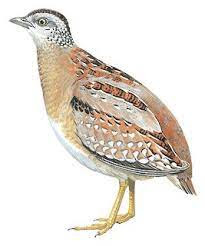
I might add that various other memes (example above) on this Facebook page and elsewhere seem to me to be disrespectful and scornful of records sincerely believed in by some birders. As my friend Glen Ingram points out, humour is meant to be uplifting; it should not be about putting people down. Glen and I are among those birders, incidentally: we believe we saw BBBQ on the ground, up close and clearly, near Iron Range in 1984. In the wake of this hullabaloo, Patrick Webster published some useful photographs on Facebook; he has declined to allow me to reproduce them here. Other information has been provided by various observers, notably my friend Chris Corben, which helps to shine a line on BBBQ identification features. Some of Patrick’s images on Facebook demonstrate that the rich colouring on the upperparts of a Painted can be more extensive with females in the breeding season than is generally believed to be the case; the colouring was widely considered to be restricted to the shoulder area. Based on specimens photographed by Patrick, and on the Birds of the World illustrations (first and last images in this post ) - themselves modelled on the same photographs - the rump and upper tail of a BBBQ should be sandy-rufous rather than brownish-grey. It looks to be the case that a good feature for BBBQ is the relative absence of dark bars on the back and scapular feathers, so a BBBQ should appear more uniformly sandy-rufous in this area than Painted. However, this part of the bird was largely not visible in John’s photograph. The bird in John’s image, which has since been shown to other observers, shows wing coverts heavily spotted black and white; it has been suggested to me that BBBQ wing markings should show much less black, with essentially just white spots on a plain sandy-rufous background. John insists that several well-qualified observers have backed his assertion that the bird is indeed a BBBQ, but says these people do not wish to be identified. (So fraught are events surrounding this controversy that a degree of reticence to publicly join the fray is perhaps understandable.)
In light of these various exchanges, I asked John to again show me his photograph to refresh my memory as there remained features I considered to be of interest, including the relative absence of spotting on his bird other than on the wing coverts. John declined my request. Some reputable observers tell me my description fits Painted better than BBBQ. The eye colour in BBBQ should be yellow, not red (as in the Painted above), and the BBBQ bill should be longer and heavier. My view remains that it is not possible to be certain of the bird’s identity in the absence of images showing the key bill and eye colour features. At the end of the day, the central point of this matter is the absence of proof of eye colour and bill shape and size in John's image. John says those features are clearly visible in some of 15 colour images he obtained from his camera traps. He told me he has shared those images with Lloyd but nobody else. John says on Facebook: “Lloyd and I are totally happy we have Buff Breasted Button Quails and we are far from amateurs as some out there might think. We have decided to keep everything to ourselves now till we are ready…. We will just squirrel our info away from here on in till we are ready to reveal all.” I visited Lloyd twice at his Mt Molloy home (below) last week to discuss the BBBQ conundrum and other matters. Lloyd told me had seen just one image, which similarly to the one I was shown, did not show key identification issues; he has not seen an image showing the bird’s head. When I asked Lloyd to say for the public record how confident he was that we finally had an image of a BBBQ, he replied: “I’m convinced it’s a Buff-breasted from what I’ve seen in the field but I’d like to see a bit more of it. Having seen 20-odd Buff-breasted Buttonquail over many years, I’d say I’m 99 per cent sure.” Features he cited in support of this view were wing pattern (“not as streaky and dark” as Painted) and plain and uniform tail and rump.
Plumage aside, other features are cited as being helpful for identifying BBBQ. It is supposedly significantly larger than Painted, but specimen measurements taken by Patrick suggest this is not the case. The infrequency of sightings has been attributed to its unusually shy disposition, but there is no reason why the BBBQ should be any more obtuse than its cogeners, and buttonquail generally, while sometimes difficult, are not exceptionally difficult to track down in the field. John and Lloyd insist they will not be sharing images further pending publication of a joint paper on the BBBQ that Lloyd has been working on for several years. For his part, Lloyd is awaiting an indisputable image of a BBBQ before completing the paper. Nor will John and Lloyd disclose the site. They say they do not want a repeat of the way John was treated after his Night Parrot discovery, and that the birds have been there for thousands of years and are therefore not at risk if their whereabouts remain a secret.
I respectfully disagree, and John’s Night Parrot discovery helps to explain why. I have in the past been critical of John’s treatment post-discovery and of the early handling of the Pullen Pullen project. It has become clear over the eight years since John’s finding that the Night Parrot population in the region is critically low, contrary to what many thought would turn out to be the case. With young parrots leaving the nest being highly vulnerable to predation by feral cats (photographed at Pullen Pullen above), and continuing risks from fire and other factors, the future of this population is precarious. Ongoing, highly interventionist management by Pullen Pullen’s owners, Bush Heritage Australia, shaped by University of Queensland research at the site, is essential. In my view, history will judge John’s generous decision to share his find with others at the time – however much he may regret it now – as the right thing to do. That decision has arguably been responsible for salvaging a critically endangered Night Parrot population. And of course, it was the spark that ignited research efforts that led to the discovery of parrot populations in Western Australia.
Recent history is replete with other examples of short, sharp wildlife population declines. Witness how rapidly the population of the Golden-shouldered Parrot (above) – like the BBBQ, another Cape York woodland endemic – has declined in recent times due to changing fire regimes. Other Cape York woodland birds are in decline. The northern-most population of the Eastern Bristlebird, in Queensland’s Conondale Range, was extinct by 1991, within a few years of its discovery. The remarkable Gastric-brooding Frog was similarly extinct within a decade of its discovery. Because something has been there for thousands of years, it does not mean it is going to be there in another 1000 or 100 or even 10 years. Fingers crossed for the Buff-breasted Buttonquail.

Monday, 29 November 2021

Buff-breasted Buttonquail: an Update

A scientific report has been amended in response to criticism by some in the birding community that researchers were dismissive of multiple sight records of the extremely rare Buff-breasted Buttonquail (illustration above by Birds of the World). The report published by the Threatened Species Recovery Hub of the National Environmental Science Program last July raised the prospect of all recorded sightings of Buff-breasted Buttonquail from south of Cooktown being misidentified Painted Buttonquail. A newly amended version of the report concedes that some records may be authentic. The Buff-breasted Buttonquail is found only in the savanna woodlands of Queensland’s Cape York Peninsula (below). The July research report by a team of University of Queensland scientists says the last confirmed records of the bird were probably in the 1920s. It argues that the buttonquail population may have crashed due to several factors including the introduction of cattle, changed fire regimes and feral predators. What follows are recent changes [in square brackets] made to the report.
(1) Version 1: “These unverified observations have influenced our perception of the species’ autecology and threats….” Version 2: “These observations have influenced our perception of the species’ autecology and threats….” [unverified is dropped] (2) Version 1: “This research has found sufficient evidence to suggest that all southern records of Buff-breasted Button-quail could involve misidentified Painted Button-quail. Our research has found the features and methods researchers and birdwatchers have used to identify Buff-breasted Button-quail from Painted Button-quail are incorrect.” Version 2: “Our research has found that many of [not all] the features and methods researchers and birdwatchers have used to separate Buff-breasted Button-quail from Painted Button-quail are incorrect. This may suggest that a significant proportion of southern records of Buff-breasted Button-quail could involve misidentified Painted Button-quail.” [The suggestion that all southern records could involve misidentification is removed.] (3) Version 1: “Due to our research there is now considerable evidence to suggest all reports from this region have in fact been misidentified Painted Button-quail.” Version 2: “Due to our research there is now evidence to suggest many, and perhaps most [not all] reports from this region may have been misidentified Painted Button-quail.” (4) Version 1: “Furthermore, this project has determined previous reports from the 1980s to the present day in the Wet Tropics and Einasleigh Uplands Bioregion are likely to be erroneous, suggesting the last confirmed record of this species was probably in the early 1920s.” Version 2: “Furthermore, this project has determined that a significant proportion of reports from the 1980s to the present day in the Wet Tropics and Einasleigh Uplands Bioregion could have been misidentifications.” [“significant proportion” is added; “likely to be erroneous” is deleted] (5) Version 1: “However no contemporary reports are accompanied by verifiable evidence despite the dramatic increase in photography by the birding community.” Version 2: “However, no contemporary reports are accompanied by verifiable evidence, such as a skin or photograph, despite the dramatic increase in photography by the birding community.” [What constitutes verifiable evidence is clarified.] The edited report is here (copy and paste URL): file:///C:/Users/Greg%20Roberts/Documents/BBBQ%20version%202.pdf

Sunday, 7 February 2021

Buttonquail feast at Dunmore, Southern Queensland

Good numbers of Red-chested Buttonquail (above), Little Buttonquail, Painted Buttonquail and Stubble Quail were the order of the day (and night) during a visit to Dunmore Road in Western Creek State Forest, south of Cecil Plains on Queensland’s Darling Downs. A fair sprinkling of normally difficult or uncommon inland species for south-east Queensland were also present.
Toowoomba birder Tyde Bands uncovered this hotspot, which features extensive grassland bordering well-grassed woodland. It’s the best part of a 5-hour drive from the Sunshine Coast but all those buttonquail were hard to resist. I began exploring the grassland at 4pm, being joined soon after by Matt Hansen. During 2.5 hours, I or both of us saw a total of 5 Red-chested Buttonquail (above), 6 Little Buttonquail and 4 Stubble Quail in the grassland, and 1 Painted Buttonquail on the road (below).
Driving the road slowly at night failed to turn up any hoped-for buttonquail, as observers have sometimes encountered elsewhere. It may be that birds are attracted to roads only in special, well-defined circumstances. However we heard a couple of Red-chested Buttonquail and several Little Buttonquail both in the grassland and the woodland. We encountered an impressive Eastern Snapping (Wide-mouthed) Frog (below) along with a couple of Common Dunnarts. Another 10-15 Eastern Snapping Frogs were calling from inside burrows. Good numbers of frogs seen recently on the road at night here were not present.
During another 2.5-hour stint the next morning in the grassland, this time extending to other areas, a further 6 Red-chested Buttonquail were seen (totall 11 for the trip) along with 5 Little Buttonquail (total 11) and 6 Stubble Quail (total 10). Many more Stubble Quail were heard during both sessions. The quail and buttonquail were easily identifiable on the wing and their behaviour differed. Red-chested showed as quite or conspiciously rufous and the upperwing panels were evident; this species flew the furtherest when flushed, usually going a considerable distance before ditching. Little Buttonquail flew just a short distance and typically gave a distinctive short call as ithey did so; birds were much paler with their white underparts and “saddles”. Stubble Quail were considerably larger and bulkier; they looked uniform greyish above with clear streaking. I managed poor shots (below) of this species and none of Little Buttonquail. Several more Painted Buttonquail were seen and heard in the woodland.
Horsfield’s Bushlark was abundant in the grassland.
A classy act to follow the grassland forays was as many as 10 White-backed Swallows hanging about with Tree Martins in the woodland. This species was once regular in south-east Queensland but appears to be in decline.
In the same area were quite a few White-browed Woodswallows, including adults feeding youngsters. A single Masked Woodswallow was among them.
Diamond Dove, another species usually found well inland, seemed to be quite plentiful. Several Common Bronzewings were seen.
A few Plum-headed Finches(below) were about along with bigger numbers of Zebra Finches.
Hooded Robin was encountered a couple of times, and Jacky Winter was common.
A few Speckled Warblers were in the woodland.