Sunshine Coast Birds

Birding and other wildlife experiences from the Sunshine Coast and elsewhere in Australia - and from overseas - with scribblings about travel, environmental issues, kayaking, hiking and camping.

Wednesday, 8 November 2023

Europe 2023 Part 3 Birding Portugal and Spain


White-headed Duck

Following our visit to Scotland (following post) we checked out the English town of Liverpool before flying to Porto in Portugal. A few days sight-seeing here before hopping on to the train to Lisbon. One bird on my wishlist was Iberian Chiffchaff but I thought with the time of our visit (early October) the birds would have headed south on migration. This was a particularly warm autumn, however, so plenty of migrants were still about. I found an Iberian Chiffchaff recorded on ebird while I was in Lisbon at a city park, Jardin do Cobeca, a known hotspot for the species. I went there and eventually located a dark-legged bird giving the characteristic call of the species among a tumble of Willow Warblers. I believe but am not entirely sure that this is the bird in the image below. Later I located another calling Iberian Chiffchaff in another Lisbon park, Jardin Afonse de Albuquerque.

Iberian Chiffchaff

In these parks and elsewhere, plenty of migratory passerines were gathering for an expected exodus southward, possible awaiting a cool change in the still hot weather. These included European Pied and Spotted flycatchers and numerous warblers of various species.

European Pied Flycatcher

We picked up a car hire and headed through southern Portugal, spending a few days in the pleasant village of Redondo and surrounding towns before crossing the border into Spain and a spell of sight-seeing in Seville. We continued south to connect with a much-wanted White-headed Duck, a bird I had repeatedly dipped on. A single female was present in Laguna de Camino and another female in the adjoining Laguna de Bonanza.

White-headed Duck female

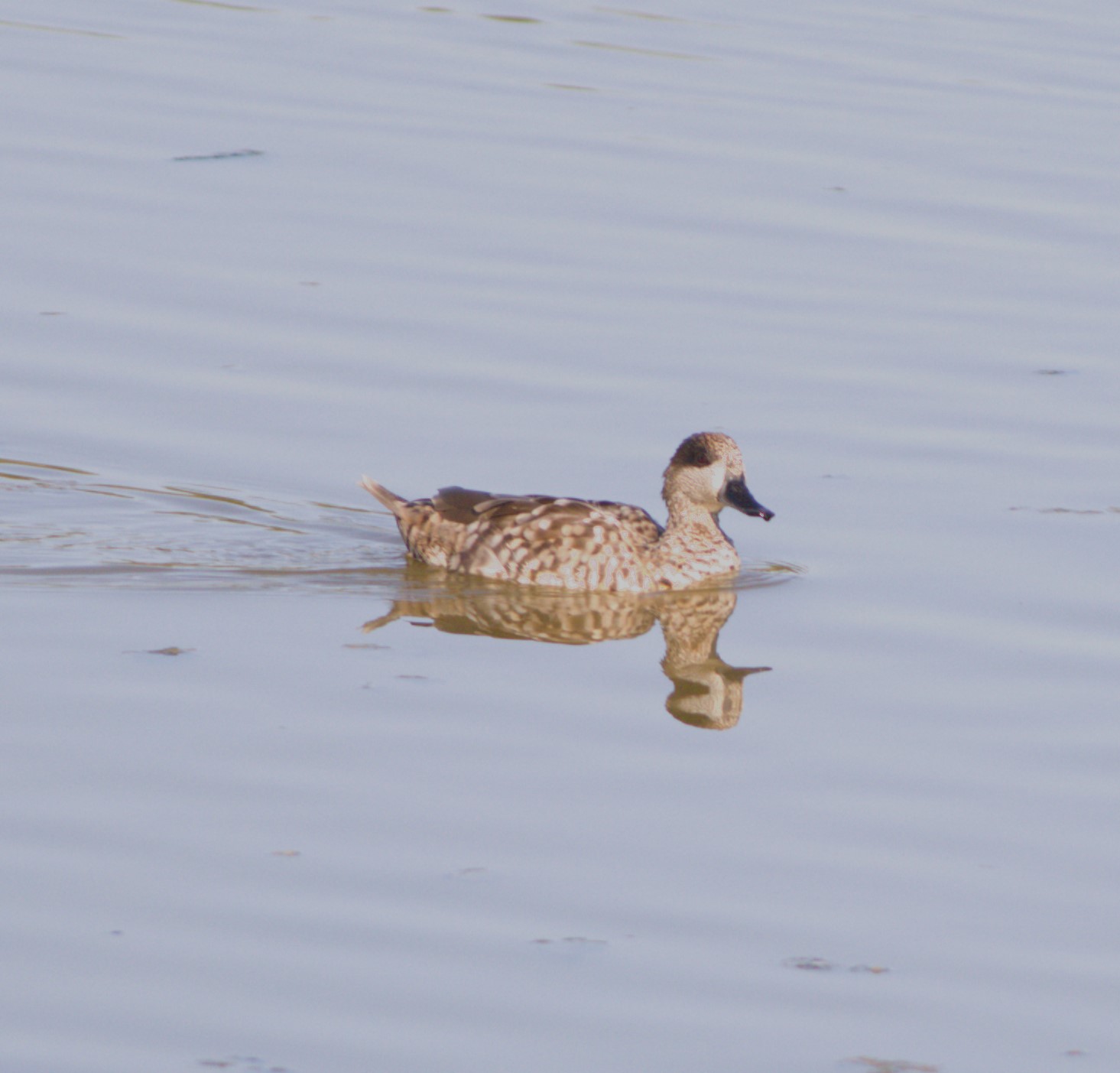
Small numbers of Marbled Teal were in the lagoons.

Marbled Teal

Continuing south, I saw small numbers of Scopoli’s Shearwaters in the Strait of Gibralter from several points on the southern Spanish coast, all heading westwards in migration. One bird showed very well at close quarters at Tarifa. Later I saw more Scopoli’s Shearwaters further east off the coast near Malaga. The British outpost of Gibralter was visited, where a dark phase Eleanora’s Falcon and Barbary Macaque showed well.

Barbary Macaque

Good numbers of Greater Flamingo were present at Malaga’s Parque del Guadalhorce. Spotless Starling was common here.

Greater Flamingo

Spotless Starling

We had several days in the extensive forest reserves of Sierra de Andujar, staying at Villa Matilde which I’m afraid to say seems to have gone downhill somewhat and may not be the best accommodation option. This was the place I expected to see Iberian Lynx but searching over five days failed to come up with the goods. Over that time I was regularly in touch with local and overseas wildlife enthusiasts in the area; none of us saw a lynx, though collectively we learned of a total of 4 sightings by others. Visitor numbers to the area have risen greatly, in part because of the lynx’s fame, and observers fear this is impacting the animal’s presence in areas which had been reliable for sightings. Compensation in some form came with the splendid scenery.


And raptors. Spanish Eagle was on my wishlist and several were seen, mostly on the first day in windy and wet conditions. The only one to offer a picture was a bedraggled three or four-year-old bird that passed reasonably close.

Spanish Eagle

Griffon and Black (Cinereous) Vultures were common.

Black Vulture

Griffon Vulture

Iberian Green Woodpecker was another on the target list and several obliged, with none offering a photographic opportunity. Azure-winged Magpie and Red-legged Partridge were more obliging.

Azure-winged Magpie

Red-leggedPartridge

Other mammals performed a little better. Red and Fallow Deer were common.

Red Deer

A single Mouflon was seen along with a distant male Iberian Ibex.

Iberian Ibex

In the tunnel at Jindula Dam I found three species of bat – Myotis daubentonii (Daubenton’s Bat), Myotis myotis (Greater Mouse-eared Bat) and Miniopterus schreibersii (Schreiber’s Bat).

Daubenton's Bat

Greater Mouse-eared Bat

We overnighted in Alcazar de San Juan, visiting the splendid wetland of Laguna de Veguilla. About 25 White-headed Duck were present including several lovely males.

We moved on to the town of Cascante, north-east of Madrid, to look for larks in the Ablitas area around the Ebro Valley. This a go-to site for Dupont’s Lark, another species high on my wishlist that I missed in Morroco and on a previous visit to Spain. Although it’s a bad time of year to see this cryptic species, thanks to help from Dani Lopez and Jose Ardaiz, I managed to see a Dupont’s Lark at close quarters and heard a total of 4-5 giving their characteristic call before sunrise.

Ebro Valley - Dupont's Lark site

Also of interest was a Eurasian Eagle-Owl calling outside our hotel in Cascante before dawn. Three more owls were seen later in the morning in flight. The Dupont’s could not be photographed so I settled for an image of a singing Greater Short-toed Lark. Our trip ended with a few days of sight-seeing in the pleasant Spanish capital of Madrid.

Greater Short-toed Lark


Tuesday, 7 November 2023

Europe 2023 Part 2 Birding Finland & Scotland


Hazel Grouse

Our trip to Europe was more about culture and aesthetics than chasing critters, as there aren’t too many in Europe that I’ve not seen. A few though remained sought after, with Wolverine and Ural Owl welcome additions to my lists (see following post). Another add-on was Taiga Bean Goose, a flock of which was spotted in fields from the train en route to Joensuu in central Finland. Finnish birders have established that this species and the recently split Tundra Bean Goose have different and well-defined migration routes across the country. Whooper Swan and Black-throated Diver were about but not as common as I expected.

Whooper Swan

We visited the delightful Patvinshon National Park (below) en route to the wolverine hides. 

Apart from usual fare such as Great Spotted Woodpecker (above) a female Black Grouse was seen here.


 After visiting the hides and heading north later, I came across a lek of about 8 male Black Grouse displaying in dense vegetation, but none offered a photograph.

We had three delightful days at a beautifully positioned lodge, Jongunjoen Matkailu Oy (above) overlooking a lake. Fieldfare, Redwing, Common Chiffchaff and Bluethroat were among birds that were active in scrub around the lodge. 

Common Chiffchaff

Fieldfare

I hoped that numerous bushes choked with red berries offered a chance for Bohemian Waxwing, and this came good on the last day with a flock of 20 waxwings appearing (below), followed an hour later by a second flock of 55 birds. Clearly they were on a migration run. Conditions generally were relatively warm still in mid-September so most palearctic migrants had yet to head south.


After returning to Helsinki, local birder David Radnell (with me below) kindly offered to take me birding in the Espoo area, west of the capital.. David picked out a female Smew at the Matalajarvi wetland on the far shore; a pair had been present there for several weeks. This small migratory duck had long been on my wishlist.


Large flocks of migratory Barnacle Goose were about along with good numbers of local waterfowl including Eurasian Teal, Goldeneye and Common Pochard.


David had been tipped off that Hazel Grouse were seen recently in Espoo Central Park. I’d looked hard for this species in central Finland without success so hopes were not high as we entered the forest. It was very pleasing to spot a grouse within a few minutes of us getting to the park and a male bird subsequently performed nicely. Later at the University Aalto wetland, birds included Western Marsh Harrier and decent numbers of Ruff and Dunlin.

Hazel Grouse


We also scored a Common (European) Toad.


From Finland it was on to Scotland and after a pleasant few days in Edinburgh, to the village of Boat of Garten in the Scottish Highlands in the Strathspey region. We stayed in the pleasantly positioned Fraoch Lodge, where the proprietor was unfortunately as unhelpful as she was financially dodgy. Plenty of nice birds were about in the Caledonian Forests, including large numbers coming in to feeders. 

Chaffinch & Eurasian Blue Tit

European Robin

The target though was Scottish Crossbill, endemic to these forests and the only bird species restricted to the United Kingdom. I spotted a likely candidate in the garden of Fraoch Lodge before encountering several small flocks in the nearby forest reserve. Common Crossbill was also present and easily distinguished by voice. A bigger identification challenge is posed by the Parrot Crossbill, with a call more like that of a Scottish Crossbill. After checking my recordings of alarm and other calls, it seemed to be the case that Scottish Crossbill was the most common species in the forest area I explored. However, the future taxonomic status of this bird is surely under a cloud.

Scottish Crossbill

We moved on to the Isle of Skye and the fabulous scenery of north-west coastal Scotland, hiring a “tiny house” in the hamlet of Flodigarry. From the house it was possible to watch seabirds close to the coastal cliffs below. While in bed I scored another tick as a Great Skua sailed past.


The following day we took a return ferry from the town of Uig to Lockmaddy. European Storm-Petrel was one of only two species of bird that I had seen dead (this one in Ireland) but not alive. That needed to be fixed. I saw about eight storm-petrels without difficulty on the return leg. I also had better views of another Great Skua.

Great Skua

Birds that were common included Northern Gannet, Manx Shearwater, Common Murre and Black-legged Kittiwake. A couple of Northern Fulmars were spotted. 

Common Murre

Northern Gannet

Mammals put on a good show with Harbour Porpoise, Grey Seal and Long-finned Pilot-Whale all offering decent views.

Grey Seal

Golden Eagle was seen a couple of times while driving around the beautiful Isle of Skye.


Monday, 6 November 2023

Europe 2023 Part 1 Wolverine


Wolverine had long been around the top of my must-see list of the world’s mammals. This hulking, shaggy, loping, secretive denizen of far-flung corners of the Palearctic is mesmerising. It’s the stuff of movies: ask Hugh Jackman. In 2011,


 I was on an expedition to the Russian Arctic that split into two groups for an onshore day trip. The group I wasn’t in saw a pair of Wolverines. I was severely wounded by the dip of the decade and determined to right the wrong one day. So when we decided to embark on a 9-week+ tour of Europe from the beginning of September this year, the beast wove its way into the plans.

We flew to the Finnish capital of Helsinki and took a pleasant four-hour train journey to the regional centre of Joensuu in central Finland. We picked up a hire care and headed north-east towards the Russian border. A drive of about 1.5 hours (we took much longer to look at things along the way) brought us to Keljianpuro Lodge, the base for the famed Era-Eero wildlife hides of Kontiovaara; beware, the route is not straightforward and it takes a bit of research to get one’s head around how to get there.


 Here is Wolverine Wonderland, with little doubt the best place in the world to see a Wolverine in the wild. Indeed, half an hour into an introductory talk by our hosts,, a Wolverine bounded past the window in full view and disappeared into the surrounding taiga forest. We were assured this was extremely unusual. 


Other visitors to feeders outside the window included Eurasian Red Squirrel (above), andWillow Tit and Crested Tit. 

Crested Tit

Marsh Tit

We were driven by our hosts, Eero Kortelainen and Sini Hyvärinen, 5km through the forest to a series of hide-huts overlooking a grassy wetland glade in the taiga. This is one of three similar hide areas on properties accessed by Era-Eero. You enter the hides about 3pm and are asked not to leave until 8am the next morning; the idea is not to scare off any animals coming into the glade. Wolverine is the star attraction, but other visitors include Brown Bear, Wolf and occasionally Eurasian Lynx.


Eero then strategically placed pieces of meat in hiding places scattered around the glade (above). Then the hosts left and we were left to sit it out. The hides are rustic: inside pit toilets, basic beds and bedding, carefully arranged seating. You are given a small quantity of food to tie you over to morning. There is the option of two kinds of huts: larger glassed huts are more roomy and comfortable, offering elevated views over the glade. But they are glassed in, limiting photographic opportunities. The “photography hides” (below) are smaller and dingier but are at ground level, putting you close to animals. They have a series of well-structured holes from which camera lenses may protrude. These hides are a good deal more expensive than the more opulent glassed ones for reasons that are not entirely clear.


 Finland hosts similar hide-huts elsewhere but Era-Eero has the best strike rate for Wolverine. Bears are easier at other lodges because those locally – once regular visitors at Era-Eero - have been decimated by Finalnd’s annual bear hunting season. Nonetheless, wolverines here are not guaranteed and while unusual, sometimes they fail to show.


 It’s a magical place in the heart of the taiga. Few birds are about. The occasional Eurasian Jay (above) and Northern Raven make an appearance, looking for the hidden meat. At one point a Northern Raven is pursued by a Northern Goshawk (below).


 After about 40 minutes of waiting, the first Wolverine appears, uphill from the photograhy hides and right in front of the glassed hide, which is occupied by a single guest who enjoys spectacularly close views. The animal methodically searches out potential meat hiding spots: overturning rocks, climbing trees, burying under tussocks. There is debate about the ethics of “baiting” wild carnivores. 


My view is if an animal as scarce as a Wolverine benefits from limited supplementary feeding, that is no bad thing. Later two more wolverines appear – probably an adult female and a well-developed cub – to join the search for meat scraps.


 Later still, shortly before the sun finally fades, another animal turns up. They are formidable beasts: the largest member of the weasel family, weighing up to 28kg. At first light the following morning, I am greeted by the face of a wolverine a couple of metres outside the hide; so close that I’m unable to focus the camera. Altogether, including the animal at the base lodge, we saw a total of 4 or 5 Wolverines. That’s a good haul. 


 For me, the cream on the pie came later in the night when I heard a Ural Owl calling from the road above the hide. It was dark so there was no prospect of seeing or disturbing animals in the glade, so I quietly broke the rules and left the hide to call in a fabulous Ural Owl (below) – a species I had long wanted to spot - at close quarters. 


My intrusion was immediately detected by camera trap but the next morning there were no hard feelings about this transgression. In summer, when potential viewing hours occupy most of the night, it would not have been possible; we were there in early September, the beginning of the northern autumn, when days are not so long.