Sunshine Coast Birds

Birding and other wildlife experiences from the Sunshine Coast and elsewhere in Australia - and from overseas - with scribblings about travel, environmental issues, kayaking, hiking and camping.

Friday, 10 April 2020

Sunshine Coast Game On (notwithstanding that global pandemic)

Powerful Owl


There's plenty of doom and gloom about right now with the Covid-19 pandemic wreaking havoc around the globe. The virus is believed to have originated in the so-called wet markets of central China, where huge numbers of domestic animals and wildlife are slaughtered in unhygienic circumstances, allowing deadly pathogens to jump from animals to people. Much the same thing happened years ago with the SARS virus in China but the Chinese learned nothing from that experience. Ebola and HIV are among other devastating diseases to have their origins in the human consumption of wildlife. We can expect more of the same.

But enough of that for the moment. Here on the Sunshine Coast, The Game is on again this year. Through BirdLife Australia's Sunshine Coast Facebook page, birders photograph as many species as possible locally in the calendar year. It's a challenge and it's fun. I decided to make a Big Year of it in 2018, photographing 310 species in the region. Last year the so-called Zone of Happiness was extended substantially westward to the South Burnett, so 2020 looked like a good time to have another stab. The New Year began well enough, with interesting birds on the Maroochy River floodplains in early-January including Horsfield's Bushlark, Brown Songlark, Pallid Cuckoo and Oriental Cuckoo.

Brown Songlark
Conditions inland due to a prolonged drought presumably forced some of these species towards the coast. A Black Falcon turned up for a couple of weeks and I was happy to see it near Bli Bli.

Black Falcon
A Freckled Duck which had been hanging around Lake Alford in Gympie late last year was still about in January; that was one species I missed in 2018.

Freckled Duck
A pelagic trip of Mooloolaba in January came up with the goods including the first White Tern and Masked Booby recorded for The Game as well as Sooty Tern and loads of Tahiti Petrels.

Sooty Tern

Masked Booby
A late-January visit to Jimna was rewarded with fine views of White-throated Nightjar and Australian Owlet-Nightjar.

White-throated Nightjar
Also in the Jimna-Yabba Road area was Brown Treecreeper, a species that could be recorded for the first time this year in the Zone of Happiness because it is found only in the newly expanded western portion of the region.


Brown Treecreeper
Other good birds here and further along the road to Kilcoy included Yellow-tufted Honeyeater, Dusky Woodswallow, two parties of feeding Glossy Black Cockatoo, Weebill and Buff-rumped Thornbill - the latter another species recorded for the first time locally in 2020 due to the zone's westward expansion.


Buff-rumped Thornbill

Glossy Black Cockatoo
Back on the coast, some of the more skulking waterbirds were showing in January including Baillon's Crake at Parklakes and Spotless Crake at Ewen Maddock Dam.


Baillon's Crake
A second pelagic trip off Mooloolaba for the year in February was as productive as the first with Long-tailed Jaeger, another first for The Game, being seen along with Streaked Shearwater, Bridled Tern and Pomarine Jaeger.


Streaked Shearwater

Long-tailed Jaeger
An adult female Australian Little Bittern at Parklakes in early-February was a welcome find as this is one of the more difficult species to see, let along photograph.

\
Australian Little Bittern 

February was a good month to clean up shorebirds including Wandering Tattler at Alexandra Headland, Red Knot at Kakadu Beach and Common Sandpiper at Pacific Harbour.


Wandering Tattler
February saw heavy rains over the region, putting an end to the prolonged dry and providing new food sources in expanding flooded areas for our resident White-winged Tern population.


White-winged Tern
Then later in the month, another new record for the region, the recently split (Asian) Gull-billed Tern turned up at Toorbul (found by Helen Leonard); the bird was kind enough to remain in the region for a few more weeks.


(Asian) Gull-billed Tern
The mega record of the year came in late-Feburary when Jane Cooksley discovered the famed Kenny, a Kentish Plover, in the Noosa River estuary. The bird was still there this week.


Kentish Plover
Early March saw a trip to the Tin Can Bay-Cooloola Cove-Inskip Point area, a favoured stamping ground. Radjah Shelduck showed nicely at the Tin Can Bay golf course, as it did in 2018.


Radjah Shelduck
Inskip Point was excellent for shorebirds with Sanderling, Black-tailed Godwit, Grey Plover and Terek Sandpiper all seen.


Sanderling
Also in early-March, a drive up the beach from Noosa North Shore to Double Island Point, Cooloola was productive with Common Noddy (Species Number 200 for the year) and Lesser Crested Tern showing.


Brown Noddy
Closer to home, Eastern Barn Owl was in its regular haunt at Valdora while Charlie Moreland Park, as ever, produced the rainforest specialties such as Pale-yellow Robin and Paradise Riflebird.


Paradise Riflebird

Eastern Barn Owl
As March marched on, the looming menace of Corvid-19 was rearing its ugly head in spectacular fashion. It became obvious that lockdowns and travel restrictions would be the order the day so we embarked on a four-day camping trip through the western part of the region while camping remained possible. Common Bronzewing showed nicely at Goomeri Bush Camp.


Common Bronzewing
Then it was on to Nanango, where in woodland east of the town, two more species not available in 2018 – Superb Fairywren and Brown-headed Honeyeater – were chalked up in short order. Red-rumped Parrot was seen on the outskirts of Blackbutt in the same area where I found the species several years ago.


Brown-headed Honeyeater
We moved on to Yandilla, a spot which proved highly productive in 2018. A drive up Mt Kilcoy Road in Conondale National Park turned up the hoped for Red-browed Treecreeper.


Red-browed Treecreeper
Later in March, before the travel restrictions started biting, I visited Beerwah where I tracked down a roosting Powerful Owl in the same area where I had a pair in 2018. One of that pair was believed to have been the victim of vehicle collision and the birds were not recorded during the 2019 breeding season. However, a single bird (presumably the one I saw) has been heard repeatedly by locals in recent months; whether it is the survivor of the 2018 pair is unknown.


Powerful Owl
I visited Conondale National Park where excellent views of Sooty Owl and Marbled Frogmouth were the order of the night,and Imbil State Forest, where a male Black-breasted Buttonquail was bagged.


Black-breasted Buttonquail

Sooty Owl
By this time, at the end of March, I was supposed to be leading a birding trip to Ghana, but that's another story. With April now well advanced, movement everywhere is very much restricted by the Covid-19 lockdown. Some scope remains for birding as hiking, kayaking and other outside exercise continues to be permitted. My tally for the year stands at 266. Hopefully images like this will help lighten the mood a little.


Marbled Frogmouth


Sunday, 23 February 2020

Twitching Sunshine Coast Kentish Plover & Asian Gull-billed Tern


Kentish Plover

It's been a good week for twitching around the Sunshine Coast. Jane Cooksley made a fantastic discovery late yesterday afternoon when she found a Kentish Plover at Noosa. The bird was on a sandflat in the Noosa River about 1.5km upstream from the river mouth at low tide opposite Noosa River Holiday Park at Munna Point. The Noosa River has had its share of rarities in the past, including Queensland's only Hooded Plover.

Kentish Plover
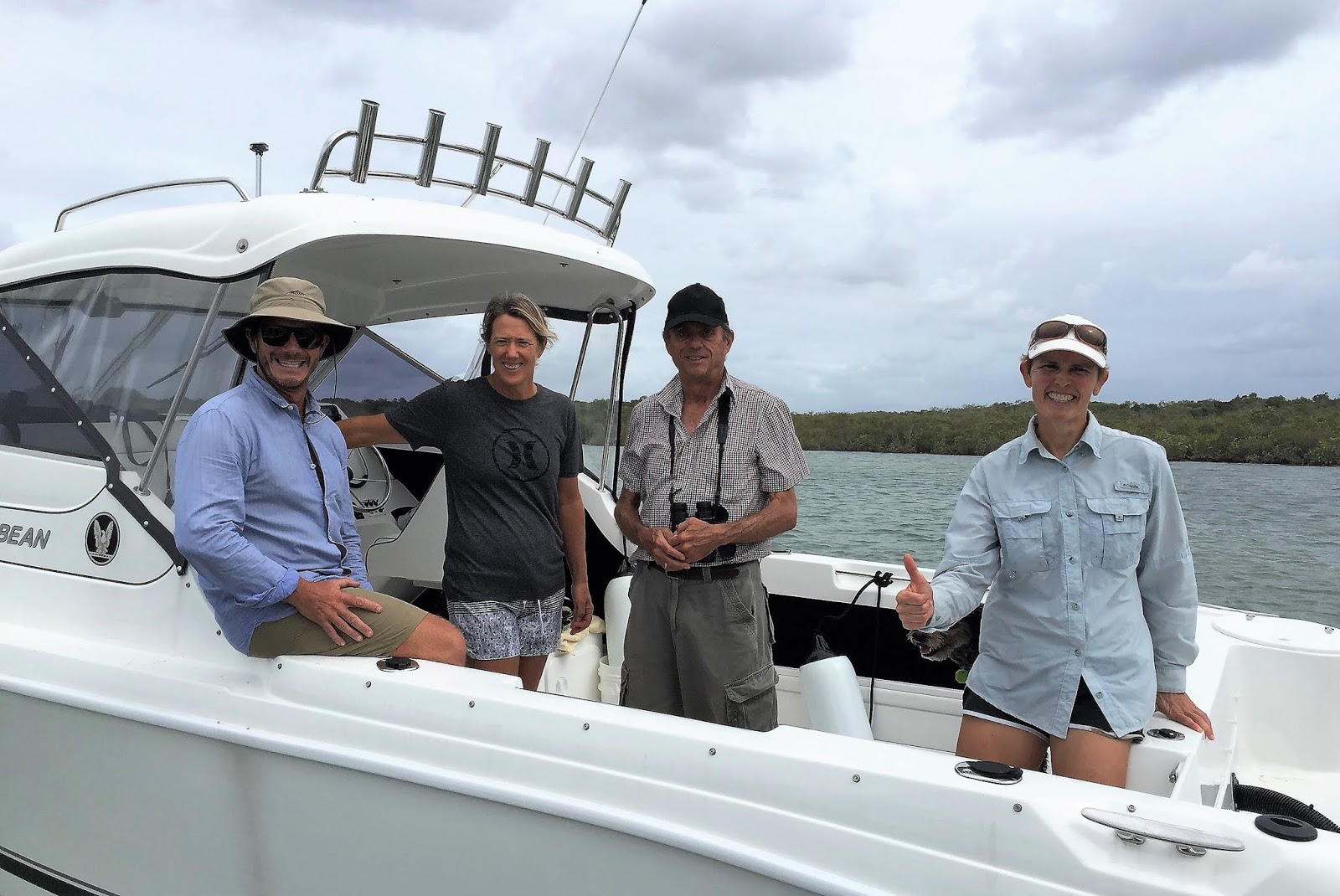
Jane and her hubby Andrew had been walking the sandflats after disembarking from the family dinghy. Jane and Andrew kindly offered to take Carolyn Scott and I out today in an upgraded family boat! With a king high tide scheduled for 8am and the river sandflats under water, the initial plan was to head out in the afternoon at low tide. However, Andy Jensen spotted the bird early this morning from the river's south bank; it was distantly on a sandbar on what was almost certainly the island that hosts nesting Beach Stone-Curlews.

Kentish Plover
So we opted for an early morning high tide search instead. We landed on the island but no Kentish Plover, just a couple of Red-capped Plovers and loads of terns. Then Rob Morris subsequently saw the bird close to the river mouth (the joys of Facebook instant messaging) so we headed to the north shore and disembarked; it's likely the plover and other birds had been flushed from the island by a visiting kayaker. Carolyn spotted the plover along the high tide line. The bird was associating loosely with a flock of about 20 Red-capped Plovers and was immediately very different in appearance.

Kentish Plover & Red-capped Plover
The north shore can be accessed by road after crossing the Noosa River by vehicular ferry at Tewantin. Non-4WD vehicles can drive to the end of Esplanade/Flying Fish Track/Wilderness Track (called various things on different maps), which runs along the river's north shore off Beach Road. Vehicles can be left in the bush there and you can walk 1km to the river mouth. We saw the bird at high tide. If it moves back into the river as the tide recedes, you can generally walk the sandflats at low tide, although they cover an extensive area. Sometimes low tide is not particularly low, in which case a boat would be needed to access the sandflats. Or you can be satisfied with more distant views from shore.

Successful plover twitch (Andrew & Jane Cooksley, Greg Roberts, Carolyn Scott)
Last Tuesday, Helen Leonard found an (Asian) Gull-billed Tern at the Toorbul high tide shorebird roost. This species, affinis, was split recently from what is now known as the Australian (Gull-billed) Tern macrotarsa. I looked for the bird without success at Toorbul on Wednesday but found an Asian Gull-billed Tern hawking the mudflats of Godwin Beach on a receding tide later during the day.

Asian Gull-billed Tern

Asian Gull-billed Tern
Later in the week, Helen photographed an Asian Gull-billed Tern at the shorebird high tide roost of Kakadu on Bribie Island. It's likely these three sightings are of the same bird. It is possibly the same bird that has been seen several times in recent weeks in the Pine Rivers area a little further south. While not of the same vintage as a Kentish Plover, this is another scarce visitor to these shores from distant lands.

Asian Gull-billed Tern

Asian Gull-billed Tern


Saturday, 22 February 2020

West Coolum Wetland to be Protected


West Coolum Wetland
The West Coolum Wetland on Queensland's Sunshine Coast is to be protected and managed as a nature reserve in a significant win for the environment. The decision by the Sunshine Coast Council at its February meeting to protect the 90-hectare site means more than 700 hectares of contiguous wetland and coastal woodland in the heart of the Sunshine Coast will be preserved.

The West Coolum Wetland is on land formerly used for sugar cane production. The area was inundated by tidal flows from Coolum Creek following the collapse of canal floodgates after the council acquired the site in 2011, allowing a thriving wetland to be created in the same way that the nearby Yandina Creek Wetland came to be.

Broken floodgates at West Coolum Wetland
The 190-hectare Yandina Creek Wetland was drained and earmarked for development before it was acquired by Unitywater in 2016 as part of the corporation's nutrient offsets program following a lengthy campaign to save the wetland. The site has been restored as a flourishing wetland and the numerous birds that had called it home are returning. Prior to Unitywater's intervention, the Sunshine Coast Council came under fire for rejecting proposals to purchase the land and restore the wetland.

The council has since demonstrated an encouraging change of heart. Last year it launched its Blue Heart Sunshine Coast Project, aiming to sustainably manage 5,000 hectares of the Maroochy River floodplain in partnership with Unitywater and the Queensland Department of Environment and Science. The project's objectives include the securing and protection and management of the floodplain's most environmentally critical areas.

The council will play a role in the future management of the Yandina Creek Wetland as part of its Blue Heart commitment. The move to protect the West Coolum Wetland, which had partly been designated for “open space sport development”, is another important step. Yandina Creek Wetland, the Coolum Creek Reserve and West Coolum Wetland are now joined in a large protected area.

West Coolum Wetland - looking towards Mt Coolum
I stumbled upon the West Coolum Wetland while kayaking along Coolum Creek in 2016. I was immediately impressed with its potential as a reserve and wrote to the council requesting that it be protected as a wetland. Among nice bird records there were one of only two sightings of Australian Spotted Crake from the Sunshine Coast region, and the scarce Eastern Grass Owl and Australian Little Bittern. The council undertook environmental consultancy studies which indeed underscored the site's environmental values.

Sunshine Coast Mayor Mark Jamieson said the wetland would be managed for conservation and added to council’s environment reserve network. “The lands, located west of the Sunshine Motorway at Coolum Beach, offer an exciting opportunity to establish an estuarine wetland due to the frequent tidal inundation of the site,” the mayor said.

Google Earth image of West Coolum Wetland
Speaking more generally about Blue Heart, Mark Jamieson said: “The project is a fantastic example of how council is taking action now to identify risks, and help our community prepare for the impacts of a changing climate. Working across approximately 5000 hectares on the Maroochy floodplain, the project seeks to deliver effective land and water management to proactively respond to a transitioning landscape through conservation, recreation, flood mitigation and new carbon storage opportunities.”

As with Yandina Creek Wetland, there is no public access to West Coolum Wetland. Unitywater has given repeated undertakings to eventually allow pubic access to Yandina Creek. The council is expected to take the same approach with West Coolum.

West Coolum Wetland site map
One pressing problem facing the Maroochy River floodplain remains, however. As I have written previously, the council has allowed the residential subdivision of sugar cane farms on the floodplain in contravention of state government and council planning guidelines. As a consequence, extensive areas of cane and grassland that are home to an abundance of birdlife are being carved up for homes that must surely be flood-prone.


One of the newly approved residential developments on Maroochy River floodplain 

Thursday, 6 February 2020

Rescue Mission for Endangered Eastern Bristlebird

Eastern Bristlebird

In a sign of what we are rapidly coming to appreciate is the “new normal” of severe climatic events in Australia, an extraordinary operation is underway to rescue a remnant population of the endangered Eastern Bristlebird from the bushfires which have been ravaging south-eastern Australia for the past five months.

The unprecedented rescue operation involves the Australian Defence Force, Zoos Victoria, Parks Victoria, Queensland's Currumbin Sanctuary, Monash and Wollongong universities, the Orbost Incident Management Team, and the Victorian Department of Environment, Land, Water and Planning.


Rohan Clarke with a captured bristlebird
Leading the charge in the field is Monash University's Rohan Clarke. Rohan has written on Facebook of the efforts of a team of people working to save the Howe Flat population of Eastern Bristlebird. The birds are at risk of being consumed by fires which have devastated the nearby town of Mallacoota and hundreds of thousands of hectares of bushland across four states. About 180 bristlebirds frequent the threatened site.


Chinook helicopter to the rescue
Seven rescuers were taken to the area in an ADF Chinook helicopter after flying from Melbourne to Sale. The biodiversity hotspot is threatened by fires burning to the north of Howe Flat – near Marshmead and the Victoria-NSW border in Nadgee Nature Reserve. Says Rohan: “The operation is likely unprecedented both in terms of the action – rescuing an endangered species ahead of an approaching fire – and the level of support provided. My role is to lead a catch team alongside Rowan Mott and people from Zoos Victoria, Parks Victoria and DEWLP.”


Rohan checks the mist-nets
Birds are snared in mist-nets, with 15 having been caught by Wednesday night. With two birds per containment cage, the precious cargo is taken by boat to Mallacoota and then by charter flight to Melbourne Zoo. The best outcome for all concerned is that Howe Flat doesn't burn and the birds can be released back there when the danger is over. Rohan says that alternatively, if the worst happens, a captive insurance population can be used to rebuild the southern population as conditions recover. He adds: “Nestled within this is a positive story where a collection of agencies and organisations and an impressive group of people (both those on the ground but also critically those behind the scenes that just make things happen) have been working together to achieve this.”

Says Victorian Environment Minister Lily D’Ambrosio: “Our hardworking teams are ensuring this precious little bird has a chance at a bright future despite the impact of these devastating fires, which are still posing a threat to our native wildlife.”

Captured bristlebirds head to safety
With 15 birds in protection, the first phase of the mission is completed; the target had been between 15 and 20. Says Rohan: "There's still lots of hard work ahead. People remain on the ground fighting the fires to protect assets such as the incredible biodiversity at Howe Flat.  Zoos Victoria is pulling out all stops to house and support a very special bird. Work is underway to plan and implement the next steps that will aid with recovery this species and others impacted by the fires."

Eastern Bristlebirds can breed successfully in captivity. Currumbin Sanctuary has bred several pairs of the critically endangered northern population that frequents the NSW-Queensland border area. That population is likely to have been hit by fires which raced through its distributional range last September. About half the territory of one pair I've been monitoring for several years has burned.

By some estimates, as many as one billion wild animals have perished in the bushfires.

Eastern Bristlebird