 |
| Night Parrot - pic by John Young |
I
wrote about Penny Olsen's new book, Night Parrot, in The
Weekend Australian of 11-12 August, 2018, highlighting research
issues between Bush Heritage Australia and Australian Wildlife
Conservacy; ongoing controversy over John Young's 2013 rediscovery;
and the disappointingly low number of Night Parrots recorded since
then. There is much more to the book, however. I'm outlining here a
grab bag of notes from the book, with a bit of commentary woven
through.
Captain
Charles Sturt mounted two expeditions through the Australian outback
in search of an inland sea. He didn't find a sea, but his expedition
naturalist, John McDouall Stuart, collected the first specimen of a
night parrot in 1845 on the second of these forays. The bird was shot
on the western edge of Lake Lady Blanche in northern South Australia.
Thought initially to be a Ground Parrot, it was not until 1861 that
John Gould recognised it as a new species. Sturt noted the bird had
“dark green plumage mottled with black”.
A
total of just 28 Night Parrot specimens are known, 22 collected by
Frederick Andrews in South Australia. All but one of Andrews' birds
were taken in the Gawler Ranges of northern Eyre Peninsula in the
1870s and early-1880s. Andrews made observations similar to those
noted at Pullen Pullen Reserve in south-west Queensland, where Young
made his discovery. For instance, Andrews says “in some instances I
have known them to fly a distance of 4 or 5 miles”; the distance of
6.4-8km is similar to that undertaken nightly by parrots at Pullen
Pullen.
In the book, Olsen chronicles numerous expeditions mounted to search for the bird after its numbers crashed in the 1880s, when the last confirmed specimen was collected. A specimen claimed in 1912 by Martin Bourgoin from Western Australia was lost and cannot be verified, although Olsen appears to accept its authenticity.

Among the more enthusiastic Night Parrot searchers was Boer War veteran Samuel White, who conducted numerous expeditions in the 1910s and 1920s to “every haunt where there was a record of the bird having been seen in the early days”.
Often
White was accompanied by his wife Ethel, who was such a novelty in
the outback that she often was the first white woman seen by Aborigines.
Olsen
clearly
has
a soft spot for Australian history. While some of her accounts of the
early ornithogists are entertaining,
there is a great deal of biographical
information in the book that has nothing to do with Night Parrots.
While
no
Night
Parrots
were recorded with certainty in Queensland until a dead
bird was found near Boulia in 1990, there
were plenty of unconfirmed reports. Doctor-cum-ornithologist
William Macgillivray wrote
in 1920
that
four “extremely
rare spinifex or night parrots” were seen on Nappa Merrie Station
by Clive Conrick around
the Cooper Creek in the Channel Country. Conrick's
neighbour, Albert Walker, managed the
neighbouring
Innamincka Station across across
the border
in South
Australia;
Walker recorded
that
he “frequently”
saw Night
Parrots until
1885, when there was an invasion of feral cats.
Cats feature also in the writings of CH McLennan in 1907 about the Night Parrot in the mallee of the sunset country in western Victoria. McLennan noted the bird's “plaintive whistling note heard in the still of night”. The parrots were “unfortunately becoming extinct” because hundreds of cats had been released in the mallee to control rabbits. Cats appear to be scarce in the Queensland area frequented by parrots; perhaps their numbers are kept in check by dingoes, which had not been heavily persecuted by local pastoralists.
 |
| Night Parrot habitat - Diamantina National Park |
The
night parrot expeditions continued as the decades rolled by. In 1972,
26 technical college students travelling in two mini-buses camped for
three weeks by the Diamantina River looking for the birds. They had
to give up when bulldust clogged one of their engines.
News
of the 1990 Boulia discovery was broken by me in the pages of The
Sydney Morning Herald. The semi-mummified carcass was found on
the roadside by Walter Boles, Wayne Longmore and Max Thompson, who
were on an Australian Museum expedition. The year before, in 1989,
entrepreneur Dick Smith had offered $50,000 for scientific evidence
of the bird surviving. Smith was initially reluctant to part with the
money; after “spirited discussion” over whether a dead parrot met
his requirements, Smith's Australian Geographic Society handed over a
cheque to the museum.
A
second semi-mummified corpse was found in September
2006
in
Diamantina National Park,
200km from Boulia, by
ranger
Robert
(Shorty) Cupitt. That
find was made public
by me in
the pages of The
Australian
in February
2007. The
Queensland Government had
kept
it a secret for five months for reasons it has
never
properly
explained.
It
is perhaps
surprising,
with the benefit of hindsight, that John Young was the first
and only
person to follow up Cupitt's find,
other than a bit of cursory looking around by park rangers.
It
was in this breakaway
country of the Mayne Range, where the boundaries of Brighton Downs
Station and Diamantina National Park meet, that
Young focused his search in
2007,
although
he says he had searched other places earlier. The
bird first
photographed
by
Young was
just 11
kilometres from Cupitt's
dead parrot (that's not in the book).
Olsen
is no friend of Young and
is
relentless in her attacks
on
him
in the book. She says
he had in the past made “unbelievable” claims about owl survey
numbers and discovering Paradise Parrots with eggs. His claim in 2006
to have discovered a new bird,
the Blue-browed Fig-Parrot, in the rainforests of north-east
NSW was “based on a fabricated photo and a story that grew with the
telling”.
Olsen
concedes, however,
that the July
2013 announcement
by Young that he had photographed a
Night Parrot for the first time was the “avian
find of the century and a personal triumph for Young”. She
notes no living person had definitely seen a Night Parrot until then.
But in a video screened
as
the discovery
was announced at the Queensland Museum in Brisbane, there was
“something amiss… a wing appeared to hang slightly and the bird's
gait was odd”.
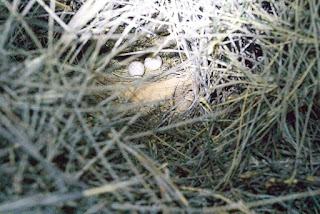 |
| Night Parrot nest - pic by Steve Murphy |
I
detail
in The
Weekend Australian
how Olsen and ecologist Steve Murphy, who once collaborated with
Young but fell
out of favour with him, suggest Young's bird was injured and captured
to
be
set up for a photographic session. John Stewart, who was with Young
at the time of the discovery, went public to insist the bird came in
of its own accord and that the pair was
unaware of any injuries.
Olsen
says Young
had “indisputably put in some hard yards in tough
country”, but his
claims
to
have spent
17,000 hours searching over 15 years, riding
11,000km
on a bike and driving
320,000 km in a vehicle “seem
embellished”. Of Young's first photographs, Olsen says: “These
were not obviously doctored images, as had been the case with the
fabulous fig-parrot.”
Olsen
relates how Young took Steve Murphy into his confidence, showing him
the bird in a part of Brighton Downs Station that was to be
acquired
by Bush Heritage Australia and named
Pullen Pullen Reserve. In Cairns in 2011, Young played Murphy a
recording of a four-note call from what he believed was a Night Parrot.
Young called Murphy in 2013, before the announcement, to tell him
“with
great excitement that he had 600 images and 200 feathers” from a
Night
Parrot. As
the two worked together in subsequent months, Murphy “felt
that he was on a tightrope…
knowing
that John
Young
quickly dropped anyone who challenged him”. Murphy
told Olsen he wanted a follow-up plan for further research focused on
habitat requirements, detection, threats and nesting.
Murphy
was so distrustful of Young that he secretly recorded playback of
the bird's call on
a USB stick when Young first played it
while
the pair was
together in the field, “just
in case their arrangement went pear-shaped”. In his
field notes, however, Murphy praises Young:
“Despite his obtuse manner, can't help but like the guy. Most
incredible field ornithologist ever. Egg collecting past really
allowed him to hone his skills to an awesome degree.”
The
Night Parrot Recovery Team was established in 2014. Writes Olsen:
“Finally, the time was right – there was: a known Night Parrot
location; funding; an advisory panel; Murphy with his survey
experience and scientific skills and political sensibilities; and
Young, the talented and tenacious field naturalist.”
Murphy
and Bush Heritage Australia refused initially to release playback of
the bird's call – or precious little other information - so others
could search for parrots in new localities. That stance was
criticised by many birders, who felt secrecy over calls and the
bird's general whereabouts (without giving away specific site
information) could hamper discovery efforts.
Olsen
reveals Young was not invited to a secret meeting between Peter
Britton, the owner of Brighton Downs, and BHA
which resulted in Britton subdividing 56,000ha of
the station to
establish Pullen Pullen; BHA acquired the reserve in 2016. In a
glaring
case of bureaucratic idiocy, the excision was initially opposed by
the Queensland Government on the grounds the
56,000ha
was not viable as a
pastoral
lease.
BHA
got off to a bad start by
evidently
stuffing
up the naming of
the
reserve. Pullen Pullen is supposedly the local Aboriginal name for
Night Parrot. Olsen says it is an “erroneous moniker”; leading
linguists could find no evidence for it in the literature and
indigenous
languages in the area did not have final consonants.
Meanwhile,
relations between Young and Murphy deteriorated. Olsen
writes
of
how Young became “disgruntled
at his increasing loss of control of the situation and the research
project”. Young
and Murphy were part of a research effort
funded by
an offsets grant from Fortescue Metals. Young finally
quit in early-2015
following
a row with Murphy over the placement of sound recorders.
Twelve
months later, Young was hired as a senior ecologist by Australian
Wildlife Conservancy. Part of his job is to research Night Parrots in
Diamantina National Park, which adjoins Pullen Pullen. BHA and AWC
are Australia's two biggest private conservation groups. They work in
close proximity to each other on Night Parrot research but do not
share information.
Olsen
gets stuck into me for revealing in May 2016 in The
Australian
that Brighton Downs was where Young rediscovered his Night Parrot. At
the time, the
information was not publicly available. Olsen said I “truly
overstepped the mark”.
BHA was forced to install
surveillance cameras and implement
other
security measures to guard against, among others, “overenthusiastic
birdwatchers”.
I
and others argued that birders
could be BHA's biggest ally in its efforts to protect the Night
Parrot, but as Alice Springs birding guide Mark Carter said,
“instead we're treated like lepers”. I
did not in fact reveal where the birds were; instead
I
identified
a sprawling
420,00ha
property in
the hope that other searches would be mounted in that region in
search of further populations. As it transpires, the hordes of destructive twitchers did not materialise; just a handful of groups have ventured to the remote area to look for Night Parrots.
 |
| Penny Olsen |
Olsen notes that while the reserve was being established, Britton asked Murphy to write a list of rules for BHA staff after volunteers brought dogs into the area, which was still being grazed by cattle at the time.
Olsen has another go at me because in March 2017 I reported that “glamping” trips to Pullen Pullen were being hawked among wealthy birders overseas, offering a visit for $25,000 a head. Olsen accuses me of a “blatant misrepresentation” of BHA policy, which takes wealthy donors to reserves “to see what they are funding”. Olsen ignores the email which prompted my story in
The Australian; it was sent by Adam Riley, the head of South African bird tour company Rockjumper. For the record, Riley says in the email he was invited on an exclusive six-person trip “to see the Night Parrot” and he was in contact because “with your interest in the bird, I thought I would offer you the opportunity”.
Olsen records how it was with relief, given how tiny the south-west Queensland population remained years after Young's announcement, that the bird was found 2000km away in the Murchison area of Western Australia in March 2017 by Nigel Jackett, Bruce Greatwich, George Swann and Adrian Boyle. Olsen makes no reference to the controversy generated by the disappearance of two birds at that site when one was later netted and fitted with a radio transmitter by the Night Parrot Recovery Team.
In May 2017, Mark Carter and fellow Alice Springs ornithologist Chris Watson “probably” detected a Night Parrot call on a sound recorder south of Alice Springs. Olsen says it is ironic that Carter and Watson vowed not to share location data for the site given they were “among the most vocal critics of the need for initial secrecy regarding Pullen Pullen”. Carter says in response that the issue at the time of the Pullen Pullen stand-off was whether call recordings should be released, not whether the site should remain secret.
In October 2017, a Night Parrot in flight was captured in a camera trip near Mulan in the Great Sandy Desert of WA. Young says he has found Night Parrots at several sites in Diamantina National Park as well as in the Goneaway National Park further east, and in Kalamurina Sanctuary in northern South Australia. Olsen claims in the book that none of these records are confirmed but AWC, ecologist Rod Kavanagh and academic Peter Valentine have disputed this.
Young was not interviewed by Olsen for the book although Murphy was, and at length. Olsen says Young was invited to contribute an account of his discovery but nothing was received. There is a good deal of material about the birds' behaviour and movements in Pullen Pullen, almost all of it from Murphy, which I won't repeat here as it is already in the public arena.
The book will be published
next month by CSIRO Publishing, RRP $50, 360pages.


