Sunshine Coast Birds

Birding and other wildlife experiences from the Sunshine Coast and elsewhere in Australia - and from overseas - with scribblings about travel, environmental issues, kayaking, hiking and camping.

Wednesday, 8 August 2018

Australasian Bittern, Regent Honeyeater, Lesser Crested Tern & Big Year Update

Australasian Bittern
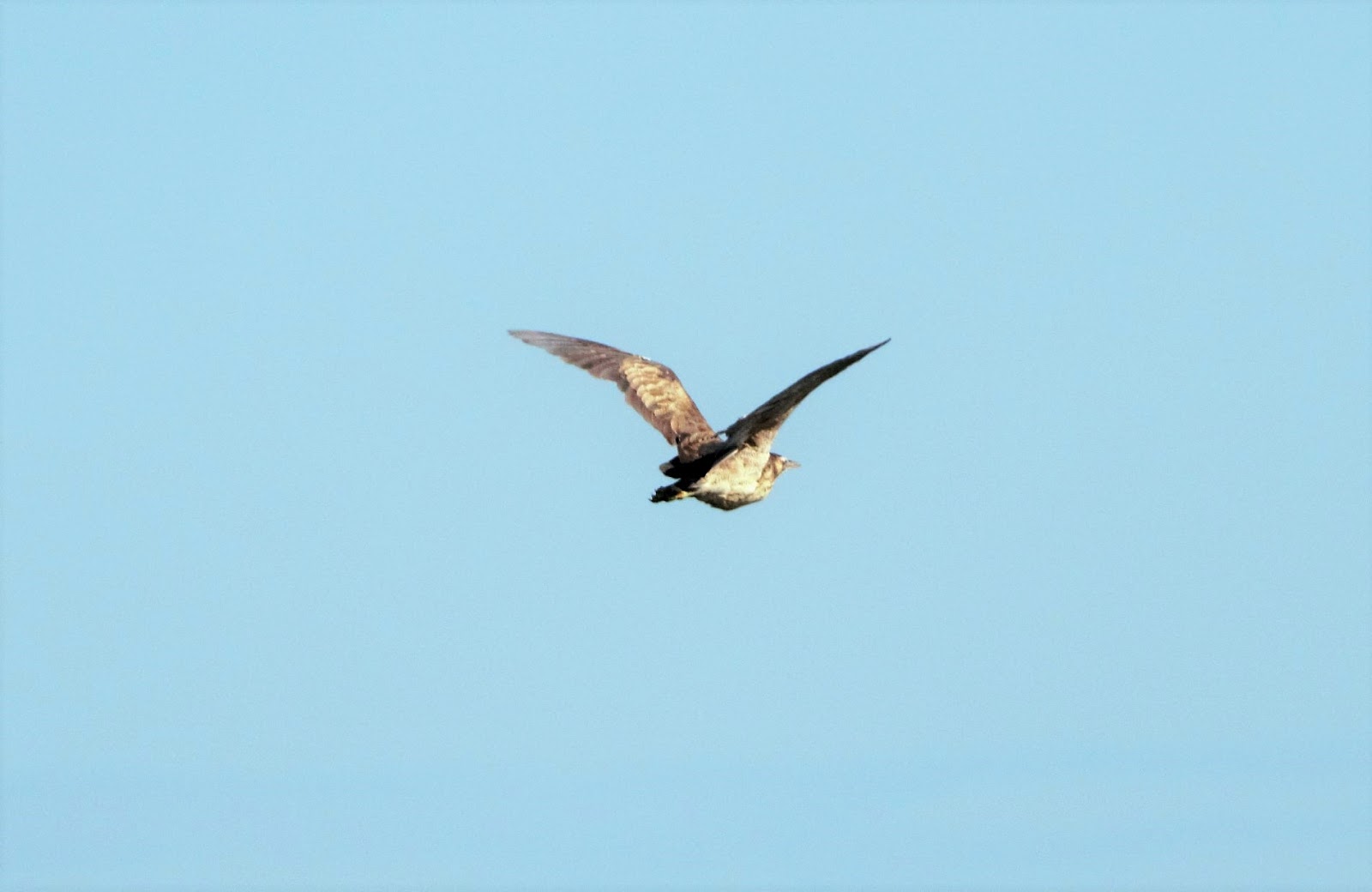
Plenty of avian activity hereabouts in recent weeks. An Australasian Bittern was reported by a Sunshine Coast Birds Australia outing to Garnett's Lagoon at Hervey Bay. This is a favourite spot which I've regularly visited. When I finally had the opportunity to visit the lagoon with John Knight on August 2, the bittern had been there for about 3 weeks; some observers had dipped, others were successful. Australasian Bittern is very rare in South-East Queensland. It took a bit but we eventually found the bittern lurking in the reeds - my second Queensland sighting of the species and my first images of it.

Australasian Bittern

Australasian Bittern
A white phase Eastern Reef-Egret at Hervey Bay was nice.

Eastern Reef-Egret

Excitement was in the air when a Regent Honeyeater turned up at Tin Can Bay recently for what looks to be the third record of this endangered species north of Brisbane. It was not seen subsequently but a Regent Honeyeater, likely the same bird, was spotted at nearby Carlo Point near Rainbow Beach on August 5. The bird has been seen each day since in exactly the same spot – behind caravan park site E4. Carlo Point is another favourite spot; we have camped here several times. The honeyeater was seriously harassed by Noisy Friarbirds and Little Friarbirds but kept returning to the same group of trees. 

Regent Honeyeater

Regent Honeyeater
 From Carlo Point I ventured out to Inskip Point, where a large group (450+) of Crested Terns was roosting on the shore. I'd dropped in here a few days ago on the way to Hervey Bay but the same flock was on an island offshore – too distant to make much of. This time I managed to find a Lesser Crested Tern in the scrum.

Lesser Crested Tern

Lesser Crested Tern
The tern was number 286 and the honeyeater 285 in my Sunshine Coast region 2018 Big Year. Still 14 to go to hit the target of 300, but being away for most of the rest of the year, that won't be easy. Seven other species have been seen but not photographed. Recent additions included a Green Pygmy-Goose that Jane Cooksley found at Lake MacDonald - another species that is very rare in South-East Queensland. 

Green Pygmy-Goose
Steve and Carol Popple discovered a Red-backed Kingfisher at Upper Glastonbury several weeks ago, which by all accounts is still there. 

Red-backed Kingfisher
We camped at the Brooyar State Forest camping ground nearby and heard and saw several White-throated Nightjars. I found a road-killed nightjar near Miva.

Camping at Brooyar State Forest


White-throated Nightjar
Spotless Crake at Parklakes Wetland and Nutmeg Mannikin at Bli Bli were further additions to the list.

Nutmeg Mannikin

Spotless Crake
I visited the Kilcoy area, finding good numbers of Cotton Pygmy Goose at Villaneuve and a nice Peregrine Falcon.

Cotton Pygmy-Goose
Peregrine Falcon
 Also of interest at Villaneuve was a large flock (400+) of Yellow-faced Honeyeaters on migration. These birds were heading south far earlier in the year than is usually the case - perhaps another consequence of climate change.

Yellow-faced Honeyeater migration

A Beach Stone-Curlew put on a show feeding on soldier crabs in the Noosa River estuary.

Beach Stone-Curlew

Beach Stone-Curlew
I tried unsuccessfully to photograph Swift Parrots at Sheepstation Reserve but did see a small flock in the distance. A Powerful Owl was there however, along with the Barking Owl nearby that I saw recently.

Powerful Owl


Monday, 6 August 2018

Sunshine Coast Pelagic August 2018


Providence Petrel
With a forecast wind direction of W-NW - about as bad as it gets - following several days of westerlies, we had some challenges ahead of us as we left Mooloolaba Marina at 7am on Sunday August 5, 2018. A Wedge-tailed Shearwater and a couple of Hutton's Shearwaters were seen on the way out. So were good numbers of Humpback Whales, including a group of about 12 that were hanging around a fishing boat. A pair of Brown Boobies were perched on a trawler nearby.

Brown Booby pair

Humpback Whale
We reached the shelf in 400 metres 32 nautical miles offshore at 9.40am (26.41,61 S; 153.13, 431E) and began laying a berley trail. During the 3.5 hours that we drifted off the shelf we had Providence Petrels about and a few Hutton's Shearwaters, but it was otherwise pretty much a bird-free zone. The wind was blowing a comfortable 10-12 knots on a swell of 1.5 metres making for pleasant conditions, but the north-westerly failed to produce the goods as might be expected.

Hutton's Shearwaters
The occasional Australasian Gannet and a few more Hutton's Shearwaters were seen on the return journey and we arrived back at the marina at 3.50pm.

Australasian Gannet
PARTICIPANTS
Greg Roberts (organiser), Toby Imhoff (skipper), Zoe Williams (deckhand),
Warren Bennett, Robyn Combes, Jo Culinan, Phil Cross, Alex Ferguson, Richard Fuller, Steve Grainger, Nicholas Haass, Judith Hoyle, Alan Kind, Wayne Kroll, James Martin, Gillie Matthew, Deb Metters, Stewart Meltlon, Rachel Oh, Gavin O'Meara, Xiatong Ren, Carolyn Scott, Raja Stephenson, Shen Zang.

SPECIES  Total (Maximum at one time)

Wedge-tailed Shearwater 2 (1)
Hutton's Shearwater 15 (4)
Providence Petrel 20 (3)
Brown Booby 2 (2)
Austrasian Gannet 5 (2)
Crested Tern 80 (20)
Pied Cormorant 2 (2)

Humpback Whale 30 (12)
Offshore Bottle-nosed Dolphin 20 (6)


Wednesday, 18 July 2018

Red-lored Whistler, Murray-Sunset & Werribee

Red-lored Whistler

Following the visit with Bernie O'Keefe and Scott Baker to Diamantina National Park and our travels down the Birdsville Track and through the Flinders Ranges, we moved on to the huge expanse of mallee in the Murray-Sunset National Park on the Victoria-South Australia border. We set up camp in a spot the guys knew of at the junction of Pheeneys and Old Bore tracks in remote, old growth mallee deep in the national park. I've always loved the mallee and it was a joy to be back in it.

Camping in Murray-Sunset National Park
Red-lored Whistler is one of the more difficult Australian birds to see and photograph so was high on our wishlist. I found a male whistler three kilometres north of the camp in almost exactly the same spot where Scott saw one many years previously. This was just the second time I've seen this species. At the same time, Scott found another bird south of the track junction, while a third whistler was heard early the evening before in the vicinity of the camp. So we had three Red-lored Whistlers within 4kms of each other over.

Red-lored Whistler

Red-lored Whistler
Striated Grasswren was another much-wanted image and having a pair of these at close quarters was satisfying.

Striated Grasswren
Striated Grasswren
The yellow-rumped form of Spotted Pardalote, a potential split for sure, was plentiful.

Spotted (Yellow-rumped) Pardalote
Other mallee birds showed nicely in this area, notably Southern Scrub-Robin, Shy Heathwren and Chestnut Quail-thrush. Yellow-plumed Honeyeater was fairly common and we looked without success for Black-eared Miners, finding just a single Yellow-throated Miner.

Shy Heathwren

Southern Scrub-Robin

Yellow-plumed Honeyeater

Chestnut Quail-thrush
We travelled more than 100km along park roads before leaving Murray-Sunset the next day and heading for our next overnight destination – the mallee town of Ouyen in Victoria. Mulga Parrot was plentiful along the way and White-browed Babbler was all over the place.

Mulga Parrot
White-browed Babbler
We visited Hattah-Kulkyne National Park the next morning but had no luck looking for Mallee Emu-wren, although we had seen the species previously. We did find the mound of a Malleefowl, not far from where I saw a malleefowl in 2014.

Malleefowl mound
We continued eastward to Lake Tyrrell, where Rufous Fieldwren took some searching in the cold and windy conditions, before finally arriving at Bernie's Melbourne home for some much-needed warmth and rest.

Lake Tyrrell

Rufous Fieldwren
The next day Bernie and I went to St Kilda pier, famed for its Little Penguin rookery in the retaining wall rocks. We found a single penguin sitting on an egg in a crevice between the rocks but the bird was difficult to photograph.

Little Penguin

St Kilda Pier
An elderly German-born man at the pier put on quite a show for the tourists as he fed several unusually tame Water-Rats, or rakalis as they are referred to now. The man fed the rats fish fingers, which appeared to be much relished, and had a cup of fresh water out for them.

Water-Rat
The following day Scott took me to the Werribee sewage treatment works. It had been many years since I'd been to this delightful birding destination. We'd hoped to encounter overwintering Orange-bellied Parrots and may have seen the species as three Neophema parrots crossed the road in front of the vehicle before disappearing into the distance. Other goodies as we drove around the wetlands included good numbers of Red-necked Avocet and Swamp Harrier.

Red-necked Avocets

Swamp Harrier
Spotless Crake and Australian Spotted Crake were in the reed-beds.

Australian Spotted Crake

Spotless Crake
We finished the trip with a visit to the excellent Blue Bamboo Vietnamese restaurant near Bernie's home.


Tuesday, 17 July 2018

Letter-winged Kite, Birdsville Track & Flinders Ranges

Letter-winged Kite roost at sunrise

Following our visit to Diamantina National Park, we (myself, Bernie O'Keefe and Scott Baker) headed west towards Boulia, turning south at Springvale Station towards Coorabulka Station. Having had some excellent encounters with Grey Falcon, we were looking forward to another raptor treat. A gathering of Letter-winged Kites had been reported recently (I believe Jannette Manins first found them) at Whitewood Creek, between Coorabulka and the Kennedy Developmental Road.

Letter-winged Kites

Letter-winged Kites

Letter-winged Kite
We had no trouble finding the kites in the early afternoon upon arrival (4/7). A total of 16-17 birds, including a couple of immatures, circled high in the air, evidently riding wind currents; the behaviour seemed unusual for this species, especially at that time of day. They soon landed in stunted coolibah trees lining the gully, which was surrounded by sparse Mitchell grass and gibber plains. We found widely scattered nests along about 1.5km of the gully that clearly had been used in recent times.

Letter-winged Kite nest

Letter-winged Kite site
Plenty of Little Crows were about here.

Little Crow
It's good news indeed that Letter-winged Kites are again being seen in this region. They were regular in that part of the world but had been largely absent over the past couple of decades. The species generally is in steep decline, most likely due to the predation of nesting adults and chicks by feral cats.  We camped at the site and that evening spotlighted 40km to the north and south along the road. We were delighted to find a Kowari, notwithstanding the sole poor image I managed.

Kowari
We found a Gibberbird on the road at night. The following morning, after farewelling the kites at their roost, we continued south, finding another Gibberbird before connecting with the Diamantina Developmental Road.

Gibberbird
Gibberbird at night
We stopped at a few spots along the way, connecting with Cinnamon Quail-thrush, Purple-backed Fairywren,  Australian Pratincole and a nice roadside Wedge-tailed Eagle (among others) before arriving in Birdsville.

Australian Pratincole
Wedge-tailed Eagle

Cinnamon Quail-Thrush

Purple-backed Fairywren
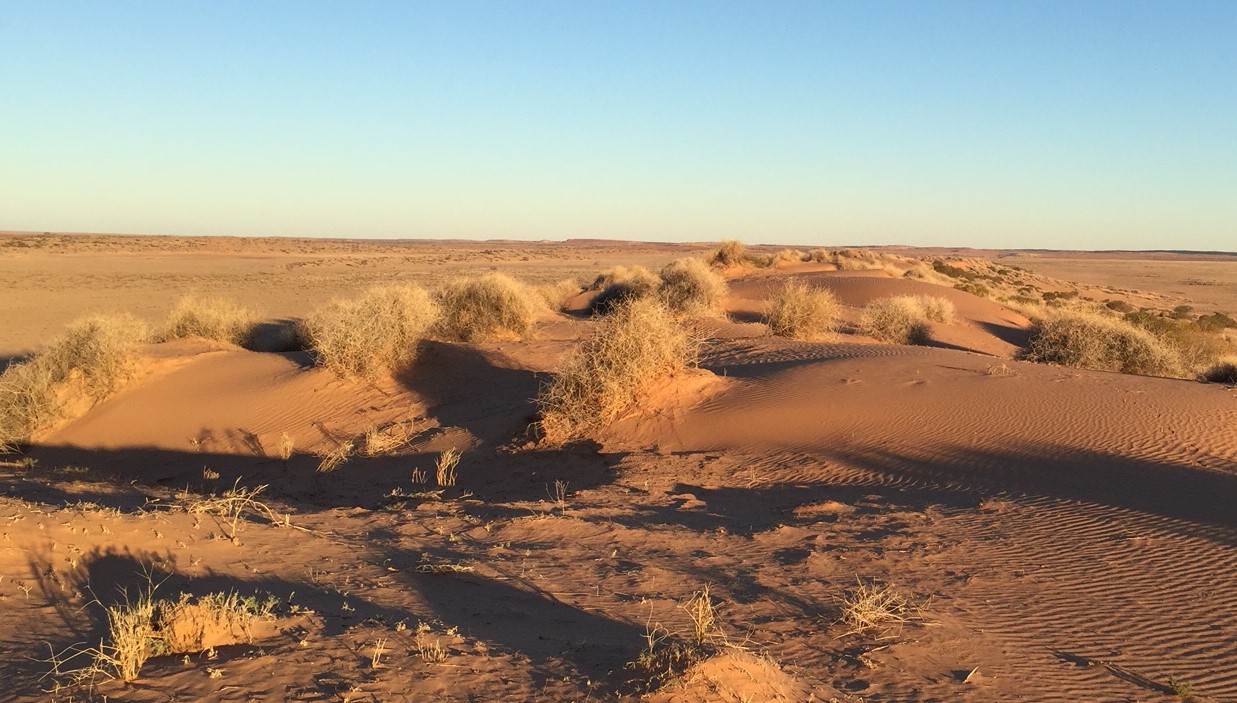
In the late afternoon we checked out a sand dune where Eyrean Grasswrens had recently been seen 17.5km east of Birdsville. We found the birds and managed a couple of mediocre images as they kept to the interior of canegrass tussocks.

Eyrean Grasswren

Grasswren dune near Birdsville
After overnighting at the Birdsville Hotel, we continued south 91km along the Birdsville Track to lignum and saltbush flats that have emerged as a hotspot for Grey Grasswren (Bernie O'Keefe, one of our group, discovered this spot a few years ago.) Unfortunately the weather conditions had changed dramatically overnight from warm and still to cold and windy. That took care of the flies that had been plaguing us, but grasswrens are difficult in these conditions and two of us managed just brief views of a single bird. A pair of Orange Chats showed nicely here.

Orange Chat male

Orange Chat female
We tried unsuccessfully to drive into Pandiburra Bore and almost got bogged in the process as heavy rain had fallen in the area recently. Various old homestead ruins along the Birdsville Track are worth a look. We found a Bynoe's Gecko near one of the old homesteads. Bynoe's  Gecko and Eastern Tree Dtella were found earlier in Diamantina National Park.

Getting out a sticky situation - Pandiburra Bore track

Homestead ruins
Bynoe's Gecko
Eastern Tree Dtella
We spent the next evening at the Mungarannie Hotel. Continuing south along the Birdsville Track the next day we picked up other goodies including Stubble Quail,  White-backed Swallow and a flock of Blue-winged Parrots.

Stubble Quail
Blue-winged Parrots

Blue-winged Parrot
White-backed Swallow
A sole Ostrich along the track is evidently well-known - not tickable but wild. We saw more Eyrean Grasswrens on a dune 140km south of Mungarannie. After overnighting at the Lyndhurst Hotel we failed to connect with Thick-billed Grasswrens at a nearby site the next morning.

Ostrich
We moved on to the Flinders Ranges, where our run of bad luck with grasswrens continued. We couldn't find Short-tailed Grasswren at Stokes Hill; I suspect that wind combined with the absence of calling mid-winter was responsible for the lack of grasswrens. We also had limited to time to look for the birds, all of which had been seen previously by the three of us. As usual, the Flinders Ranges did not disappoint aesthetically.

Flinders Ranges from Stokes Hill
We had more joy at Brachina Gorge where Yellow-footed Rock-Wallaby showed nicely, along with Grey-fronted Honeyeater, while Euro was abundant throughout the area.

Yellow-footed Rock-Wallaby

Grey-fronted Honeyeater

Euro