Sunshine Coast Birds

Birding and other wildlife experiences from the Sunshine Coast and elsewhere in Australia - and from overseas - with scribblings about travel, environmental issues, kayaking, hiking and camping.

Tuesday, 19 November 2013

Lady Elliot Island - Part II (Birds other than Terns)

Red-tailed Tropicbird
Apart from the impressive populations and variety of terns on Lady Elliot Island (next post - see here) there are plenty of other avian attractions, chief among them the Red-tailed Tropicbird. Two pairs of tropicbirds were nesting during our stay - one at the end of the airstrip and one in front of a tourist cabin. Both nests contained a single well-fledged youngster. Like most other island birds, the tropicbirds were unconcerned by the presence of humans.

Red-tailed Tropicbird

Great Frigatebird - male
Frigatebirds were frequently seen flying about the island, although none were spotted landing or roosting during our stay. A good proportion of birds were young, presenting identification challenges at times, but I estimated that 70-80 per cent of the 100-120 frigatebirds I saw over five days were Great Frigatebirds.  The remainder were Lesser Frigatebirds; often the two species were in the air together. Small numbers of Brown Booby were among other seabirds seen offshore.

Great Frigatebird - female

Lesser Frigatebird - female

Buff-banded Rail


Buff-banded Rails were extremely common on the island, with 200-300 birds present. They could be a nuisance at the dinner table, being quick to raid an unattended plate. The rails are secretive in their well-vegetated habitat on the mainland but on the island they are fearless and forage openly, even at night.

Buff-banded Rail

Eastern Reef-Egret
 Eastern Reef-Egrets were fairly common; about 70 per cent were white phase, the remainder grey phase.
Lesser Sand-Plover
 About 10 Lesser Sand-Plovers were on the island.

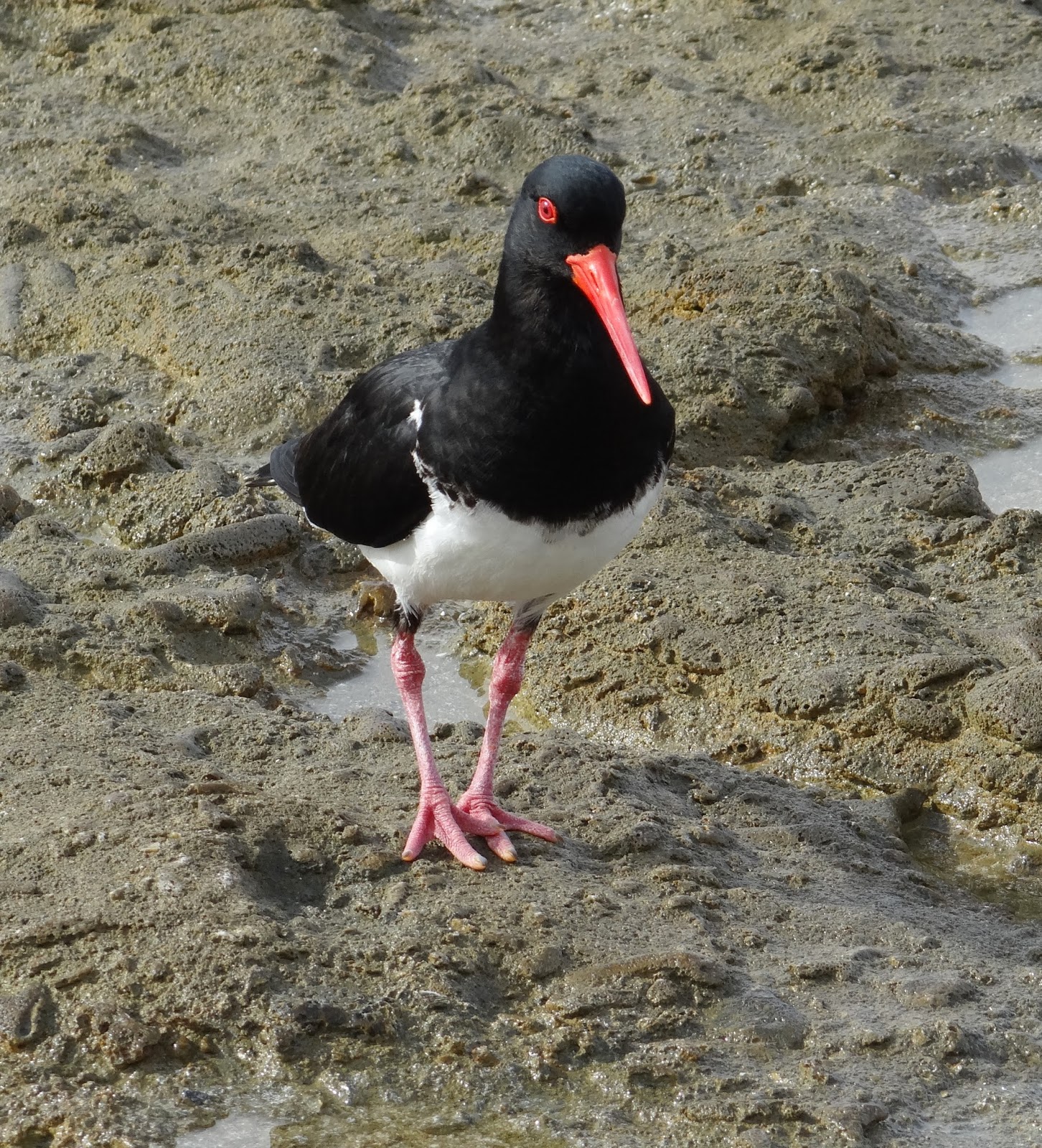
Pied Oystercatcher
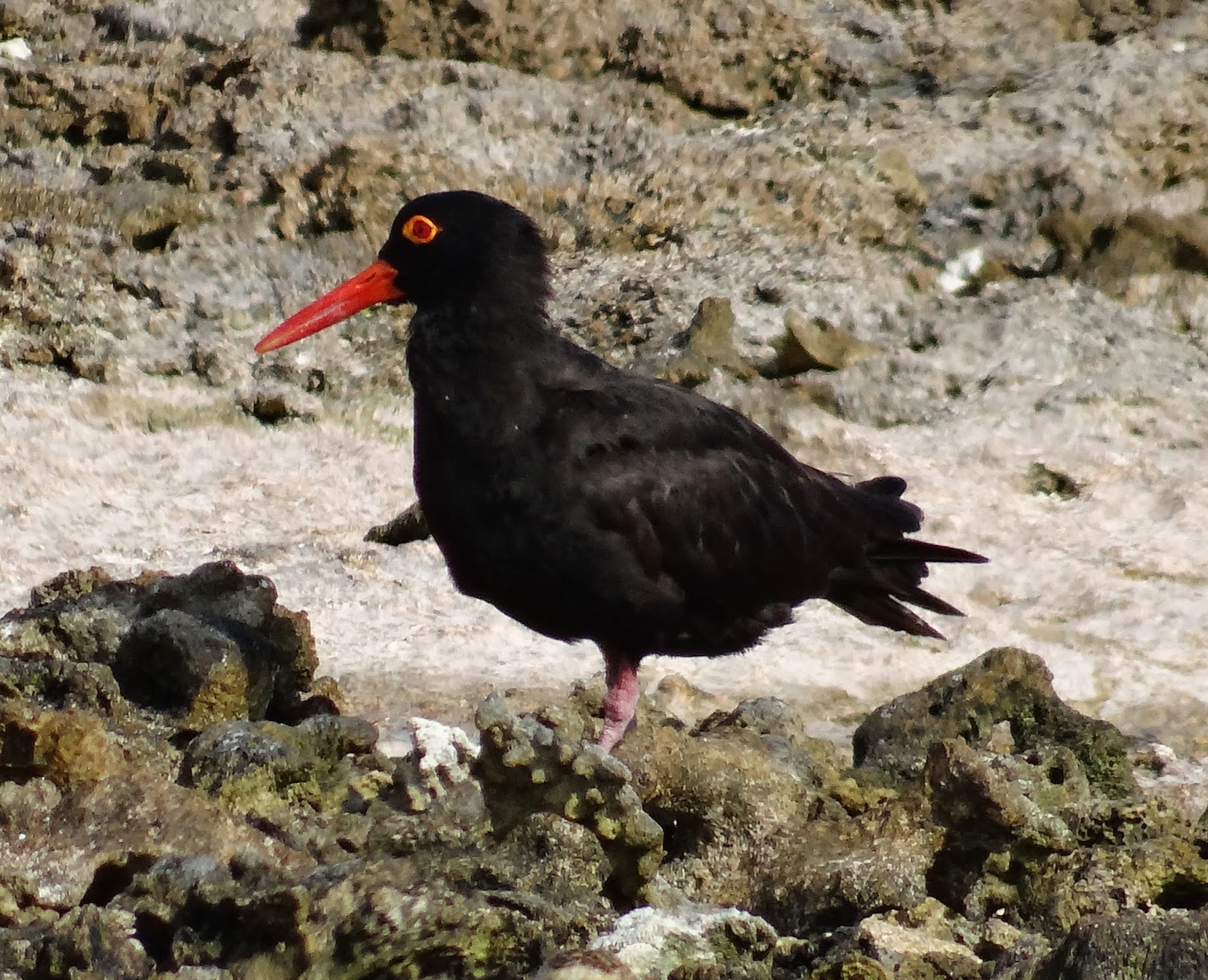
One pair each of Pied Oystercatcher and Sooty Oystercatcher was present, sharing similar habitat. Note the large eye-ring of the northern race of Sooty Oystercatcher opthalmicus here.

Sooty Oystercatcher

Grey-tailed Tattler
Both species of tattler were in good numbers and it was interesting to see them sharing similar habitat (like the oystercatchers). A total of 22 Grey-tailed Tattlers and 9 Wandering Tattlers were counted. Sometimes they roosted loosely together at high tide on the reefs.

Wandering Tattler
 I was surprised to find a Wandering Tattler in breeding plumage roosting in a tree.
Wandering Tattler

Pacific Golden Plover & Ruddy Turnstone
Good numbers of Ruddy Turnstone and Pacific Golden Plover were on the island along with a few Red-necked Stints.
Red-necked Stint

Sanderling
An unexpected find was a Sanderling which fed on the airstrip or along an adjacent beach, sometimes keeping company with the stints.

Wedge-tailed Shearwater
Wedge-tailed Shearwaters were nesting commonly about the resort, including a pair behind our cabin. They flew in after dusk and were quite vocal throughout the evening, which is why the resort supplies free earplugs to guests. I also found several beachwashed Short-tailed Shearwaters on the island - they would not normally be expected here but it was not surprising given the extent of the huge wreck of this species being experienced this spring throughout south-eastern Australia.

Wedge-tailed Shearwater

Silvereye
A few Silvereyes of the distinctive Great Barrier Reef race chlorocephala were about, though not as commonly as I expected. Other land birds included a couple of Tawny Grassbirds, several Sacred Kingfishers and Channel-billed Cuckoo heard. The only raptor seen was a single White-bellied Sea-Eagle.

Lady Elliot Island Resort
A general shot of the resort (above) and the island's historic lighthouse. The service and food at the resort was excellent and this ecotourism destination can be highly recommended. A separate post will follow on turtles and fish seen.


Monday, 18 November 2013

Lady Elliot Island - Part I (Terns)

Lady Elliot Island
We have returned from a wonderful five days on Lady Elliot Island, the southern-most island of the Great Barrier Reef, seen here from the air as we arrived. We drove to Hervey Bay for the short flight to the island, stopping at Bundaberg en route.

Black Noddy with chick
What strikes the visitor to Lady Elliot more than anything upon arrival is the abundance of birdlife. An estimated 100,000 seabirds nest on the island; we were there at the height of the nesting season. About 70 per cent of the seabirds are Black (White-capped) Noddies, which nest in trees across the island, including throughout the resort grounds.

Black Noddy & Me
Like most other seabirds on the island, the Black Noddies are oblivious to the presence of human interlopers. They seemed to be constantly busying themselves, adding material to their flimsy nests, and keeping up the activity until well after sunset.

Black Noddy

Common Noddy with chick
Common or Brown Noddies were nesting on the island in smaller numbers, mostly at both ends of the airport runway. Unlike the Black Noddy, the Common Noddy nests on the ground. Both noddies had chicks in various stages of development - Black Noddy chicks are dark while Common Noddy chicks are pale.

Common Noddy

Common Noddy (left) & Black Noddy (right)
Sometimes the two noddy species could be seen together, allowing good comparisons. Two or three (sometimes more) planes land on the island daily, and some bird collisions are inevitable;  this Common Noddy below was a victim during our stay.

Plane arriving on Lady Elliot
Common Noddy plane strike victim


Bridled Tern
 Bridled Tern was also numerous, nesting throughout the island and, like the Black Noddy, it was common around the resort grounds.


Many Bridled Terns were sitting on eggs on nests which were little more than slight scrapes in the ground, or small niches among the coral. Others had chicks resembling balls of fluff. Early morning was the best time to watch the youngsters being fed tiny fish or squid by their parents.

Bridled Tern
The Bridled Terns nested everywhere and anywhere. It was a challenge not to step on them at times while wandering around the resort, especially at night.

Sooty Tern
Sooty Terns were in much small numbers - about 20 birds were concentrated in one short stretch of beach, with several pairs sitting on eggs.

Sooty Tern

Bridled Tern (above) & Sooty (below) Tern
 Bridled Terns and Sooty Terns were nesting side-by-side.

Roseate Tern
 About 400 Roseate Terns were nesting on the island, with most pairs attending well-developed chicks.

Roseate Tern
 Most Roseate Terns were in breeding plumage but the odd bird was in eclipse plumage.

Black-naped Tern
Black-naped Terns were present in small numbers - about 30 or 40 birds were concentrated in a small section of beach.
Black-naped Tern (left) and Roseate Tern (right)
 Black-naped and Roseate Terns were nesting side-by-side in one spot.

Crested Tern
 Several hundred Crested Terns were nesting beside the airstrip.
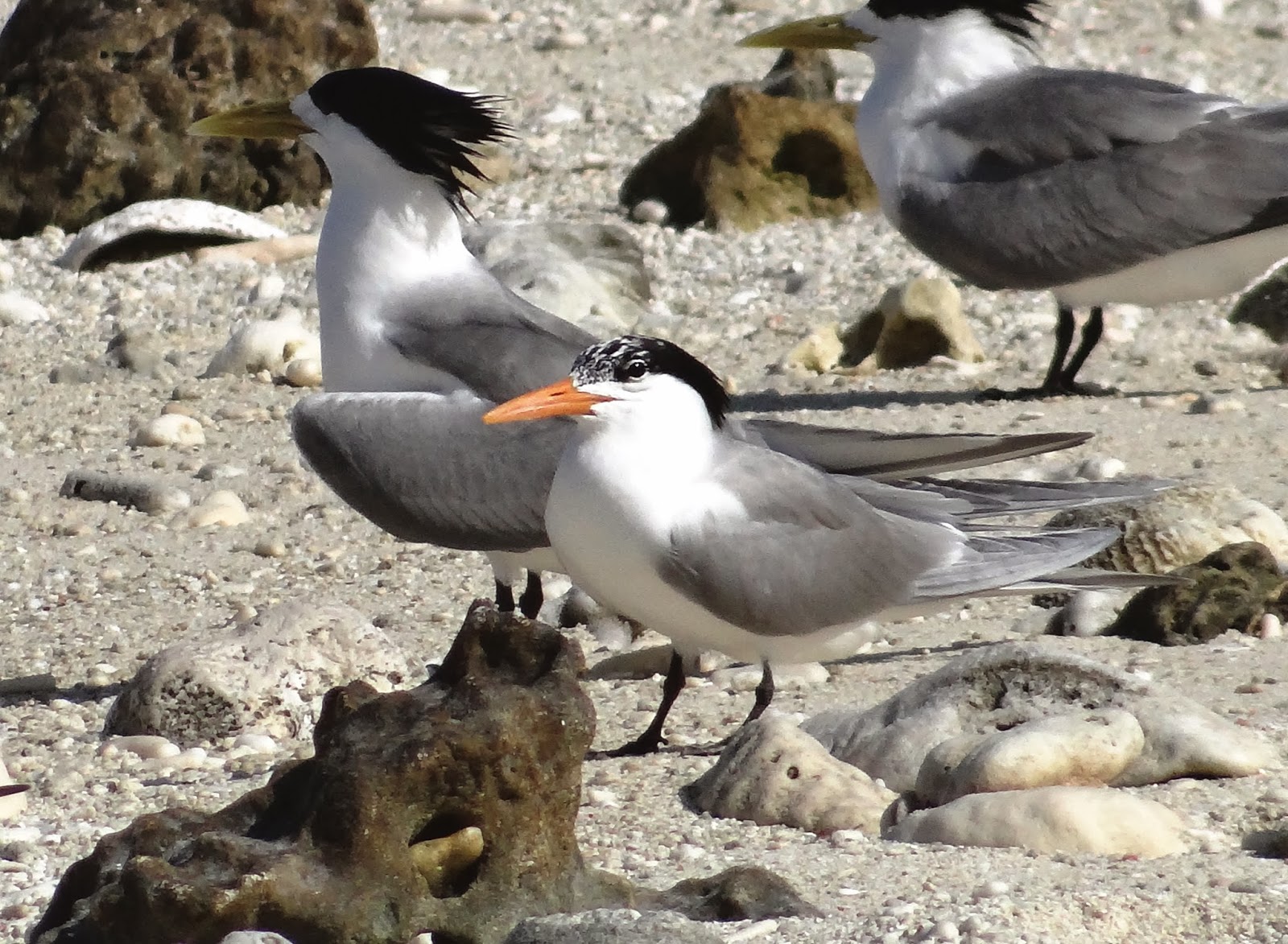
Crested Tern (rear) & Lesser Crested Tern (front)
 Among the Crested Terns on the beach was a single Lesser Crested Tern.

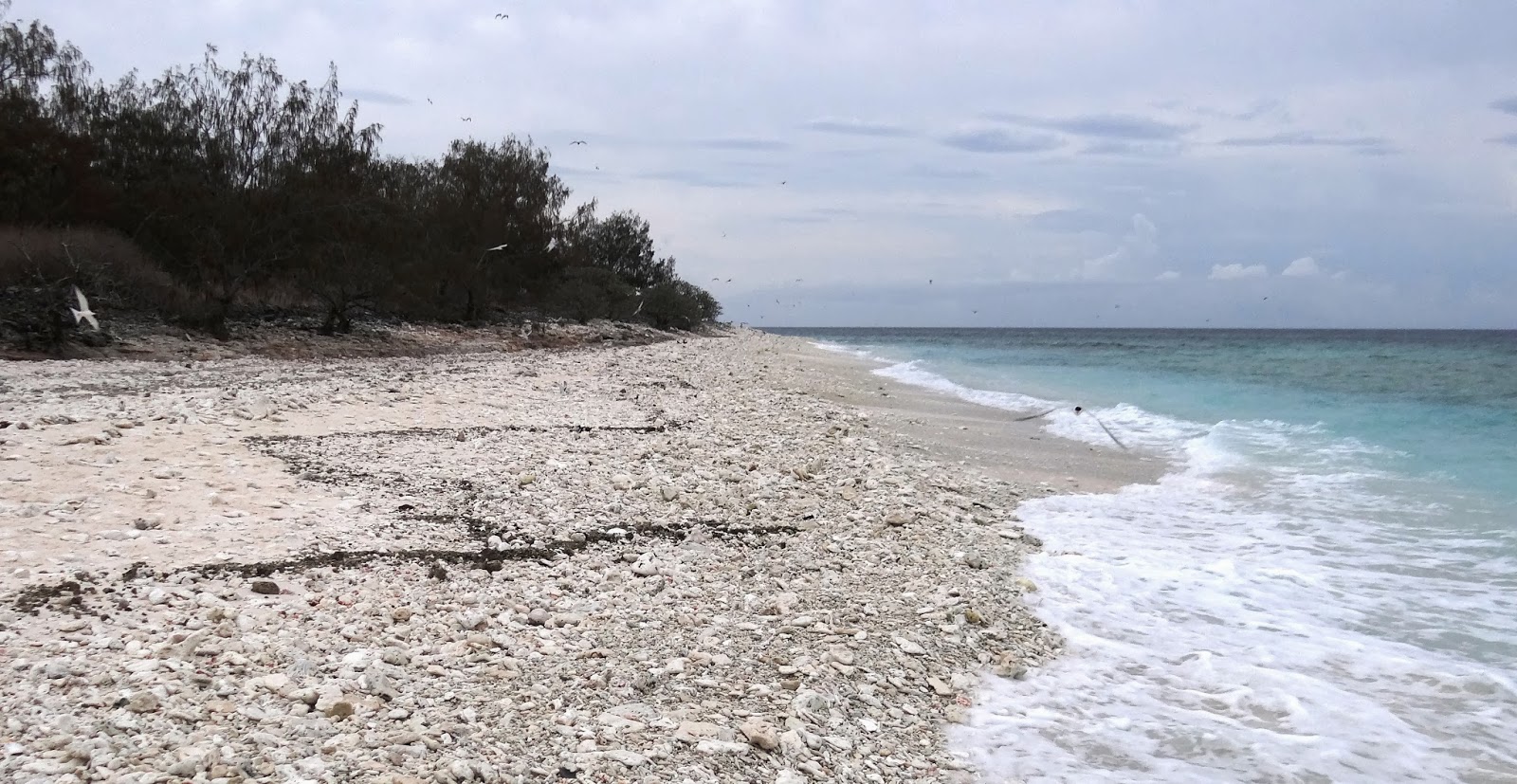
Lady Elliot Island beach
The stretch of beach where the Roseate and Black-naped Terns were nesting.

Our hut on the island
The island has varying standards of accommodation depending on price. We elected to stay in the cheaper "eco-hut" but it was comfortable and adequate for our purposes, with sea views and birds constantly about the hut. We had Bridled Terns nesting by the hut wall and Wedge-tailed Shearwaters nesting behind the hut (more birds in the next post). 

Saturday, 2 November 2013

Sunshine Coast Pelagic Trip November 2013

Mottled Petrel and large numbers of Short-tailed Shearwaters were the highlights of the November 2 pelagic trip off Mooloolaba on the Sunshine Coast. We had high hopes for this pelagic as there had been a prolonged period of rough weather offshore in the days preceding and a forecast 10-15 knot south-easterly. As it transpired, however, the wind was barely moving; it was consequently one of those days when not much was happening, although some cetaceans and a big fish livened things up.

Short-tailed Shearwater
The day belonged to the Short-tailed Shearwaters, the first of which we saw even before we had left the Mooloolah River following our departure from the Mooloolaba Marina at 6.30am. The Short-taileds were ever present as we headed offshore on a fine, sunny day, with a water temperature of 25 degrees and a maximum temperature for the day of 27 degrees. A fair number of Wedge-tailed Shearwaters made an appearance inshore. Cetaceans were looking good with three species of dolphin seen on our way out.

We crossed over the shelf in two hours following a smooth ride with a swell of under a metre and began leaving a berley trail at 8.40am at 410 metres, 32.5 nautical miles from shore (26',36',692'S; 153', 43', 630'E). The wind was barely discernible, an easterly breeze of under 5 knots which altered little as the day progressed.
Mottled Petrel - Picture by Raja Stephenson
Our hopes lifted soon after arriving on the shelf when we saw a distant Mottled Petrel. However, Short-
tailed Shearwaters and a few Wedge-tailed Shearwaters were all that were coming to the boat. The Short-taileds were about the boat all day. A distant Sooty Tern was seen soon after we arrived on the shelf. Soon after, a single Wilson's Storm-Petrel passed by the boat and later in the morning a second storm-petrel stopped briefly to check out the berley.

Short-tailed Shearwater
Wedge-tailed Shearwater
A welcome diversion was afforded by a Tiger Shark which appeared just under the surface and lingered around the boat for a while. Then around midday a second Mottled Petrel was seen, this one closer but still not coming to the boat.

Short-tailed Shearwater
It was evident that the Short-tailed Shearwaters were hungry as they were feeding constantly. Large numbers of shearwaters are currently being washed up on Sunshine Coast beaches, continuing the trend over the past 3-4 weeks which has seen a huge wreck of this species along the coast of south-east Queensland and New South Wales.

After drifting south with the current for 8 nautical miles, we headed inshore at 1.30pm, seeing little other than a nice pod of Pantropical Spotted Dolphins and arriving back at the harbour at 3.30pm.

PARTICIPANTS: Lachlan Tuckwell (skipper), Greg Roberts (organiser), Luke Bennett, Duncan Cape, Wayne Ellis, Rod Gardner, Nikolas Haass, Sue Lee,  Ross Sinclair, Natalie Sinclair, Raja Stephenson, Paul Walbridge, Brian Willey, Michael Wood.

SPECIES: Total (Maximum at one time)

Short-tailed Shearwater 400 (30)
Wedge-tailed Shearwater 40 (5)
Mottled Petrel 2 (1)
Wilson's Storm-Petrel 2 (1)
Crested Tern 6 (2)
Sooty Tern 1 (1)
Silver Gull 8 (6)

Offshore Bottle-nosed Dolphin 4 (2)
Short-beaked Common Dolphin 2 (2)
Pantropical Spotted Dolphin 7 (4)