Sunshine Coast Birds

Birding and other wildlife experiences from the Sunshine Coast and elsewhere in Australia - and from overseas - with scribblings about travel, environmental issues, kayaking, hiking and camping.

Monday, 25 February 2013

Birding Mudumali Tiger Reserve - India Part 6

Crested Tree-Swift
We departed the highlands town of Ooty (see following post) for the final leg of our India trip - Mudumali Tiger Reserve and the surrounding dry woodlands of Tamil Nadu state. On the way downhill along Kallatti Road from Ooty, birds seen included Crested Treeswift, Tawny-bellied Babbler and a Tytler's Leaf-Warbler. We arrived at our accommodation, the Jungle Hut, where we found Jerdon's Leafbird in the leafy, very birdy gardens.

Crested Serpent-Eagle
The next morning we hired Jungle Hut's bird expert, Siddha, and were disappointed to discover that he palmed us off to two friends who could not speak English. Nonetheless, we enjoyed a pleasant early morning strolling with them through open Acacia savanna reminiscent of East Africa, with elephants rumbling in the distance. The top bird here was a male White-bellied Minivet, always a difficult species to find.

Indian Nuthatch
 Other birds included Crested Serpent-Eagle and Indian Nuthatch.

Malabar Lark
We drove to a dry, open hillside nearby where a regional specialty, Malabar Lark, was quickly found. (Siddha had told us falsely that this was a difficult bird and we would need to hire him for two days to find it.)

Grey-bellied Cuckoo
At another stop in a well-wooded gully, we found a Grey-bellied Cuckoo.

Oriental Scops-Owl
That evening, I was too ill to join the others for dinner (two of the four of us suffered from food-related illness at the Jungle Hut), when I heard an Oriental Scops-Owl calling. I was able to track it down for excellent views.

Indian Peacock
The next morning we visited Theppakada for a bus ride through the national park, seeing plenty of peafowl.

Nilgiri Thrush
Some of the best birding was in the Jungle Hut grounds, where we birded and relaxed for a full afternoon and morning. Nilgiri Thrush was an unexpected find at this altitude, although we had seen it at Ooty.

Yellow-billed Babbler
The endearing if noisy Yellow-billed Babbler was common in the grounds.

Purple-backed Sunbird
 As was the lovely Purple-backed Sunbird.

White-browed Wagtail
White-browed Wagtail was a fixture at a waterhole near our rooms.

White-bellied Drongo
White-bellied Drongo was another regular.


Two or three Tickell's Blue-Flycatchers were ridiculously tame.

Malabar Parakeet

Malabar Starling
Malabar Parakeet and Malabar Starling were regular visitors to fruiting trees around the Jungle Hut.

Indian Pitta
An Indian Pitta was often out in the open at all times of the day - unusual behaviour for pittas.

Little Cormorant
After Mudumali, we ended our Indian trip with a pleasant two-day trip on the back waters of the Alleppey area on a converted rice boat. Little Cormorant was frequently seen between cocktails on board.
I will file separate posts on mammals, culture and the like.

Friday, 22 February 2013

Munnar, Ooty & Chinnar in the Western Ghats - India Part 5

Nilgiri Laughingthrush

Following our successful forays in the lowlands of the Thattekkad area in Kerala province in south-west India, and in the dry north-west province of Gujarat (see following posts), it was on to the high country of the Western Ghats in search of regional specialties. After Hornbill Camp, we moved to the elegant and highly recommended Olive Brook Resort in the hill town of Munnar (1600m).

Besra

 Our first afternoon saw us beating through shoulder-high shrubs and grasses to reach the top of a ridge known as the key site for a particularly scarce endemic, the Broad-tailed Grassbird. A Besra was a familiar face early in the hike but we were rewarded for our physical efforts by decent flight views of two grassbirds as well as Nilgiri Pipit, Nilgiri Flycatcher and a very close covey of Painted Bush-Quail.

Grey Junglefowl

Grey Junglefowl were plentiful about the Munnar area, as they were throughout our south-west Indian visit.

Yellow-throated Bulbul
The morning of our second day at Munnar had us out of bed very early for the long drive to Bodi Ghat, where we succeeded in seeing several Yellow-throated Bulbuls in roadside shrubs on a steep stretch of road; this is one of the more difficult Western Ghats endemics.


In the late afternoon we visited the Kunniamally shola near Munnar, a tiny scrap of native forest that has several specialties in residence. We saw Kerala (Grey-breasted) Laughingthrush and Blue-capped Rock-Thrush here.

The next morning we went high into the mountains to visit Eravikulam National Park, battling the throngs of local tourists as they crowded onto the buses which must be patronised to reach the park.

Grey (Jungle) Nightjar

We had a Grey (Jungle) Nightjar at its roost close to the bus on the way up.

Hill Swallow
 We saw quite a few Hill Swallows around the park entrance and along the main walking trail. This bird is a recent split from the Pacific Swallow, differentiated mainly by its glossy upperparts.


Nilgiri Pipit
We had close views of Nilgiri Pipit and plenty of Kerala Laughingthrushes along the walking trail.

White-bellied Blue-Robin
In the afternoon we returned to the Kannimalai shola, where after some effort we finally connected with close views of White-bellied Blue-Robin, or White-bellied Shortwing.

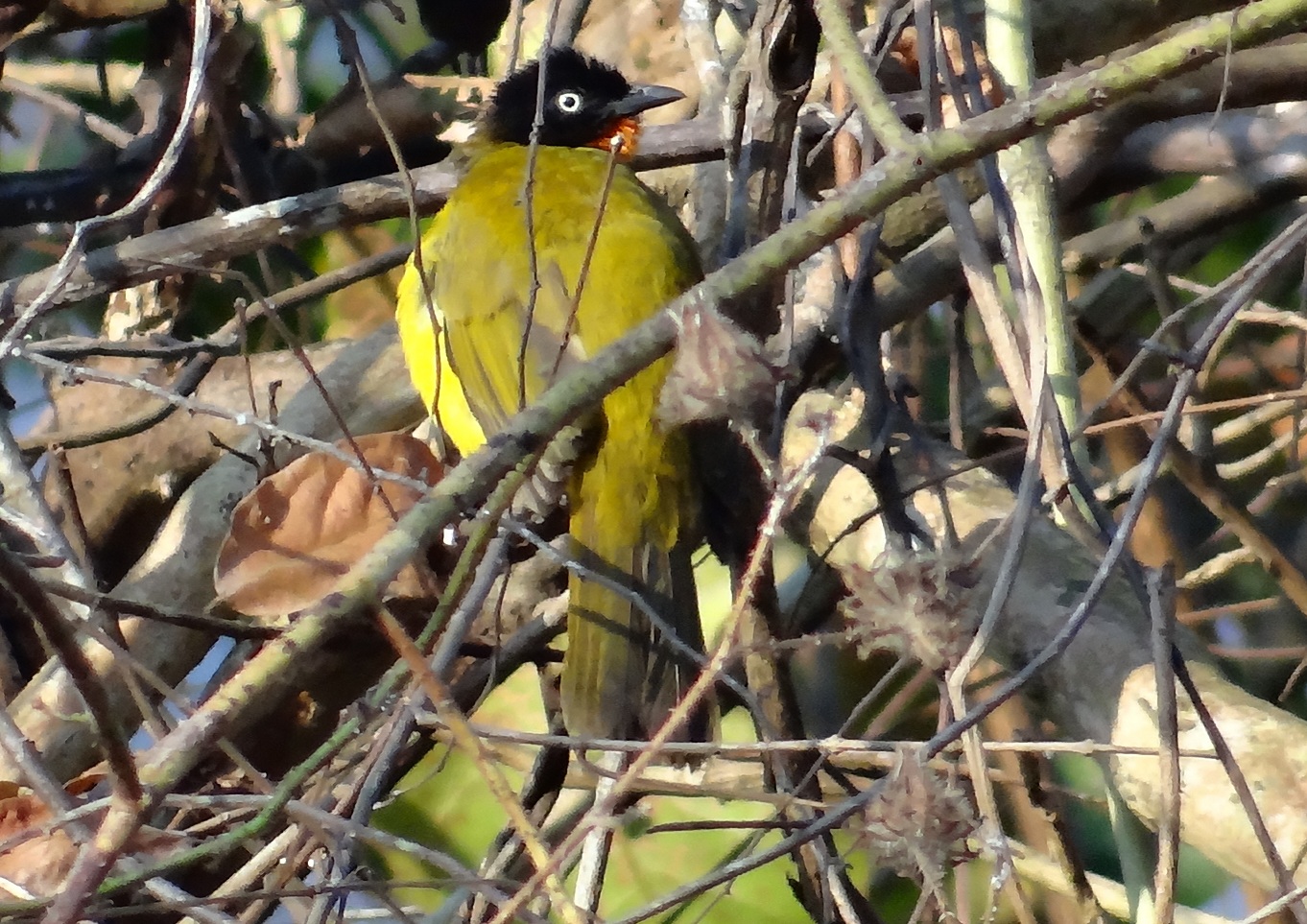
Black-and-Orange Flycatcher
Black-and-Orange Flycatcher was another nice find in this decrepit looking bit of habitat.

Malabar Whistling-Thrush
Malabar Whistling-Thrush was plentiful but painfully shy, as this image suggests.  We left Munnar after three nights, heading through the dry scrub of the Chinnar Wildlife Sanctuary where we scored Blue-faced Malkhoa from the car. We walked along a rocky creek bed with a park ranger, failing to find the resident roosting Spot-bellied Eagle-Owls but seeing nice birds such as Puff-throated Babbler and Asian Paradise-Flycatcher.

Asian Paradise-Flycatcher
Our final destination in the highlands was the resort town of Ooty for two nights in the noisy Monarch Hotel, which appears to host a constant string of traditional, very loud wedding ceremonies . Our first morning saw us at Doddabetta, an area of shola forest near the town which holds most of the local specialties. We saw plenty of Nilgiri Laughingthrushes (first image in this post) along with Indian Blackbirds.

Indian Blackbird
The birds were oblivious to the constant stream of human traffic making its way through a forest trail to some sort of theme park.

White-bellied Blue-Robin
It took a while to catch up with the main target, the White-bellied Blue-Robin, or White-bellied Shortwing, which like its Nilgiri cousin, is endemic to a very small patch of south-west India.

Mountain Hawk-Eagle
Another nice find was a distantly perched Mountain Hawk-Eagle. In the afternoon we visited Ooty's Botanic Gardens, where we saw another White-bellied Blue-Robin feeding at a rubbish dump at the top of the gardens, along with an unexpected Nilgiri Thrush.

Sunday, 17 February 2013

Hornbill Camp & Thattekkad - India Part 4

Sri Lanka Frogmouth

After a week in the dry Indian state of Gujarat (see the following three posts), Bill Watson and I met up with Sandra Watson and Glenn Scherf in Delhi for a bit of cultural activity around Agra (more on that later) before flying to Kochi, the capital of Kerala state in the south-west of the country. We were looking forward to the change of scenery and birds.

White-cheeked Barbet

Kochi-based Kalypso Adventures organised our 12-day trip through Kerala and Tamil Nadu states, and they did an excellent job. We opted not to have a birding guide full-time, using locals on occasion, but we wanted a driver who more-or-less knew where to go for the birds. That driver, Joji, was very good and is highly recommended. Our first call was three nights at Hornbill Camp, birding the Thattekkad area in the forests of the Western Ghats.
Local guide Danish Trogon in the Western Ghats

 Our local guide at the camp, Danish Trogon, proved to excellent at tracking down specialties. Contrary to what has been written in some reports, you do not need to visit Periyar for the regional specialties.

Hornbill Camp

Jungle Babbler

Around the camp, common birds included the Western Ghats endemic, White-cheeked Babbler, and Jungle Babbler.

Flame-throated Bulbul

Our first morning saw us in an excellent dry forest patch amid rocky outcrops at Kallypar. Here we scored the elusive Grey-headed Bulbul, a Ghats endemic along with fellow regional endemic bulbuls Flame-throated  and Yellow-browed.

Yellow-browed Bulbul

The birds came thick and fast and we had quickly ticked off Malabar Trogon, Malabar Parakeet, the soon-to-be-split Fork-tailed Drongo-Cuckoo, Black-headed Cuckoo-shrike and Malabar Woodshrike.

Malabar Woodshrike

Black-headed Cuckoo-shrike female
Fork-tailed Drongo-Cuckoo
Other than Kallypar, our time in the region was centred on several visits to forest patches at Urulanthanni and Idamalayar. We saw loads of Grey Junglefowl, a wonderfully close pair of Red Spurfowl and a few Heart-spotted Woodpeckers. Regional specialties included Grey-fronted Green Pigeon, Orange Minivet, Indian Blackbird, Indian Scimitar-Babbler, White-bellied Blue-Flycatcher, Crimson-backed and Long-billed Sunbirds, Dark-fronted Babbler and Malabar Grey Hornbill, while more familiar species included Common Hawk-Cuckoo. A pair of Sri Lanka Frogmouths at roost during the day were admired in a patch of scrub; a single third bird was found nearby. Indian Pittas also showed themselves here.

White-bellied Blue-Flycatcher
Nilgiri Wood-Pigeon was an unexpected find as this is usually a high-altitude species. Other Western Ghats endemics included White-bellied Treepie, Malabar Whistling-Thrush and Rufous Babbler.

Common Hawk-Cuckoo

Malabar Grey Hornbill
A nice find near the camp was Brown Fish-Owl at its day roost. Jerdon's Nightjar was taped in at the camp, though we dipped on the resident Mottled Wood-Owls nearby. We were fortunate to track down a Sri Lanka Bay Owl just before dawn one morning and to see a rare Wynaad Laughing-Thrush in thick bamboo at a site we have been asked not to reveal. Here, as in other parts of the region, elephants were an ever present hazard and we had to exercise care in trawling the forests. We heard and smelled elephants on several occasions when they were close by, and in this part of the world they are highly intolerant of people.

Brown Fish-Owl

Tuesday, 5 February 2013

Birding the Arabian Sea Coast, Greater & Little Ranns of Kutch - India Part 3

Rock Eagle-Owl
Our second day in the Greater Rann of Kutch began with a visit to the Naliya Grasslands, where we failed to find Indian Bustard, a species I saw in the country during a 1990 visit. There were good numbers of raptors about, including Tawny Eagle, while Bay-backed Shrike was among the interesting passerines in scattered shrubs.

Tawny Eagle
Bay-backed Shrike
We moved on to the coast at Mandvi, where the river estuary and roadside ponds were full of waterbirds. An abundance of waders include many Ruffs, including some in breeding plumage, and Common and Spotted Redshanks.

Ruff


Spotted Redshank
We found a flock of Demoiselle Cranes - a much desired species - in a field as we moved north along the coastal road.
Demoiselle Crane

Other waterbirds we saw included Painted Stork, large numbers of Black Ibis and Dalmation Pelicans at roost with more numerous Great White Pelicans.

Painted Stork

Black Ibis

Dalmatian Pelican
Moving to the coast at Modhba, we found two Crab Plovers, one a begging juvenile, on the broad sandy beach. There were also good numbers of Greater Flamingoes on the beach.
Crab Plover
Greater Flamingo

The next day, our third in the Greater Rann region, saw us returning to the Banni Grasslands. We encountered a group of Indian Coursers in a cultivated field, while other birds about the region included Indian Bushlark.

Indian Bushlark

Indian Courser
We moved on to an area of rocky ridges and dry watercourses where we connected with Grey-necked Bunting.

Grey-necked Bunting

Then it was on to a ravine where a Rock (Indian) Eagle-Owl was flushed (first image in this post) from its daytime roost, and Spotted Owlets were seen.

Spotted Owlet
After four days in the Greater Rann we transferred to the Rann Riders Lodge, our base for birding the Little Rann of Kutch. During our first day here in the arid grasslands we had good albeit distant views of several Macqueen's Bustards, while a Laggar Falcon was seen nicely.

Laggar Falcon
 During a visit to Nawa Taleo Lake, we saw large numbers of Lesser Flamingoes and a flock of several hundred Demoiselle Cranes.
Lesser Flamingo
Hundreds of wintering Greylag Geese were present on another wetland, Tundi, along with more Grey-necked Buntings, Black-headed Buntings and Indian Reed-Warbler.

Greylag Goose
Some of the more common birds around the lodge included the following.

Hoopoe

White-throated Kingfisher

After two days around the Little Rann, we transferred to the capital of Gujarat, Ahmedabad, seeing en route some Sarus Cranes, Asian Open-bill and about 20 White-rumped Vultures near the village of Dumana. As is well-documented, the position of all vulture species in India is precarious due to chemical poisoning and it was a surprise to learn of this population.

Shikra
Among raptors more generally, Shikra was probably the most numerous that we encountered in Gujarat.

Sarus Crane

White-rumped Vulture
Asian Open-bill