Sunshine Coast Birds

Birding and other wildlife experiences from the Sunshine Coast and elsewhere in Australia - and from overseas - with scribblings about travel, environmental issues, kayaking, hiking and camping.

Wednesday, 7 November 2012

Little Bittern, crakes and other goodies on Ewen Maddock Dam

Spotless Crake

A day in the kayak and walking around Ewen Maddock Dam near Landsborough on the Sunshine Coast proved most productive, with good birds including Australian Little Bittern, Spotless Crake, Baillon's Crake, Black-necked Stork, Little Grassbird, Red-kneed Dotterel, Great Crested Grebe and Whiskered Tern.


In the kayak I was able to explore the extensive reed beds around the lake which are difficult to penetrate from land. At this spot I flushed a Little Bittern.

Spotless Crake

Soon after I flushed a Baillon's Crake from the reedbeds, then tracked down this Spotless Crake.

Little Grassbird

I saw 6 or 7 Little Grassbirds and a single Tawny Grassbird in the reeds. As usual, the Littles proved difficult to photograph.

Black-necked Stork

At the southern end of the lake, it was nice to see this female Black-necked Stork.


SEQ Water has lowered the dam level to allow for construction works so large areas of mud are exposed at the southern end of Ewen Maddock. The habitat is looking promising for potential rarities to turn up.

Red-kneed Dotterel

About 20 Red-kneed Dotterels were in the area; this is a rare bird on the Sunshine Coast so the concentration of this many birds is exceptional. A few Sharp-tailed Sandpipers and Red-necked Stints were about.

Whiskered Tern

Thirty or so Whiskered Terns were on the dam, most looking smart in breeding plumage. Other waterbirds seen included Chesnut Teal, Wandering Whistling-Duck and Great Crested Grebe.
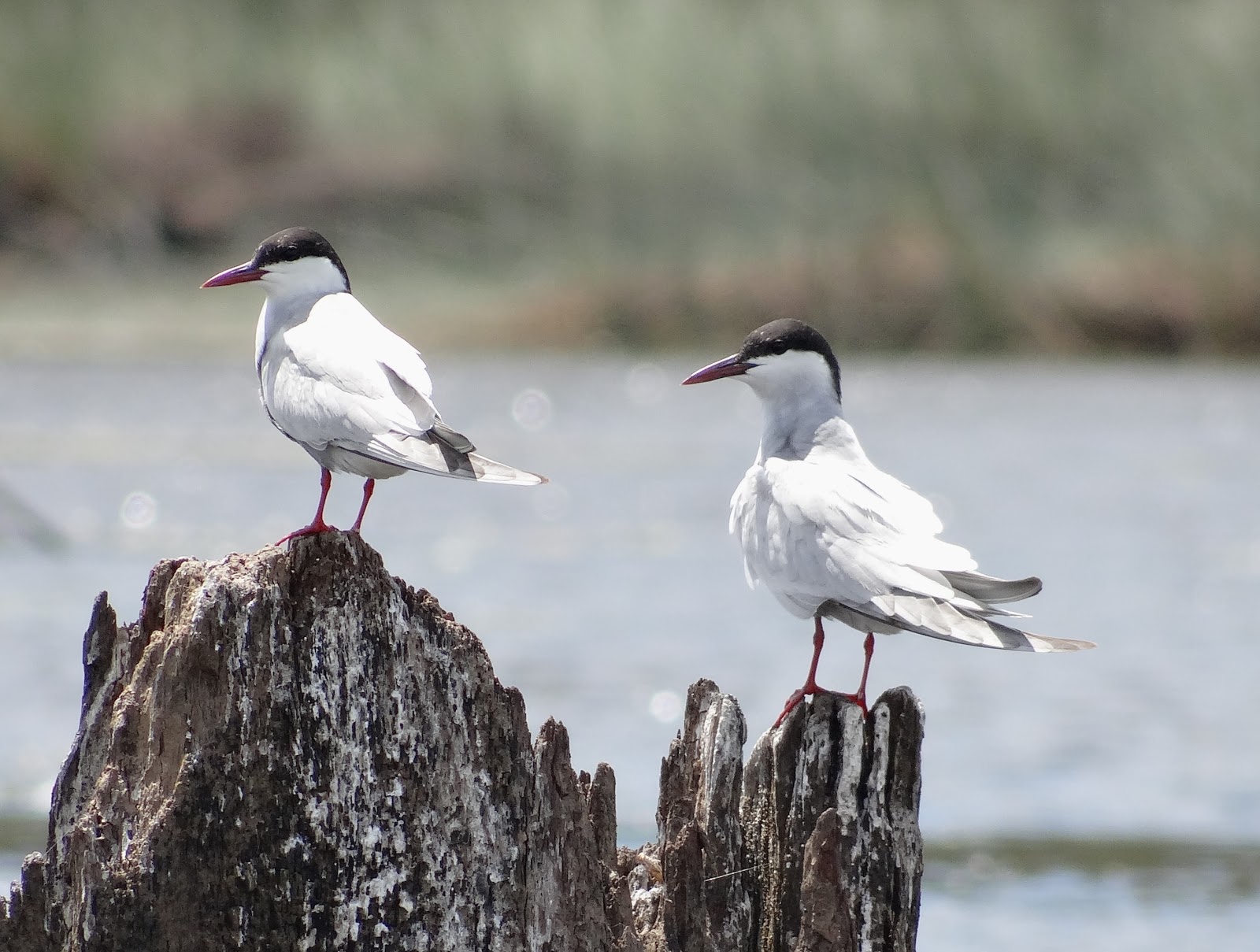
Whiskered Tern

White-bellied Sea-Eagle

With water levels low, fish are an easy catch for raptors. On three occasions I saw a White-bellied Sea-Eagle with a huge fish that looked like an over-sized eel.

Osprey

Ospreys do not usually feed over fresh water but the fish have attracted them.

Australasian Darter

The best way to access the dam is by driving to the end of Kowald Road. It terminates at a t-junction, with short driveable tracks to the left (north) and right (south). At the end of the left track, park your vehicle at the gate and walk a short distance further to the water. There are reed beds in this area. Follow the shore of the dam to the right, around to its southern end, where the exposed mud areas area.


Monday, 5 November 2012

Spring offerings from the Sunshine Coast


Black-faced Monarch

Spring sightings from the Sunshine Coast area this year include three species of monarch together at several sites; multiple sightings of Ground Parrot near Noosa; nice encounters with Marbled Frogmouth and Australian Owlet-Nightjar; and Brolga and waders at Toorbul.

White-eared Monarch
It appears that White-eared, Black-faced and Spectacled Monarchs have no trouble co-existing in at least three favoured lowland and mid-elevation rainforest sites in the Sunshine Coast hinterland. Of the three, Spectacled and White-eared are resident while Black-faced is a summer migrant.

Spectacled Monarch
Wallum heath
Ground Parrots have been particularly co-operative this year, with repeated sightings from wallum heath near Noosa. On my latest visit last week, we flushed one from the side of the track within a few minutes of arriving.

Australian Owlet-Nightjar
Marbled Frogmouths are showing well again this year with two pairs in adjoining territories coming into conflict during one of my visits recently; four or five birds were vocalising noisily during the interaction. Another nice sighting was an Australian Owlet-Nightjar very close to us. Some other recent bush birds:

Shining Bronze-Cuckoo

White-breasted Woodswallow
Golden-headed Cisticola


Brolga

Toorbul is just south of the Sunshine Coast municipality limits, but there are several birds that are easier to see here. They include a pair of Brolga that for several years have frequented a swamp, presently dry, between Toorbul and the Bruce Highway.

Bar-tailed Godwit & Great Knot

Waders at the high tide roost yesterday included these species.

Black-tailed Godwit

Curlew-Sandpiper

Great Knot & Red Knot

Red Knot

This appears to be a good season for Red Knot. Though still heavily outnumbered by Great Knots, about 20 Red Knots were present yesterday.

Friday, 2 November 2012

Large-tailed Nightjar and Waders at Boonooroo

Comb-crested Jacana

Large-tailed Nightjar and loads of waders were the highlight of a three-night camp at Boonooroo, south-east of Maryborough on the Great Sandy Strait. We visited Boonooroo after spending time at Burrum Heads and Bundaberg.
Comb-crested Jacana with chick

 The jacana in the image above had two tiny nestlings on a freshwater pond near the township. One of the youngsters can just be seen in the bottom right-hand corner of the picture above.

Large-tailed Nightjar

I first heard the distinctive call of a Large-tailed Nightjar from near the banks of Little Tuan Creek in the early morning from the Boonooroo Caravan Park. At 4am the next morning I went to that area and had no trouble enjoying excellent, repeated views of a pair of nightjars in the coastal scrub. The birds were very flighty and I was unable to photograph them; thanks to Geoff Jones from Barra Imaging for this one. Boonooroo is close to the southern-most limit of the distributional range of this species.

Bar-tailed Godwits and Great Knots

Boonooroo is well-known for its migratory waders and they were there in good numbers. The most common species were Bar-tailed Godwit, Eastern Curlew, Whimbrel, Great Knot and Grey-tailed Tattler. In lesser but still reasonable numbers were Curlew Sandpiper, Sharp-tailed Sandpiper, Red-necked Stint, Pacific Golden Plover and Mongolian Sand-Plover. Species in small numbers included Common Greenshank, Red Knot, Terek Sandpiper, Grey Plover and Greater Sand-Plover, with resident waders including Pied Oystercatcher and Red-capped Plover.


The waders could be found in various places at high tide behind the mangroves on salt pans a little to the north of the township.

Buff-banded Rail

A Buff-banded Rail was in the mangroves of Little Tuan Creek.

Common Greenshank

Eastern Curlew

Great Knots

Grey-tailed Tattlers

Gull-billed Terns

Mongolian Sand-Plovers and Red-necked Stints

Pacific Golden and Mongolian Sand-Plovers
Greater Sand-Plover

Pacific Golden Plover

Pied Oystercatcher

Red-necked Stints (with 1 Curlew Sandpiper)

Sharp-tailed Sandpiper

Terek Sandpiper

Shining Flycatcher
During a morning kayak along Little Tuan Creek, a single Shining Flycatcher - a juvenile female - was seen.


Thursday, 1 November 2012

Square-tailed Kite nesting and Shining Flycatchers galore - Burrum Heads & Bundaberg

Square-tailed Kite on nest

A Square-tailed Kite on the nest and multiple sightings of Shining Flycatcher were highlights of a visit this week to Burrum Heads and Bundaberg. We camped for three nights at Burrum Heads before moving on to Boonooroo (the subject of a separate post), and visited Bundaberg for the day.

Trevor Quested & Greg Roberts

In Bundaberg, we met up with Trevor and Annie Quested, along with Bundaberg birding legend Eric Zillmann, and headed off to an active nest being used by a Square-tailed Kite in open woodland north of the city.

Square-tailed Kite on nest

Weather conditions were lousy and the most we saw of the bird was its head occasionally showing. The nest was about 20 metres up in a Lemon-scented Gum. A single, well-developed chick was in the nest but was not visible to us.

Square-tailed Kite

Here's a more comprehensive image of this rare raptor; thanks to Geoff Jones of Barra Imaging for this one.

Eric Zillmann

Eric Zillmann reports that a pair of Square-tailed Kites has been nesting at this same site, near Smith's Crossing - usually in different nests but over a total area of just a few hundred square metres - each year since 1985. They have successfully raised young in all but a handful of nesting seasons. Usually one young is raised; although two or three chicks may hatch, the parents dispose of the others, presumably because of the difficulty of providing sufficient food. A new nest is built most years but occasionally an old one is topped up with twigs and used again.
I've written previously about Eric's knowledge of the Paradise Parrot; he is a wealth of knowledge about birds in the Bundaberg-Gin Gin region.

White-winged Triller

In Trevor and Annie's garden outside Bundaberg, a delightful male White-winged Triller was busy building a nest.

Shining Flycatcher

From Burrum Heads, I spent a morning along the Burrum River in my kayak. I saw a total of seven Shining Flycatchers and heard two others.

Shining Flycatcher

Five of the seven birds were males. Other birds seen from the kayak included:

White-bellied Sea-Eagle

Mangrove Honeyeater

Pied Cormorant
Brahminy Kite